

Taiwan president welcomed, denounced by Chinese community in New York as she arrives for a stopover

1 / 3
Members of the Chinese community in New York gather to welcome Taiwan President Tsai Ing-wen at the Lotte Hotel in Manhattan, New York City, on March 29, 2023. (Reuters)
2 / 3
Protesters opposed to Taiwanese independence gather at a hotel where Taiwanese President Tsai Ing-wen was expected to stay in New York on March 29, 2023. (AP Photo)
3 / 3
Taiwan's President Tsai Ing-wen acknowledges well-wishers in New York on March 29, 2023. (AP Photo)
Short Url
Updated 30 March 2023
Follow

Taiwan president welcomed, denounced by Chinese community in New York as she arrives for a stopover

  • China has threatened reprisals if Tsai meets with US House speaker Kevin McCarthy
  • Tsai is stopping over in the US en route to Guatemala and Belize to shore up ties

NEW YORK: Taiwan’s President Tsai Ing-wen arrived in New York Wednesday for a visit that has triggered threats of reprisal by China if she meets with House speaker Kevin McCarthy — and US warnings for Beijing not to overreact.
Tsai is stopping over in the United States en route to Central America, where she will meet with the leaders of Guatemala and Belize to shore up ties with those diplomatic allies. On her way back to Taiwan she will stop in California, where McCarthy had said he would meet her.
China claims the democratic island as part of its territory to be retaken one day and, under its “One China” principle, no country may maintain official ties with both Beijing and Taipei.
Beijing warned Wednesday that it was vehemently opposed to any meeting between Tsai and McCarthy and vowed to take “resolute measures to fight back” if it goes ahead.
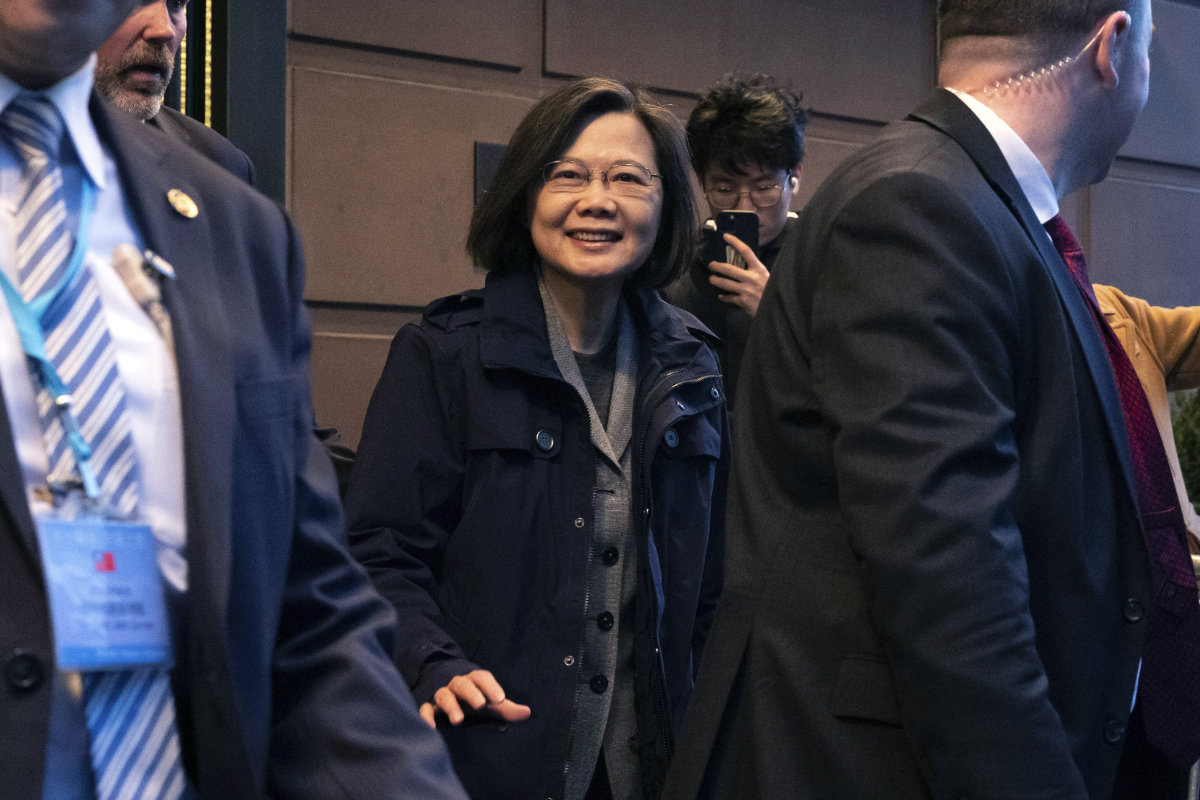


Taiwan's President Tsai Ing-wen acknowledges well-wishers in New York on March 29, 2023. (AP Photo)

The United States responded by saying China should not use Tsai’s stopover as a pretext to act aggressively around the Taiwan Strait.
Tsai was seen arriving at her hotel in New York, where dozens of pro-Beijing demonstrators waving China’s red flag gathered boisterously while nearby a similarly sized group of pro-Taiwan people cheered and waved their banner and the US stars and stripes.
Xu Xueyuan, the charge d’affaires at the Chinese embassy in Washington, said she had spoken directly to US officials numerous times and warned them that Tsai’s trip would violate China’s core interests.
“We urge the US side not to repeat playing with fire on the Taiwan question,” she told reporters, alluding among other things to last year’s visit to Taiwan by then House speaker Nancy Pelosi.
Tsai’s trip follows Honduras’s decision this month to open diplomatic relations with Beijing, leaving Belize and Guatemala among just 13 countries that have official ties with Taipei.
After first visiting New York, Tsai will meet her Guatemalan counterpart Alejandro Giammattei and Belize Prime Minister John Briceno in their respective countries, her office said.
She will then stop in Los Angeles on her way home.
McCarthy has said he will meet Tsai in his home state, although the talks are yet to be confirmed by Taiwanese authorities.
Pelosi’s visit triggered an angry response from Beijing, with the Chinese military conducting drills at an unprecedented scale around the island.
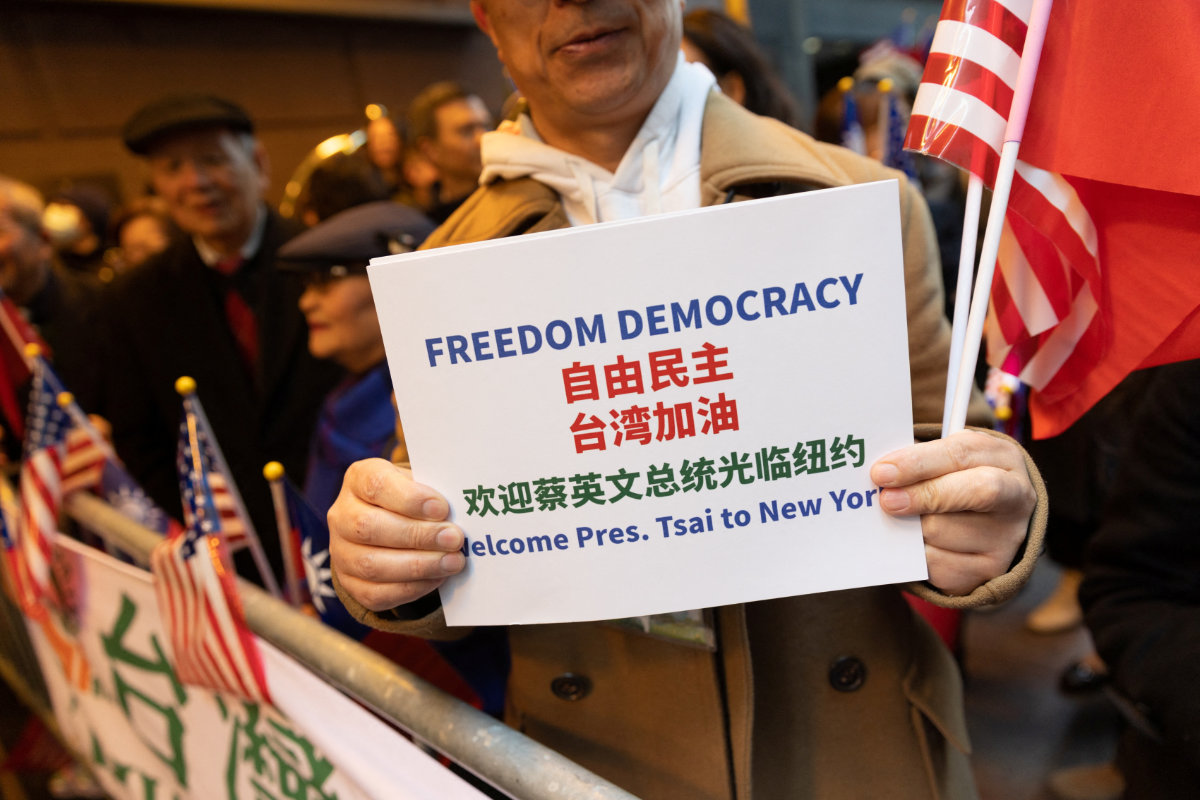


A supporter holds a sign welcoming Taiwan President Tsai Ing-wen as she arrives at the Lotte Hotel in Manhattan, New York City, on March 29, 2023. (Reuters)

Analysts say the US stopover comes at a key time, with Beijing having ramped up military, economic and diplomatic pressure on Taiwan since Tsai came to power in 2016, poaching nine of its diplomatic allies.
“Beijing’s attempts to poach Taiwan’s diplomatic partners will lead to Taiwan developing closer ties with the United States,” said James Lee, a researcher on US-Taiwan relations at Academia Sinica.
The United States remains Taiwan’s most important ally — and its biggest arms supplier — despite switching its diplomatic recognition to Beijing in 1979.
“The loss of official relations with third countries will be offset by a deepening of Taiwan’s unofficial relations,” Lee said.
Recent visits by a Czech delegation and a German minister were met with rebukes from Beijing.
One of Tsai’s most prominent domestic opponents, ex-president Ma Ying-jeou, was in China on Wednesday, the first such trip by a former Taiwanese leader.

China has increased investment in Latin America, a key diplomatic battleground between Taipei and Beijing since the two sides split in 1949 after a civil war.
Taiwan accused China on Sunday of using “coercion and intimidation” to lure away its allies after Honduran Foreign Minister Enrique Reina and his Chinese counterpart Qin Gang officially launched relations in Beijing.
Honduras, one of the poorest countries in the region, made the switch due to economic necessity, Reina had said earlier.
The move continued a trend in Latin America, with Nicaragua, El Salvador, Panama, the Dominican Republic and Costa Rica all switching diplomatic recognition to Beijing in recent years.
In addition to Guatemala and Belize, Taiwan still has official ties with a handful of countries in Latin America and the Caribbean, including Paraguay and Haiti.


Only 4% women on ballot as Bangladesh prepares for post-Hasina vote

Updated 26 January 2026
Follow

Only 4% women on ballot as Bangladesh prepares for post-Hasina vote

  • Women PMs have ruled Bangladesh for over half of its independent history
  • For 2026 vote, only 20 out of 51 political parties nominated female candidates

DHAKA: As Bangladesh prepares for the first election since the ouster of its long-serving ex-prime minister Sheikh Hasina, only 4 percent of the registered candidates are women, as more than half of the political parties did not field female candidates.

The vote on Feb. 12 will bring in new leadership after an 18-month rule of the caretaker administration that took control following the student-led uprising that ended 15 years in power of Hasina’s Awami League party.

Nearly 128 million Bangladeshis will head to the polls, but while more than 62 million of them are women, the percentage of female candidates in the race is incomparably lower, despite last year’s consensus reached by political parties to have at least 5 percent women on their lists.

According to the Election Commission, among 1,981 candidates only 81 are women, in a country that in its 54 years of independence had for 32 years been led by women prime ministers — Hasina and her late rival Khaleda Zia.

According to Dr. Rasheda Rawnak Khan from the Department of Anthropology at Dhaka University, women’s political participation was neither reflected by the rule of Hasina nor Zia.

“Bangladesh has had women rulers, not women’s rule,” Khan told Arab News. “The structure of party politics in Bangladesh is deeply patriarchal.”

Only 20 out of 51 political parties nominated female candidates for the 2026 vote. Percentage-wise, the Bangladesh Socialist Party was leading with nine women, or 34 percent of its candidates.

The election’s main contender, the Bangladesh Nationalist Party, whose former leader Zia in 1991 became the second woman prime minister of a predominantly Muslim nation — after Pakistan’s Benazir Bhutto — was the party that last year put forward the 5 percent quota for women.

For the upcoming vote, however, it ended up nominating only 10 women, or 3.5 percent of its 288 candidates.

The second-largest party, Jamaat-e-Islami, has not nominated a single woman.

The 4 percent participation is lower than in the previous election in 2024, when it was slightly above 5 percent, but there was no decreasing trend. In 2019, the rate was 5.9 percent, and 4 percent in 2014.

“We have not seen any independent women’s political movement or institutional activities earlier, from where women could now participate in the election independently,” Khan said.

“Real political participation is different and difficult as well in this patriarchal society, where we need to establish internal party democracy, protection from political violence, ensure direct election, and cultural shifts around female leadership.”

While the 2024 student-led uprising featured a prominent presence of women activists, Election Commission data shows that this has not translated into their political participation, with very few women contesting the upcoming polls.

“In the student movement, women were recruited because they were useful, presentable for rallies and protests both on campus and in the field of political legitimacy. Women were kept at the forefront for exhibiting some sort of ‘inclusive’ images to the media and the people,” Khan said.

“To become a candidate in the general election, one needs to have a powerful mentor, money, muscle power, control over party people, activists, and locals. Within the male-dominated networks, it’s very difficult for women to get all these things.”