

Palestinian children bear the scars of Israeli raids

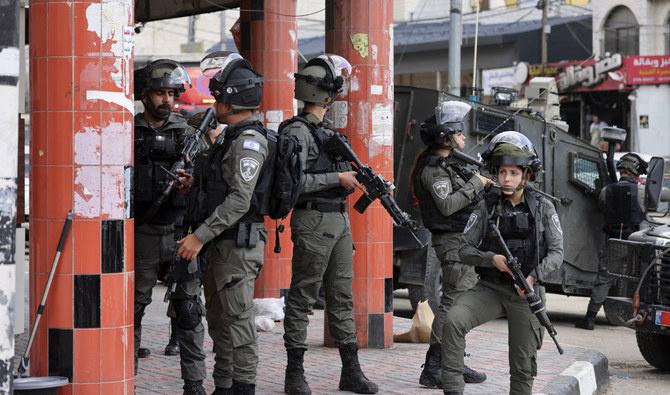
Israeli troops patrol in the occupied West Bank town of Huwara, on March 26, 2023. (AFP)
Short Url
Updated 30 March 2023
Follow

Palestinian children bear the scars of Israeli raids

  • The Defense for Children International Palestine movement has documented the testimonies of youngsters in Jenin who have been traumatized by military action

RAMALLAH: The excessive force used by the Israeli forces against civilians during incursions into Palestinian territories has resulted in children living in constant fear and anxiety, a report has said.

The Defense for Children International Palestine movement has documented the testimonies of youngsters in Jenin who have been traumatized by military action.

The movement said in its report that, in addition to violating the right to life of 17 children since the beginning of the year, the practices of the Israeli forces had resulted in significant effects on other children.

This had manifested itself in their behavior, thinking, and academic performance. The violence they had witnessed had violated their rights guaranteed by international law and threatened their psychological and social security, it said.

Among the 17 children killed since the beginning of this year, six were from Jenin.

Children had been used as human shields. They were detained for long hours in their homes which were used as military barracks and sniper and observation points during the storming of the city and its camp. All of this greatly affected the children, the report said.

A 17-year-old said: “While my colleague Mahmoud Al-Saadi, 17, and I were heading to school in the morning, the Israeli army stormed the camp and started shooting from all directions. He was killed.

“We were planning together to graduate from school, go to university, and study together, but all of that was shattered.”

A 16-year-old said: “The occupation’s raids into the camp have become routine.

“The army enters at any time, so I can no longer leave the house. I am afraid of the army’s raids while I am outside the home.”

Khaled Quzmar, DCIP director, told Arab News that the Israeli army’s use of excessive force had left Palestinian children with no sense of security and no confidence in the future.

He said: “Children live in the situation of hopelessness. For example, a child was found in Dheisheh camp moving around with his will written on a piece of paper in his pocket, because he was afraid that he would be in the wrong place at the wrong time and might be killed.”

Quzmar said that the 17 children killed by the Israeli army did not pose any security threat to the soldiers. They were killed while carrying out daily tasks.

He added that when a child returns to his classroom and finds a bouquet in the place of a classmate killed by the Israeli army, it leaves a deep psychological mark on them.

He said that Palestinian children in the areas of repeated military action, such as Jenin camp and Dheisheh refugee camp near Bethlehem, needed psychological support sessions because life had become worthless for them.

The testimony of another 17-year-old read: “In every raid there are martyrs, shootings, destroyed homes and property. 

“Bullets penetrated the walls of our house. Danger pursues me while I am in bed. When I want to move inside the house, I must crawl on my stomach for fear of a sniper or stray bullets.

“Death is more merciful than this fear and anxiety. For more than a year, I have been unable to sleep normally. Sometimes I wake up to the sound of bullets and explosions, and other times I wake up due to nightmares. I no longer distinguish between dreams and reality.”

A 15-year-old said: “[The camp] has become full of pictures of martyrs, and there is a story and memories behind every martyr. From the window of the house, I saw young men wounded by the occupation’s bullets left to bleed until they died, and I also saw completely burned bodies of martyrs.

“The occupation forces killed our teacher, Jawad Bawakna. He was the teacher closest to us. He sent us energy and hope through his activities and constant movement, full of vitality.

“He had a great ability to support us psychologically in light of these conditions in the camp.

“We lost one of the most important sources of psychological support. The school has become a painful memory for our loved ones, and we are trying to stay away from it as much as possible.”

Israeli armed forces surrounded a house during one of their incursions into the Jenin camp. They took the man residing there away from his wife and two children, Tolin, 2, and Misk, 1.

The father later said: “The behavior of the two daughters changed radically after this incident, especially Tolin, who turned from an active into a secluded child, attached to her mother and distracted, afraid of any sound or movement, except for the frequent nightmares and bouts of crying.”

Israel operating beyond ceasefire line in Gaza, satellite images suggest

Updated 6 sec ago
Follow

Israel operating beyond ceasefire line in Gaza, satellite images suggest

  • BBC probe identifies Yellow Line markers hundreds of meters further into Hamas-controlled land than agreed in US-backed deal
  • Security expert: Moving of markers, accompanying destruction would reduce swath of Gaza to ‘sterilized belt’

LONDON: Israel has moved the so-called Yellow Line marking the boundary of its area of control within Gaza, satellite images show.

A report by the BBC suggests that Israeli personnel have moved blocks denoting the line of control further inside territory ostensibly controlled by Hamas in at least three areas of Gaza.

The move endangers Palestinians living nearby who have been left unclear where they can move freely, after Israeli Defense Minister Israel Katz warned in October that the military would open fire on anyone crossing the Yellow Line.

The line’s markers have been moved further inside Hamas-controlled territory at Beit Lahia, Jabalia and Al-Tuffah, images seen by BBC Verify suggest.

In total, 16 markers were moved in the three areas, at an average of 295 meters beyond their original positions.

The BBC mapped another 205 Yellow Line markers across Gaza, with more than half of them found to have been placed further inside Hamas territory than previously agreed under the US-backed ceasefire plan.

It added that some areas of the Yellow Line — amounting to nearly 10 km in total — remain unmarked almost three months after the ceasefire came into effect, despite Katz’s warning to civilians.

A Palestinian told the BBC that in December Israeli troops moved markers around where he lives, leaving him “trapped” on the Israeli side.

“We are now living inside the Yellow Line, (but) behind the yellow blocks, with no idea what our fate will be,” said the man, whom the BBC did not name for his safety.

“The atmosphere at night is terrifying. We hear shells exploding, soldiers advancing, gunfire, and drones buzzing overhead without pause. We are also being shot at directly.”

The BBC said satellite images showed that Israeli vehicles and personnel frequently crossed the Yellow Line despite the ceasefire agreement prohibiting them from doing so.

It added that armored vehicles had been spotted at Bani Suhaila roundabout in Khan Younis, 400 meters west of the line, in verified footage, and that tanks and heavy machinery had been identified 260 meters beyond the line in Beit Lahia.

The forays into Hamas territory have often been accompanied by demolitions of buildings and infrastructure.

At least 69 incidents have been identified by the BBC since the ceasefire came into effect of Israeli troops shooting at Palestinian civilians in the vicinity of the Yellow Line.

They include an airstrike on a school building on Dec. 19 in Al-Tuffah, which was 330 meters inside the Yellow Line on the Hamas side, but which was close to a marker denoting the line that had been moved from where it should have been. The strike killed five people, local authorities said. 

In Jabalia on Dec. 10, 17-year-old Zaher Nasser Shamiya was shot and run over by an Israeli tank on the Hamas side of the Yellow Line, his father said.

“The tank turned his body into pieces … It came into the safe area (west of the Yellow Line) and ran over him,” he told the BBC.

In November, two children were reportedly killed west of the line while out gathering firewood for their family.

Middle East security expert Prof. Andreas Krieg told the BBC: “By keeping the legal line on the map and the physical blocks hundreds of meters apart, Israel preserves the ability to shift where Gazans may live, move and farm without ever formally announcing a change of border.”

On Wednesday, Israel is due to begin withdrawing from more parts of Gaza under the terms of the US plan, but no timeline has been put in place as yet.

Krieg warned that Israel’s continued moving of the Yellow Line markers and the accompanying destruction would reduce a swath of Gaza to a “sterilized belt.”

He told the BBC: “In practice, that means the status of land is less about what the ceasefire map says and more about where concrete blocks sit on a given day.”