LVIV, Ukraine: At a historic military cemetery in the western Ukrainian city of Lviv, Valeriy Pushko lights up two cigarettes. One is for himself, the other for his son whose portrait is fixed to a cross planted in the ground.
“I smoke with my son,” said the grey-haired man.
“We used to take cigarette breaks together. It’s a bad habit but it makes things easier. I talk to him, think about him and that makes me feel better.”
Pushko said many others come here to smoke with their fallen husbands or sons.
Located in southeastern Lviv, the Lychakiv cemetery is one of the oldest graveyards in Europe and is often compared to the historic Père Lachaise in Paris, where dozens of celebrities are buried.
It is the resting place of prominent figures including the poet Ivan Franko and thousands of soldiers who perished during World War I and II.
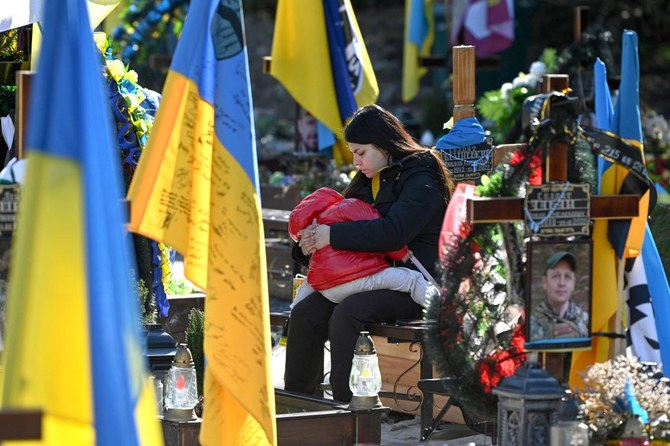
Since Russia invaded Ukraine over a year ago, rows of new graves have appeared. A sea of blue-and-yellow Ukrainian flags and red-and-black nationalist banners mark them.
Some mourners leave stuffed animals, cigarettes, and cups of coffee at the graves of their loved ones.
More unusual symbols of love and sorrow included children’s drawings, vinyl records, a golf ball, and a bottle of beer.
Shortly after the Russian invasion in February 2022, authorities began burying soldiers killed in fighting at the Lychakiv cemetery.
But the area initially designated for military burials quickly filled up, said city official Oleg Pidpysetsky.
The authorities then began laying Ukrainian servicemen to rest at a new site bordering Lychakiv.
Funerals are held nearly every day in the new burial ground. Called the Field of Mars, it now contains about 350 graves.
“No one knew how critical the situation was,” Pidpysetsky told AFP.
“Someone thought it would end in a month, two, three, six months. But, unfortunately, the war has only gotten bigger.”
Oleg, one of the mourners who came to visit a friend’s grave, called the losses “irreparable.”
“We will have our victory of course, but this is the price we pay. And that is not the end,” said the 55-year-old.
“These people gave their lives for us.”
Oleg mourns the loss of his 45-year-old friend also called Oleg.
He said the father of two volunteered to go to the front.
“Unfortunately, nothing can be done now. Thousands of Russians will not replace my Oleg,” he said bitterly.
Kyiv does not reveal the number of its military casualties but Western officials say more than 100,000 Ukrainians have been killed or wounded.
Olga, who came to visit her brother-in-law’s grave, says the mementos people leave “is all that’s left, the only connection with their heroes.”
Her sister comes to the cemetery every day, she added.
“That’s her second home now,” said Olga.
Vyacheslav Sabelnikov, who served in the infantry before receiving a serious injury, says several men he fought with are now buried at the cemetery.
“I came to visit a friend whose birthday is today,” said Sabelnikov, placing a candle in front of his portrait.
Sabelnikov said he lights up candles to remember his friends, saying it was important to “honor” their memory.
Anna Mikheyeva, a 44-year-old social worker, came to visit her son Mykhailo’s grave. He served in the 80th Parachute Brigade and was killed last year at the age of 25.
Mikheyeva says she often brings her son things “he liked” including Coca-Cola, sweets, and cigarettes.
“If I come in the morning, I buy a coffee for myself and also for him,” added the dark-haired woman.
She said she felt calm at the Field of Mars.
“There are only young people here. They are like sons and brothers to me.
“When I come I always say ‘Hi guys’. And I always, always thank them.”

Love, pain and loss at historic Ukraine cemetery
Short Url
https://arab.news/5btw5
Love, pain and loss at historic Ukraine cemetery
- Located in southeastern Lviv, the Lychakiv cemetery is one of the oldest graveyards in Europe
- It is the resting place of prominent figures including the poet Ivan Franko and thousands of soldiers who perished during World War I and II
Greece backs coast guard after latest deadly migrant crash
ATHENS: The Greek government has firmly backed its coast guard, insisting it is “not a welcoming committee” as questions grow over a collision in the Aegean Sea this week that killed 15 asylum seekers.
The deadly crash occurred late Tuesday when the high-speed boat the migrants were traveling in collided with a coast guard patrol vessel off the Greek island of Chios, not far from the Turkish coast.
Four women were among the dead, while 24 survivors have been admitted to hospital in Chios.
Rights groups and international media have repeatedly accused Greece of illegally forcing would-be asylum seekers back into Turkish waters, backing their claims with video and witness testimonies.
Greek media and opposition parties have questioned the details of Tuesday’s crash, and the country’s ombudsman has called for “an impartial and thorough investigation,” stressing that the priority should always be “the protection of human life.”
On Thursday, the government said it fully backed the maritime agency.
“We have full confidence in the coast guard and we support them,” government spokesman Pavlos Marinakis told reporters.
Conservative Prime Minister Kyriakos Mitsotakis said he was expecting “a full investigation” into the crash.
In the meantime, he argued that preliminary details showed that “essentially, our coast guard ship was rammed by a much smaller boat.”
“This is a situation that happens quite frequently in the Aegean,” he told Foreign Policy, arguing that smugglers were endangering migrants’ lives.
Had Greek authorities not been present, more people would probably have died, he alleged.
The coast guard was “not a welcoming committee” for people seeking asylum in the European Union, he told the magazine.
- Questions -
Following the crash the coast guard said the pilot of the migrant boat had ignored signals and “made a U-turn maneuver” before colliding with the Greek patrol boat.
“Under the force of the impact, the speedboat capsized and then sank, throwing everyone on board into the sea,” the agency said.
So far, none of the hospitalized survivors have testified directly.
One of them, a 31-year-old Moroccan man, was to be questioned by police as a possible smuggler.
Several Greek media outlets, including To Vima and private TV channel Mega, have reported the victims died of severe head injuries.
Some news organizations have questioned why the patrol boat’s thermal camera was not switched on.
“The captain of the patrol boat judged it unnecessary because the migrants’ speedboat had already been detected by a camera on shore and a spotlight,” government spokesman Marinakis said.
The port police released photos of the coast guard patrol vessel showing minor damage, but no images of the asylum seekers’ boat.
- ‘Obvious distress’ -
Abusive pushbacks have become the “norm” in Greece, medical charity Doctors Without Borders (MSF) said in 2023.
The crash off Chios was “not an isolated incident,” the Refugee Support Aegean charity said this week.
“Based on the available information and the initial announcement of the Hellenic Coast Guard, it appears that, instead of a search and rescue operation, an interception operation was deployed from the outset,” RSA said in a statement.
“This occurred while the refugees’ boat was in obvious distress, was overcrowded and was located at a short distance from the Greek coast,” the statement added.
It is far from the first time that international organizations have pointed the finger at Greece over how it treats migrant boats.
Eighteen of its coast guard members are being prosecuted for involuntary manslaughter due to negligence in the sinking of the trawler Adriana in June 2023.
The United Nations said around 750 people died in that tragedy — one of the worst migrant shipwrecks in the Mediterranean in the past decade.
In 2022, the European Court of Human Rights condemned Greece for its responsibility in the capsizing of a migrant boat off the islet of Farmakonisi in the Aegean Sea.
Eleven people died, including eight children.
The deadly crash occurred late Tuesday when the high-speed boat the migrants were traveling in collided with a coast guard patrol vessel off the Greek island of Chios, not far from the Turkish coast.
Four women were among the dead, while 24 survivors have been admitted to hospital in Chios.
Rights groups and international media have repeatedly accused Greece of illegally forcing would-be asylum seekers back into Turkish waters, backing their claims with video and witness testimonies.
Greek media and opposition parties have questioned the details of Tuesday’s crash, and the country’s ombudsman has called for “an impartial and thorough investigation,” stressing that the priority should always be “the protection of human life.”
On Thursday, the government said it fully backed the maritime agency.
“We have full confidence in the coast guard and we support them,” government spokesman Pavlos Marinakis told reporters.
Conservative Prime Minister Kyriakos Mitsotakis said he was expecting “a full investigation” into the crash.
In the meantime, he argued that preliminary details showed that “essentially, our coast guard ship was rammed by a much smaller boat.”
“This is a situation that happens quite frequently in the Aegean,” he told Foreign Policy, arguing that smugglers were endangering migrants’ lives.
Had Greek authorities not been present, more people would probably have died, he alleged.
The coast guard was “not a welcoming committee” for people seeking asylum in the European Union, he told the magazine.
- Questions -
Following the crash the coast guard said the pilot of the migrant boat had ignored signals and “made a U-turn maneuver” before colliding with the Greek patrol boat.
“Under the force of the impact, the speedboat capsized and then sank, throwing everyone on board into the sea,” the agency said.
So far, none of the hospitalized survivors have testified directly.
One of them, a 31-year-old Moroccan man, was to be questioned by police as a possible smuggler.
Several Greek media outlets, including To Vima and private TV channel Mega, have reported the victims died of severe head injuries.
Some news organizations have questioned why the patrol boat’s thermal camera was not switched on.
“The captain of the patrol boat judged it unnecessary because the migrants’ speedboat had already been detected by a camera on shore and a spotlight,” government spokesman Marinakis said.
The port police released photos of the coast guard patrol vessel showing minor damage, but no images of the asylum seekers’ boat.
- ‘Obvious distress’ -
Abusive pushbacks have become the “norm” in Greece, medical charity Doctors Without Borders (MSF) said in 2023.
The crash off Chios was “not an isolated incident,” the Refugee Support Aegean charity said this week.
“Based on the available information and the initial announcement of the Hellenic Coast Guard, it appears that, instead of a search and rescue operation, an interception operation was deployed from the outset,” RSA said in a statement.
“This occurred while the refugees’ boat was in obvious distress, was overcrowded and was located at a short distance from the Greek coast,” the statement added.
It is far from the first time that international organizations have pointed the finger at Greece over how it treats migrant boats.
Eighteen of its coast guard members are being prosecuted for involuntary manslaughter due to negligence in the sinking of the trawler Adriana in June 2023.
The United Nations said around 750 people died in that tragedy — one of the worst migrant shipwrecks in the Mediterranean in the past decade.
In 2022, the European Court of Human Rights condemned Greece for its responsibility in the capsizing of a migrant boat off the islet of Farmakonisi in the Aegean Sea.
Eleven people died, including eight children.
© 2026 SAUDI RESEARCH & PUBLISHING COMPANY, All Rights Reserved And subject to Terms of Use Agreement.


