

Brent plunge fails to displace Russian crude for Asian buyers

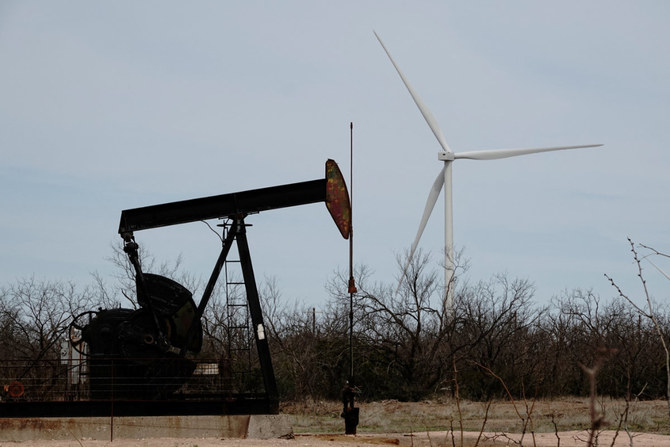
A pump jack drills oil crude from the Yates Oilfield in West Texas' Permian Basin near Iraan, Texas, on March 17, 2023. (REUTERS/Bing Guan)
Short Url
Updated 23 March 2023
Follow

Brent plunge fails to displace Russian crude for Asian buyers

  • Middle East crude prices in Asia appear to be resilient as the market bets on robust demand from China
  • With Russian crude so cheap, a move of a few dollars on Brent-Dubai EFS or even freight would not make a difference

SINGAPORE/LONDON: A plunge in Brent crude prices has narrowed the spread between Atlantic Basin and Middle East benchmarks but has failed to spur interest from Asian refiners, which are instead buying up discounted Russian oil, leaving an overhang in African supply.
Global oil benchmark Brent tumbled more than 10 percent over the past two weeks, touching a 15-month-low of $70.12 a barrel on Monday, as investors have fretted over banking sector turmoil in the US and Europe and as strikes in France have dented oil demand.
Middle East crude prices in Asia appear to be resilient as the market bets on robust demand from China, which is rebounding from zero-COVID restrictions that formerly squeezed its economy.
The Brent-Dubai Exchange for Swaps (EFS), representing the premium of light sweet Brent over Middle East sour crude Dubai, shrank to $1.40 a barrel this week, its narrowest in more than two years.
A tighter EFS typically means Brent-linked crude produced in the Atlantic Basin, including from West African countries, becomes more economical for Asian buyers.

But traders have not seen a significant uptick in Asian demand for West African crude, because the cargoes remain much more expensive than Russian oil, even though they have gained competitiveness over Middle Eastern crude.
With Russian crude so cheap, a move of a few dollars on Brent-Dubai EFS or even freight would not make a difference, other than providing Chinese buyers with a tool to drive prices lower, said a West African crude trader.
Russia’s light sweet ESPO crude for May delivery is traded at a discount of about $6.80 a barrel against the ICE Brent on the deliver-ex-ship (DES) basis to northern China, trading sources said. Meanwhile, Congo’s Djeno, a medium sweet crude favored by Chinese refiners, is assessed at a premium of $1.50 a barrel above ICE Brent for May delivery on DES basis.
The pattern is similar in India, where Russian crude is delivered at discounts to Dubai quotes while West African oil is loaded at parity or a slight discount to dated Brent, an Indian trader said.
Russia became the top crude supplier to China and India in recent months, eroding the market share of other suppliers such as West African countries.
Just over 30 million barrels of West African crude have been loaded for Asia in March, the smallest volume since 2014 or earlier, shipping data from Refinitiv and Kpler showed.
The slowing exports of West African crude are exacerbating a supply overhang in the West of Suez market and weighing down the Brent prices that the West African grades are pegged to.
On Tuesday, about 20 million barrels of Nigerian crude for April loading were still unsold, just as the trade cycle for May cargoes was about to kick off. About four April-loading Angolan crude cargoes were also awaiting buyers.
In the past three months, Nigeria has exported around 42 million barrels of crude on average each month while Angola’s average monthly exports have been around 33 million barrels.


Saudi Arabia, Japan trade rises 38% between 2016 and 2024, minister says

Updated 11 January 2026
Follow

Saudi Arabia, Japan trade rises 38% between 2016 and 2024, minister says

RIYADH: Trade between Saudi Arabia and Japan has increased by 38 percent between 2016 and 2024 to reach SR138 billion ($36 billion), the Kingdom’s investment minister revealed.

Speaking at the Saudi-Japanese Ministerial Investment Forum 2026, Khalid Al-Falih explained that this makes the Asian country the Kingdom’s third-largest trading partner, according to Asharq Bloomberg.

This falls in line with the fact that Saudi Arabia has been a very important country for Japan from the viewpoint of its energy security, having been a stable supplier of crude oil for many years.

It also aligns well with how Japan is fully committed to supporting Vision 2030 by sharing its knowledge and advanced technologies.

“This trade is dominated by the Kingdom's exports of energy products, specifically oil, gas, and their derivatives. We certainly look forward to the Saudi private sector increasing trade with Japan, particularly in high-tech Japanese products,” Al-Falih said.

He added: “As for investment, Japanese investment in the Kingdom is good and strong, but we look forward to raising the level of Japanese investments in the Kingdom. Today, the Kingdom offers promising opportunities for Japanese companies in several fields, including the traditional sector that links the two economies: energy.”

The minister went on to note that additional sectors that both countries can also collaborate in include green and blue hydrogen, investments in advanced industries, health, food security, innovation, entrepreneurship, among others.

During his speech, Al-Falih shed light on how the Kingdom’s pavilion at Expo 2025 in Osaka achieved remarkable success, with the exhibition receiving more than 3 million visitors, reflecting the Japanese public’s interest in Saudi Arabia.

“The pavilion also organized approximately 700 new business events, several each day, including 88 major investment events led by the Ministry of Investment. Today, as we prepare for the upcoming Expo 2030, we look forward to building upon Japan’s achievements,” he said.

The minister added: “During our visit to Japan, we agreed to establish a partnership to transfer the remarkable Japanese experience from Expo Osaka 2025 to Expo Riyadh 2030. I am certain that the Japanese pavilion at Expo Riyadh will rival the Saudi pavilion at Expo Osaka in terms of organization, innovation, and visitor turnout.”

Al-Falih also shed light on how Saudi-Japanese relations celebrated their 70th anniversary last year, and today marks the 71st year of these relations as well as how they have flourished over the decades, moving from one strategic level to an even higher one.