

Oil prices fall 1% as US crude, fuel inventories swell

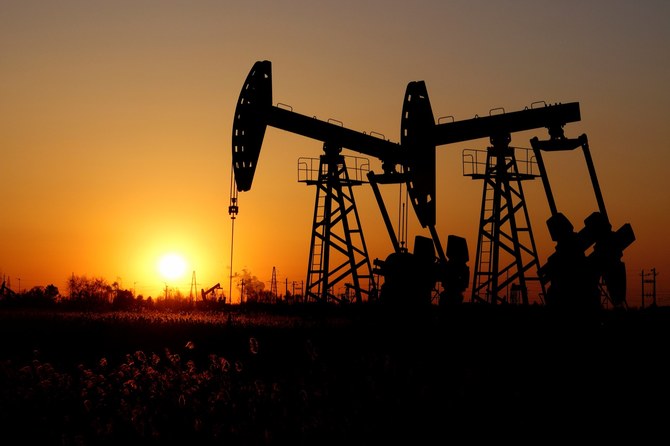
Crude oil stocks in the US rose last week to 455.1 million barrels, their highest since June 2021, boosted by growing production, the Energy Information Administration said. Reuters
Short Url
Updated 09 February 2023
Follow

Oil prices fall 1% as US crude, fuel inventories swell

NEW YORK: Oil prices fell about 1 percent on Thursday as US crude inventories swelled to their highest in months, while the prospect of the Federal Reserve continuing with an aggressive rate hike path rattled sparked fears about weakening fuel demand.

Brent crude futures slipped 86 cents to $84.23 a barrel by 11:57 a.m. ET (1657 GMT), while US West Texas Intermediate crude futures fell 87 cents to $77.60 a barrel. Both benchmarks have gained more than 5 percent so far this week.

“Relentlessly rising US commercial inventories and potentially entrenched inflation limit any immediate upside potential,” said PVM analyst Tamas Varga, adding that recovering Chinese demand and falling inflation were set to support oil prices in the second half of the year.

Crude oil stocks in the US rose last week to 455.1 million barrels, their highest since June 2021, boosted by growing production, the Energy Information Administration said. Gasoline and distillate inventories also rose last week, the EIA said, during unseasonably mild winter months.

US Federal Reserve officials said more interest rate rises are on the cards as the bank presses on with its efforts to cool inflation, sending bearish signals across risk assets like oil and equities.

The prospect of stronger demand from China provided some support to oil prices, as the world’s second largest oil consumer ended more than three years of stringent zero-COVID policy.

“We expect Chinese oil consumption to increase by around 1.0 million barrels a day this year, with strong growth emerging as early as late in Q1,” analysts from ANZ bank wrote in a note.

“Overall, this should push global demand up by 2.1 million barrels a day in 2023.”

BP Azerbaijan declared force majeure on Azeri crude shipments from the Turkish port of Ceyhan on Feb. 7, after a massive earthquake struck Turkey and Syria early on Monday. Azeri oil continues to flow there via pipeline, BP Azerbaijan said on Thursday.

Brent’s front-month loading contract rose to a $3-a-barrel premium over contracts six months out, a market structure called backwardation, which indicates traders seeing tight current supply.

A weaker US dollar, which typically trades inversely with oil, also helped limit losses in crude prices. The dollar index fell 0.7 percent to 102.74.


First EU–Saudi roundtable on critical raw materials reflects shared policy commitment

Updated 16 January 2026
Follow

First EU–Saudi roundtable on critical raw materials reflects shared policy commitment

RIYADH: The EU–Saudi Arabia Business and Investment Dialogue on Advancing Critical Raw Materials Value Chains, held in Riyadh as part of the Future Minerals Forum, brought together senior policymakers, industry leaders, and investors to advance strategic cooperation across critical raw materials value chains.

Organized under a Team Europe approach by the EU–GCC Cooperation on Green Transition Project, in coordination with the EU Delegation to Saudi Arabia, the European Chamber of Commerce in the Kingdom and in close cooperation with FMF, the dialogue provided a high-level platform to explore European actions under the EU Critical Raw Materials Act and ResourceEU alongside the Kingdom’s aspirations for minerals, industrial, and investment priorities.

This is in line with Saudi Vision 2030 and broader regional ambitions across the GCC, MENA, and Africa.

ResourceEU is the EU’s new strategic action plan, launched in late 2025, to secure a reliable supply of critical raw materials like lithium, rare earths, and cobalt, reducing dependency on single suppliers, such as China, by boosting domestic extraction, processing, recycling, stockpiling, and strategic partnerships with resource-rich nations.

The first ever EU–Saudi roundtable on critical raw materials was opened by the bloc’s Ambassador to the Kingdom, Christophe Farnaud, together with Saudi Deputy Minister for Mining Development Turki Al-Babtain, turning policy alignment into concrete cooperation.

Farnaud underlined the central role of international cooperation in the implementation of the EU’s critical raw materials policy framework.

“As the European Union advances the implementation of its Critical Raw Materials policy, international cooperation is indispensable to building secure, diversified, and sustainable value chains. Saudi Arabia is a key partner in this effort. This dialogue reflects our shared commitment to translate policy alignment into concrete business and investment cooperation that supports the green and digital transitions,” said the ambassador.

Discussions focused on strengthening resilient, diversified, and responsible CRM supply chains that are essential to the green and digital transitions.

Participants explored concrete opportunities for EU–Saudi cooperation across the full value chain, including exploration, mining, and processing and refining, as well as recycling, downstream manufacturing, and the mobilization of private investment and sustainable finance, underpinned by high environmental, social, and governance standards.

From the Saudi side, the dialogue was framed as a key contribution to the Kingdom’s industrial transformation and long-term economic diversification agenda under Vision 2030, with a strong focus on responsible resource development and global market integration.

“Developing globally competitive mineral hubs and sustainable value chains is a central pillar of Saudi Vision 2030 and the Kingdom’s industrial transformation. Our engagement with the European Union through this dialogue to strengthen upstream and downstream integration, attract high-quality investment, and advance responsible mining and processing. Enhanced cooperation with the EU, capitalizing on the demand dynamics of the EU Critical Raw Materials Act, will be key to delivering long-term value for both sides,” said Al-Babtain.

Valere Moutarlier, deputy director-general for European industry decarbonization, and directorate-general for the internal market, industry, entrepreneurship and SMEs at European Commission, said the EU Critical Raw Materials Act and ResourceEU provided a clear framework to strengthen Europe’s resilience while deepening its cooperation with international partners.

“Cooperation with Saudi Arabia is essential to advancing secure, sustainable, and diversified critical raw materials value chains. Dialogues such as this play a key role in translating policy ambitions into concrete industrial and investment cooperation,” she added.