

North Korea fires ‘long-range’ missile as South Korean president heads to Japan

1 / 3
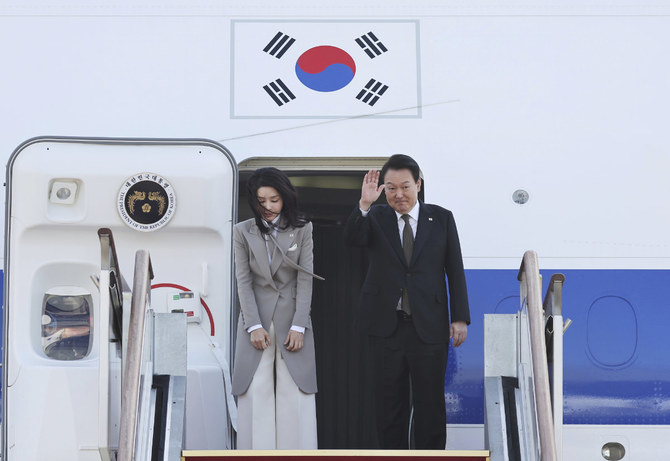
South Korean President Yoon Suk Yeol waves as his wife Kim Keon Hee bows before departing for Japan at the Seoul military airport in Seongnam, South Korea, on March 16, 2023. (Yonhap via AP)
2 / 3
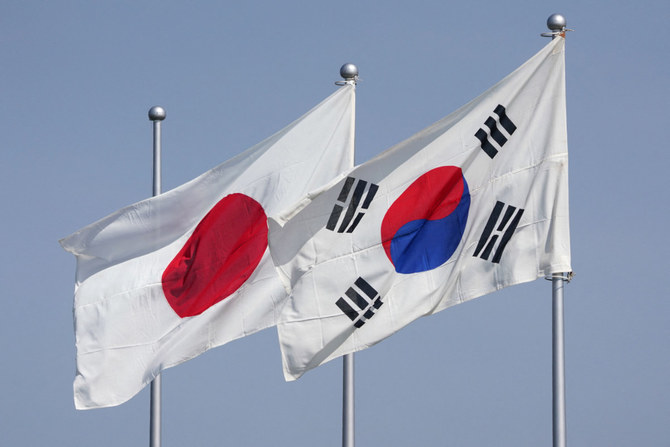
The national flags of Japan (L) and South Korea (R) flutter in the wind ahead of the arrival of South Korea’s President Yoon Suk Yeol at Tokyo's Haneda Airport on March 16, 2023. (AFP)
3 / 3
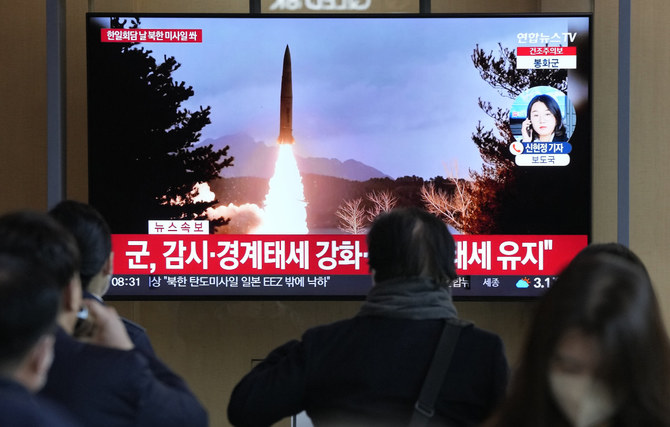
A TV screen shows a file image of North Korea's missile launch during a news program at the Seoul Railway Station in Seoul, South Korea, on March 16, 2023. (AP Photo)
Short Url
Updated 16 March 2023
Follow

North Korea fires ‘long-range’ missile as South Korean president heads to Japan

SEOUL: North Korea fired a “long-range ballistic missile” Thursday, Seoul said, as South Korean President Yoon Suk Yeol headed to Tokyo for a summit to boost ties in the face of Pyongyang’s growing aggression.
The launch was North Korea’s third show of force since Sunday and came as South Korea and the United States staged their largest joint military drills in five years.
“Our military detected one long-range ballistic missile fired from around the Sunan area in Pyongyang,” South Korea’s Joint Chiefs of Staff said, telling AFP it was an ICBM-class missile.
The missile was fired on a lofted trajectory — up instead of out, typically done to avoid overflying neighboring countries — and flew some 1,000 kilometers (620 miles), the JCS added.
At a National Security Council meeting, Yoon called for strengthened trilateral cooperation with Japan and the United States, adding that “North Korea will pay a clear price for such reckless provocations,” his office said in a statement.
Japan’s cabinet office said the missile reached a maximum altitude of more than 6,000 km.
Prime Minister Fumio Kishida told reporters he would meet ministers from the National Security Council.
“Peace and stability in the region is a very important issue,” Kishida added.
The Thursday launch came hours before the leaders of South Korea and Japan were due to meet in Tokyo, with Pyongyang’s missile and nuclear programs high on the agenda.
That summit — the first in 12 years — comes as the two neighbors seek to mend diplomatic ties long strained by Japanese atrocities during its 35-year colonial rule.
Both South Korea and Japan are ramping up defense spending and joint military exercises, which Yoon has said are essential for regional and global stability.
“There is an increasing need for Korea and Japan to cooperate in this time of a polycrisis with North Korean nuclear and missile threats escalating,” Yoon said in a written interview with media including AFP ahead of his trip.

Analysts said North Korea timed the launch on the day of the summit for “double effect” as a warning to its neighbors while protesting the US-South Korea joint drills.
Leader Kim Jong Un earlier this month ordered the North Korean military to intensify drills to prepare for a “real war.”
“For a North Korea that’s constantly looking for excuses to justify its hostile activities and weapons development, it’s prime time for Kim to roll out his missiles,” said Soo Kim, a former CIA Korea analyst who now works at management consulting firm LMI.
Leif Easley, a professor at Ewha University in Seoul, said that the test was an attempt by Kim “to threaten Tokyo for deepening trilateral cooperation with Washington and Seoul and to coerce South Korea from holding further defense exercises with the United States.”
Seoul and Washington have ramped up defense cooperation in the face of growing military and nuclear threats from the North, which has conducted a series of increasingly provocative banned weapons tests in recent months.
On Tuesday, North Korea fired two short-range ballistic missiles, having launched two strategic cruise missiles from a submarine Sunday, just hours before the US-South Korea exercises kicked off.
Known as Freedom Shield, the drills started Monday and are set to run for 10 days.
The Freedom Shield exercises focus on the “changing security environment” due to North Korea’s redoubled aggression, the allies have said.
North Korea views all such drills as rehearsals for invasion and has repeatedly warned it would take “overwhelming” action in response.
The Thursday test “may be a rehearsal for a normal angle ICBM launch or it could be a check-up in the North’s preparations for a reconnaissance satellite launch,” Yang Moo-jin, a professor at the University of North Korean Studies in Seoul, told AFP.
North Korea has never fired its most powerful missiles at a normal trajectory, and analysts question whether they have the technology to survive re-entry into the atmosphere.
Pyongyang, which last year declared itself an “irreversible” nuclear power, has said previously that launching a military reconnaissance satellite is one of its priorities.


Ice-cool Rybakina beats Sabalenka in tense Australian Open final

Updated 5 sec ago
Follow

Ice-cool Rybakina beats Sabalenka in tense Australian Open final

  • The big-serving Kazakh fifth seed held her nerve to pull through 6-4, 4-6, 6-4
  • Rybakina who was born in Moscow, adds her Melbourne triumph to her Wimbledon win in 2022
MELBOURNE: Elena Rybakina took revenge over world number one Aryna Sabalenka to win a nail-biting Australian Open final on Saturday and clinch her second Grand Slam title.
The big-serving Kazakh fifth seed held her nerve to pull through 6-4, 4-6, 6-4 at Rod Laver Arena in Melbourne in 2hrs 18mins.
It was payback after the Belarusian Sabalenka won the 2023 final between two of the hardest hitters in women’s tennis.
The ice-cool Rybakina, 26, who was born in Moscow, adds her Melbourne triumph to her Wimbledon win in 2022.
“Hard to find the words now,” said Rybakina, and then addressed her beaten opponent to add: “I know it is tough, but I hope we play many more finals together.”
Turning to some Kazakh fans in the crowd, she said: “Thank you so much to Kazakhstan. I felt the support from that corner a lot.”
It was more disappointment in a major final for Sabalenka, who won the US Open last year for the second time but lost the French Open and Melbourne title deciders.
She was into her fourth Australian Open final in a row and had been imperious until now, with tears in her eyes at the end.
“Let’s hope maybe next year will be a better year for me,” Sabalenka said ruefully.
Rybakina fights back
With the roof on because of drizzle in Melbourne, Rybakina immediately broke serve and then comfortably held for 2-0.
Rybakina faced two break points at 4-3, but found her range with her serve to send down an ace and dig herself out of trouble, leaving Sabalenka visibly frustrated.
Rybakina looked in the zone and wrapped up the set in 37 minutes on her first set point when Sabalenka fired long.
Incredibly, it was the first set Sabalenka had dropped in 2026.
The second game of the second set was tense, Rybakina saving three break points in a 10-minute arm-wrestle.
They went with serve and the seventh game was another tussle, Sabalenka holding for 4-3 after the best rally of a cagey affair.
The tension ratcheted up and the top seed quickly forged three set points at 5-4 on the Kazakh’s serve, ruthlessly levelling the match at the first chance to force a deciding set.
Sabalenka was now in the ascendancy and smacked a scorching backhand to break for a 2-0 lead, then holding for 3-0.
Rybakina, who also had not dropped a set in reaching the final, looked unusually rattled.
She reset to hold, then wrestled back the break, allowing herself the merest of smiles.
At 3-3 the title threatened to swing either way.
But a surging Rybakina won a fourth game in a row to break for 4-3, then held to put a thrilling victory within sight.
Rybakina sealed the championship with her sixth ace of the match.
The finalists were familiar foes having met 14 times previously, with Sabalenka winning eight of them.
Sabalenka came into the final as favorite but Rybakina has been one of the form players on the women’s tour in recent months.
She also defeated Sabalenka in the decider at the season-ending WTA Finals.
Rybakina beat second seed Iga Swiatek in the quarter-finals and sixth seed Jessica Pegula in the last four in Melbourne.
Rybakina switched to play under the Kazakh flag in 2018 when she was a little-known 19-year-old, citing financial reasons.