Conditions for migrant workers in Qatar have worsened since World Cup, union says 

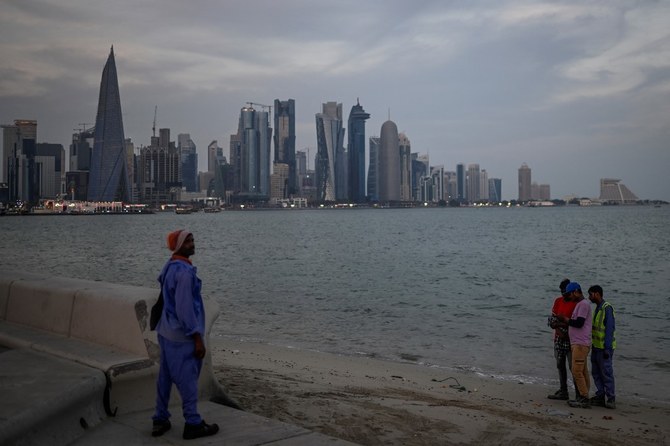
Migrant workers stand in front of the Doha skyline. (File/AFP)
Short Url
Updated 15 March 2023
Follow

Conditions for migrant workers in Qatar have worsened since World Cup, union says 

  • Global Union Federations demand that Qatar’s government set up a compensation fund for abused workers, establish a center for migrant workers
  • FIFA will review on Thursday whether enough has been done to tackle human rights violations and migrant worker deaths 

LONDON: Migrant workers in Qatar have faced worsening conditions since the FIFA World Cup, a group of eight global union federations said on Wednesday.

On the eve of FIFA’s 73rd Congress in Rwanda, the Global Union Federations issued a statement expressing “serious concerns on the decent work legacy of the World Cup and the sustainability of labor reforms in Qatar.” 

It said: “Reports on the ground in Qatar, reveal continuous breaches of the new labour legislation by rogue employers emboldened by an absence of enforcement and growing confidence that rights violations will go unpunished.”

The unions representing the skills and services sectors claim that reform has stagnated due to a lack of political will, active opposition from many abusive employers, and a lack of progress on the International Labour Organization’s Fundamental Principles and Rights at Work. 

“The threats, arrests, and sudden halt of meaningful cooperation with the Global Union Federations further confirm a deteriorating environment and reticence to build on progress achieved through dialogue and cooperation,” the statement continued.

The unions demanded that Qatar’s government set up a compensation fund for abused workers and establish a center for migrant workers. They also requested that the ILO conduct an independent review of Qatar’s efforts to meet its human rights obligations. 

Earlier on Monday, FIFA received an open letter from Amnesty International, which was supported by a million signatures, questioning whether the federation’s proposed “legacy fund” would adequately help workers who had suffered wage theft, illegal recruitment fees, and injuries in Qatar, or compensate the families of those who died. 

Following a proposal from the Norwegian Football Federation, FIFA will review on Thursday whether enough has been done to tackle human rights violations and migrant worker deaths in Qatar.

The Guardian has reached out to the Qatari government and the World Cup Supreme Committee for comment.

However, the government has previously stated: “Over the past two decades, Qatar has transformed its labor system, establishing itself as the region’s proud leader when it comes to labor rights. We have taken extensive action — working in conjunction with the ILO and other partners — to improve the lives of all workers in Qatar.”


Palestinians retrieve belongings from West Bank camp before home demolitions

Updated 7 sec ago
Follow

Palestinians retrieve belongings from West Bank camp before home demolitions

  • Israel plans to demolish 25 buildings housing up to 100 families
  • Follows IDF operation earlier this year against camps in the northern occupied West Bank
NUR SHAMS, Palestinian Territories: Dozens of residents from the West Bank’s emptied Nur Shams refugee camp returned on Wednesday to retrieve belongings ahead of the Israeli military’s demolition of 25 residential buildings there.
Early this year, the military launched an ongoing operation it said was aimed at rooting out Palestinian armed groups from camps in the northern occupied West Bank — including Nur Shams, Tulkarem and Jenin.
Loading furniture, children’s toys and even a window frame onto small trucks, Palestinian residents hurried Wednesday to gather as much as they could under the watchful eye of Israeli soldiers, according to an AFP journalist at the scene.
Troops performed ID checks and physical searches, allowing through only those whose houses were set to be demolished.
Some who were able to enter salvaged large empty water tanks, while others came out with family photos, mattresses and heaters.
More than 32,000 people remain displaced from the now-empty camps, where Israeli troops are stationed, according to the UN’s agency for Palestinian refugees, UNRWA.
Mahmud Abdallah, who was displaced from Nur Shams and was able to enter a part of the camp on Wednesday, said he witnessed for the first time the destruction that had taken place after he was forced to leave.
“I was surprised to find that there were no habitable houses; maybe two or three, but they were not suitable for living,” he said.
“The camp is destroyed.”

‘Determined to return’

The demolitions, affecting 25 buildings housing up to 100 families, were announced earlier this week and are scheduled for Thursday.
They are officially part of a broader Israeli strategy of home demolitions to ease its military vehicles’ access in the dense refugee camps of the northern West Bank.
Israel has occupied the Palestinian territory since 1967.
Ahmed Al-Masri, a camp resident whose house was to be demolished, told AFP that his request for access was denied.
“When I asked why, I was told: ‘Your name is not in the liaison office records’,” he said.
UNRWA’s director for the West Bank and east Jerusalem, Roland Friedrich, said an estimated 1,600 houses were fully or partially destroyed during the military operation, making it “the most severe displacement crisis that the West Bank has seen since 1967.”
Nur Shams, along with other refugee camps in the West Bank, was established after the creation of Israel in 1948, when hundreds of thousands of Palestinians were displaced from their homes in what is now Israel.
“We ask God to compensate us with palaces in paradise,” said Ibtisam Al-Ajouz, a displaced camp resident whose house was also set to be destroyed.
“We are determined to return, and God willing, we will rebuild. Even if the houses are demolished, we will not be afraid — our morale is high.”