

Unveiling migrant strategy, UK home secretary dodges question on Mo Farah deportation

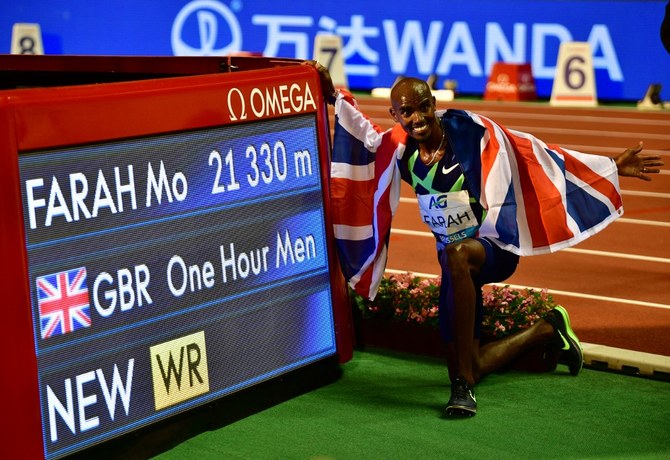
Champion runner Mo Farah was trafficked into Britain aged nine. (AFP file photo)
Short Url
Updated 08 March 2023
Follow

Unveiling migrant strategy, UK home secretary dodges question on Mo Farah deportation

  • Suella Braverman asked whether champion runner, who was trafficked age 9, would have been deported under new plan
  • UNHCR ‘profoundly concerned’ as strategy would be ‘clear breach of refugee convention’

LONDON: The UK home secretary has declined to comment on whether champion runner Mo Farah, who was trafficked into Britain aged 9, would have been deported under fresh plans to clamp down on asylum-seekers, The Guardian reported on Wednesday.

Suella Braverman said the government is abiding by the law with the proposed strategy to detain and deport asylum-seekers crossing the English Channel.

The strategy, outlined by her and Prime Minister Rishi Sunak, aims to clamp down on migrant crossings and deter would-be asylum-seekers from attempting dangerous journeys from France to Britain.

But Braverman, while unveiling the strategy, said the plan is “more than 50 percent” likely to violate human rights laws.

After the strategy was publicized, the UN High Commissioner for Refugees said it is “profoundly concerned” as the strategy would be a “clear breach of the refugee convention.”

The plans were announced as the UK faces a surging backlog of asylum claims, with 166,000 people awaiting decisions on their applications.

Braverman, in a TV interview, was asked whether Farah would have been deported under the strategy.

She struggled to answer, saying: “Well, as I said, we are very proud of our world-leading modern slavery regime. We’ve got world-leading protections on human trafficking, proud of protections the Conservative government have put in place to protect genuine victims of modern slavery.”

The new strategy, which will be put forward in Parliament, relies on a two-tiered plan: The government first aims to stop boats crossing the English Channel, and will then introduce an annual limit on the number of people will be offered asylum through legal routes.

Sunak told a press conference that illegal arrivals would be deported from Britain “within weeks” under the new strategy, which would also apply retroactively.

Opposition figures criticized the plan, with Shadow Home Secretary Yvette Cooper telling the BBC: “I think that they are being irresponsible in the way they’re doing this. Time and again they go for the gimmicks, they go for the rhetoric, they ramp up the debate on this, but they don’t actually solve the problem.”


Bangladesh votes in world’s first Gen Z-inspired election

Updated 4 sec ago
Follow

Bangladesh votes in world’s first Gen Z-inspired election

  • Ousted PM Hasina’s Awami League party banned
  • BNP, Jamaat in close race with big economic, geopolitical stakes
DHAKA: For years under former Prime Minister Sheikh Hasina, Bangladesh’s opposition had little presence on the streets during elections, either boycotting polls or being sidelined by mass arrests of senior leaders. ​Now, ahead of Thursday’s vote, the roles have reversed.
Hasina’s Awami League is banned, but many young people who helped oust her government in a 2024 uprising say the upcoming vote will be the Muslim-majority nation’s first competitive election since 2009, when she began a 15-year-rule.
The Bangladesh Nationalist Party (BNP) is widely expected to win, although a coalition led by the Islamist Jamaat-e-Islami is putting up a strong challenge. A new party driven by Gen-Z activists under the age of 30 has aligned with Jamaat after failing to translate its anti-Hasina street mobilization into an electoral base.
BNP chief Tarique Rahman told Reuters his party, which is contesting 292 of the 300 parliamentary seats at stake, was confident of winning “enough to form a government.”
Analysts say a decisive result in the February 12 vote, instead of a fractured outcome, is vital for restoring ‌stability in the nation of ‌175 million after Hasina’s ouster triggered months of unrest and disrupted major industries, including ‌the garments ⁠sector ​in the ‌world’s second-largest exporter.
The verdict will also affect the roles of rival regional heavyweights China and India in the South Asian nation.
“Opinion polls suggest the BNP has an edge, but we must remember that a significant portion of voters are still undecided,” said Parvez Karim Abbasi, executive director at Dhaka’s Center for Governance Studies.
“Several factors will shape the outcome, including how Generation Z — which makes up about a quarter of the electorate — votes, as their choices will carry considerable weight.”
Across Bangladesh, black-and-white posters and banners bearing the BNP’s “sheaf of paddy” symbol and Jamaat’s “scales” hang from poles and trees and are pasted on roadside walls, alongside those of several independent candidates. Party shacks on street corners, draped in their emblems, blare campaign songs.
It marks a sharp ⁠contrast with past elections, when the Awami League’s “boat” symbol dominated the landscape.
Opinion polls expect the once-banned Jamaat, which had opposed Bangladesh’s India-backed 1971 independence from Pakistan, to have its best electoral ‌performance even if it does not win.

China’s influence increases as India’s wanes
The election verdict ‍will also influence the roles of China and India in Bangladesh ‍in coming years, analysts have said. Beijing has increased its standing in Bangladesh since Hasina was seen as pro-India and fled to ‍New Delhi after her ouster, where she remains.
While New Delhi’s influence is on the wane, the BNP is seen by some analysts as being relatively more in tune with India than the Jamaat.
A Jamaat-led government might tilt closer to Pakistan, a fellow Muslim-majority nation and a long-standing rival of Hindu-majority India, analysts say. Also, Jamaat’s Gen-Z ally has said “New Delhi’s hegemony” in Bangladesh is one of its main concerns and its leaders met Chinese diplomats recently.
Jamaat, which calls ​for a society governed by Islamic principles, has said the party is not inclined toward any country.
BNP’s Rahman has said if his party formed the government it would have friendly relations with any nation that “offers what is suitable for ⁠my people and my country.”
Bangladesh, one of the world’s most densely populated countries with high rates of extreme poverty, has been hit by high inflation, weakening reserves and slowing investment, which has pushed it to seek large-scale external financing since 2022, including billions of dollars from the International Monetary Fund and the World Bank.
Corruption is the biggest concern among the 128 million voters, followed by inflation, according to a survey by Dhaka-based think tanks Communication & Research Foundation and Bangladesh Election and Public Opinion Studies.
Analysts say Jamaat’s clean image is a factor in its favor, much more than its Islamic leanings.
“Voters report high intention to participate, prioritize corruption and economic concerns over religious or symbolic issues, and express clear expectations for leaders who demonstrate care, competence and accountability,” said the survey.
Nevertheless, BNP’s Rahman, son of former Prime Minister Khaleda Zia, is seen as the frontrunner to lead the next government. But if the Jamaat-led coalition emerges ahead, its chair, Shafiqur Rahman, could be in line for the top job.
Mohammad Rakib, 21, who is set to vote for the first time, said he hoped the next government would allow people to express their views and exercise their franchise freely.
“Everyone ‌was tired of (Hasina’s) Awami League. People couldn’t even vote during national elections. People had no voice,” he said. “I hope the next government, whoever comes into power, will ensure this freedom of expression.”