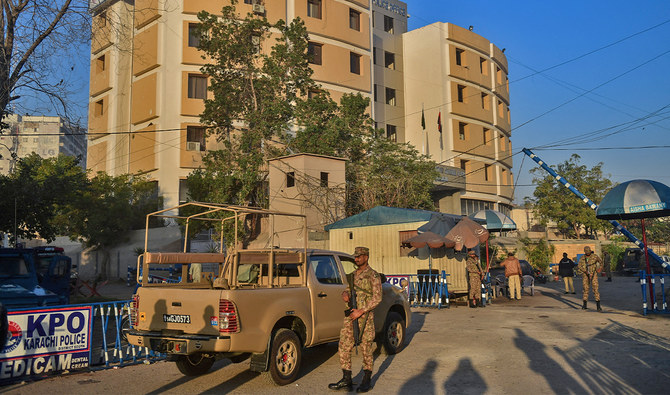

KARACHI: An attack on the police headquarters of Pakistan’s largest city last month and a spike in reported cases of extortion in the metropolis have stirred fears of insurgents regaining a foothold in the city, officials and experts said on Monday.
Karachi, Pakistan’s commercial capital, was marred by political, militant and gang violence until 2013 when a paramilitary Rangers-led operation cleaned up the city’s mean streets. Terror attacks also saw a decline across the country starting 2014 after the military launched a number of major operations in the tribal areas where most Pakistani Taliban (TTP) and allied militants were harboring. Many fighters and commanders of the group were killed in the operations while others fled across the border to neighboring Afghanistan.
But the Pakistani militants were emboldened once more after the Afghan Taliban, who the TTP is allied with, seized power in Kabul in August 2021 after US and NATO troops withdrew. Last year, the Afghan administration brokered a number of cease-fires between the Pakistan government and the TTP, the last of which was unilaterally called off by the militant group in November. The outfit has since increased its attacks on security forces, including the brazen assault on Karachi’s police headquarters last month.
On Monday, officers of Karachi’s Counter Terrorism Department said they had killed the suspected mastermind of the police HQ attack.
“[The] group which we busted comprised militants living in Karachi, [which] is one indicator,” CTD top official Raja Umar Khattab told Arab News when asked about signs of a return of the Taliban to Karachi.
“The second major indicator of the Taliban’s presence is the rise in extortion cases,” said Khattab, who runs the transnational terror cell at the city’s CTD.
The official did not provide figures for the rising extortion demands but businesses in Karachi have for decades dealt with the menace, especially from criminal gangs. The vast majority of extortion demands go unreported, police say, and victims usually decide to pay. There is no way to know the sums involved, but police say payments run into tens of millions of dollars annually in Karachi, home to Pakistan’s main stock market, and the city that handles all of the cash-strapped country’s shipping and also generates most of Pakistan’s tax revenue.
Experts tracking militancy in the region said after the breakdown of the truce with the government in November, it was unsurprising that the TTP was trying to make inroads in major city centers.
“The TTP network in Karachi is not surprising as they have moved toward urban terrorism in last few months,” Abdul Basit Khan, a research fellow at the S. Rajaratnam School of International Studies in Singapore, told Arab News. “There has been Taliban’s ingress in Pashtun areas in cities, especially Karachi.”
The Taliban’s comeback to cities like Karachi, he said, was consistent with their recent track record.
“The militants have come back to Pakistan in large numbers and have spread in cities in [the] form of small networks,” Khan said. “There are Taliban cells in all cities and they have shown their ingress in Rawalpindi, Peshawar, and recently in Karachi.”
“There are troubling signs of the TTP’s resurgence in Karachi, most significant of which is the group’s stepped up extortion activity and the audacious attack on the office of the Karachi police chief,” Dr. Asfandyar Mir, a senior expert at the US Institute of Peace, told Arab News.
At the same time, he said, the TTP appeared to be treading cautiously and had not yet announced a shadow government structure or a dedicated leader for the city as part of its recent reorganization.
“Nevertheless, as the group gains in eastern Afghanistan and along Pakistan’s western border, TTP will seek to accelerate recruitment, fundraising, and expansion of operational cells in the city,” Mir said.