CAPE TOWN: South Africa's African National Congress party will not consider any demands from possible coalition partners that President Cyril Ramaphosa step down, a top official said Sunday, as the ANC attempted to present a united front after a stinging election result ended its 30-year majority.
As South Africa heads for a series of complex talks to form a national coalition government for the first time and establish stability, ANC secretary-general Fikile Mbalula said Ramaphosa would remain as party leader and any demands from others that he resign for talks to go ahead was “a no-go area.”
“President Ramaphosa is the president of the ANC,” Mbalula said in the ANC leadership's first public comments since the landmark election results. “And if you come to us with that demand that Ramaphosa is going to step down as the president, that is not going to happen.”
Mbalula said the ANC was open to talks with every other political party in an effort to form a government, but “no political party will dictate terms to us, the ANC. They will not ... You come to us with that demand, forget (it).”
Mbalula conceded the ANC, which has dominated South African politics since the end of apartheid in 1994, “suffered heavily” in the election but said it was “not booted out.”
The ANC received just over 40% of votes, falling well short of the majority it has held for all of South Africa’s young democracy. It will still be the biggest party by some way. But it needs to talk with others to form a government and to reelect Ramaphosa for a second and final term. South Africa’s president is elected by Parliament after national elections.
“The results send a clear message to the ANC,” Mbalula said. “We wish to send a message to the people of South Africa: We have heard them.” He said the ANC was committed to forming a government that reflects the will of the people and is stable.
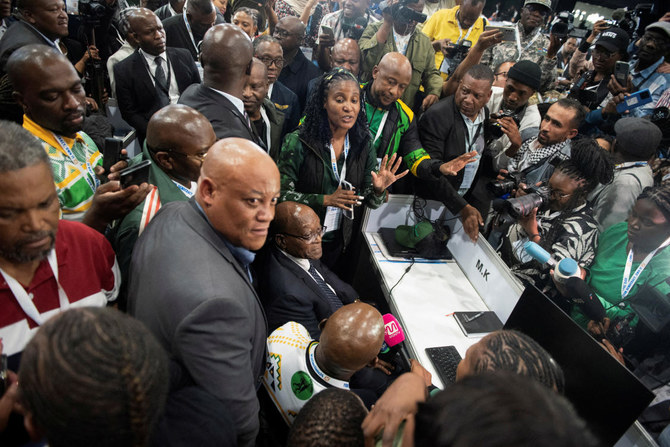
The new MK Party of former President Jacob Zuma, which won 14% in the election in a surprise showing that makes it the third biggest in parliament, has said Ramaphosa must go as leader of the ANC and the country for it to enter any coalition talks with the ANC.
The ANC has many options for coalition partners among South Africa's other parties, including one with the main opposition Democratic Alliance, which won 21% of votes.
"We’ll talk to everybody," Mbalula said. “We are talking to everybody because the election did not give us outright majority. Talks about talks are in full swing. We are engaged and we are open to engagement. We need stability in this country.”


South Africa’s ANC calls demands for President Ramaphosa to step down for coalition talks a ‘no-go’
https://arab.news/mqedy
South Africa’s ANC calls demands for President Ramaphosa to step down for coalition talks a ‘no-go’


Russia hits Ukraine with drones, missiles, kills at least 10 in Kharkiv
- Zelensky said that Russia launched 480 drones and 29 missiles targeting the energy sector and railway infrastructure
- “There should be a response from partners to these savage strikes against life“
KHARKIV, Ukraine: Russia launched a barrage of drones and missiles at Ukraine overnight on Saturday, damaging infrastructure and killing at least 10 people, including two children, in the northeast city of Kharkiv, Ukrainian officials said.
Ukrainian President Volodymyr Zelensky said that Russia launched 480 drones and 29 missiles targeting the energy sector and railway infrastructure across the country.
“There should be a response from partners to these savage strikes against life,” Zelensky said on the Telegram app.
“Russia has not abandoned its attempts to destroy Ukraine’s residential and critical infrastructure, and therefore support should continue,” Zelensky said, urging partners to continue air defense and weapons supplies.
Ukrainian air defense units shot down 453 drones and 19 missiles, the air force said. But nine missiles and 26 attack drones hit 22 sites, it said.
BALLISTIC MISSILE SLAMS INTO RESIDENTIAL BUILDING
The city of Kharkiv was targeted by both Russian drones and missiles, and 10 people, including two children, were killed after a Russian ballistic missile slammed into a five-story residential building, Kharkiv mayor Ihor Terekhov said.
“When we arrived here 20 minutes after the explosion, I thought I was going to have a stroke. I couldn’t string two words together, and my legs were buckling,” Hanna, a resident of the destroyed building, told Reuters.
“It’s good that I wasn’t there with my child and that my father was with me. It was ordinary people who lived there. What were they targeting?“
Russia’s Defense Ministry said its forces carried out massive overnight strikes on Ukrainian military-industrial complexes, military airfields and energy facilities, the Interfax news agency reported.
In Kharkiv, 15 people were also wounded, and 19 residential buildings were damaged by the Russian attacks, Syniehubov said.
Commercial and administrative buildings, electricity distribution lines, and cars were also hit, he said.
In Kyiv, three people were injured, and the heating was knocked out in 2,806 residential apartment buildings in four districts across the capital after Russian strikes hit an energy infrastructure facility, Prime Minister Yulia Svyrydenko said.
National grid operator Ukrenergo said that emergency power cuts were introduced in seven regions following the Russian attacks.
Ukrainian officials said that Russia also attacked four railway stations and other railway infrastructure in central Ukraine and port infrastructure in the southern Odesa region, setting on fire containers with vegetable oil and damaging a grain warehouse.


