

Pakistan battles another forest fire in Margalla Hills amid heat wave 

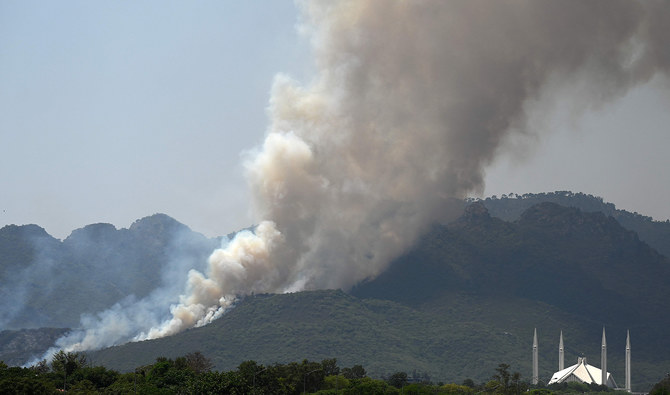
Smoke rises from a fire that erupted few days back in Margalla Hills forest near Faisal Mosque amid rising temperatures during a hot summer day in Islamabad on May 31, 2024. (AFP)
Short Url
Updated 02 June 2024
Follow

Pakistan battles another forest fire in Margalla Hills amid heat wave 

  • Fire erupted on Saturday night in Margalla Hills part located in Khyber Pakhtunkhwa, says Islamabad deputy commissioner
  • Part of the Himalayan foothills, Margalla range experiences bush fires relatively often in summer months as temperatures soar

ISLAMABAD: Pakistani authorities were busy dousing another forest fire in the city’s Margalla Hills Saturday night as South Asia continues to remain in the grip of a severe heat wave. 

The Margalla range, part of the Himalayan foothills, has experienced bush fires relatively often in the summer months. There have also been multiple fires during this month, largely attributed to the extreme heat wave affecting the region.

Authorities on Saturday said they doused a fire that had erupted in three separate locations. However, erupted again in the part of the hills located in the northwestern Khyber Pakhtunkhwa (KP) province on Saturday night, Islamabad Deputy Commission Irfan Memon said. 

“The Capital Development Authority (CDA) teams are present to douse the flames,” Memon said in a statement. “Thirty-six firefighters are busy battling the flames.”

Memon said authorities have formed a firewall to prevent the flames from reaching the capital city, adding that the Islamabad administration is undertaking joint efforts with the KP government to douse the fire. 

Parts of Pakistan have seen temperatures as high as 52.2 degrees Celsius (126 F) over the last week with South Asia sweltering in a hotter summer this year — a trend scientists say has been worsened by human-driven climate change.

Pakistan is seen by global organizations as one of the most vulnerable countries to extreme weather and climate change. In 2022, floods wreaked havoc in the country, killing over 1,700 people and displacing millions.

In India, at least 15 people died of suspected heat-stroke on Thursday with the region gripped by a debilitating heat wave expected to continue until Saturday.


Government says Pakistan preparing Cyber Security Act as digital expansion raises risks

Updated 51 min 23 sec ago
Follow

Government says Pakistan preparing Cyber Security Act as digital expansion raises risks

  • The proposed legislation will create Cyber Security Authority to oversee the country's cyber defenses
  • IT minister warns misuse of genetic and digital data could enable targeted cyber and biological threats

ISLAMABAD: Pakistan is preparing a Cyber Security Act and a dedicated regulatory authority to strengthen defenses against rising digital threats as the country rapidly digitizes government services and economic systems, IT Minister Shaza Fatima said while addressing a ceremony in the federal capital on Wednesday.

The planned legislation is part of Islamabad’s broader “Digital Nation Pakistan” initiative, which aims to expand e-governance, a cashless economy and online public services while safeguarding national cyber infrastructure.

“The more we move toward digitization, with the kind of opportunities that are opening up for us, it is also bringing an equal, or even greater, set of challenges,” the minister said. “This does not mean that we stop digitization. It means that we must make our cybersecurity systems robust.”

She said Pakistan had already activated its National Computer Emergency Response Team (CERT) and provincial CERTs to detect and respond to cyber incidents, while a multi-agency digital monitoring framework known as the National Threat Intelligence System (NTIS) operates around the clock.

“We have a Cyber Security Act coming up, under which a Cyber Security Authority will be established.”

The minister said cybersecurity was not a “generic” concept and required multiple technical specializations as well as comprehensive monitoring and regulation. She warned that the rapid expansion of data-driven technologies was creating new risks even as it opened opportunities in areas such as health and biotechnology.

Referring to advances in genomics and precision medicine, she said the same technologies that help treat diseases could also pose security risks if sensitive biological data were misused. She warned that access to large-scale genetic data could potentially allow hostile actors to develop targeted viruses or other biological threats against populations.

The minister also highlighted Pakistan’s cyber defense capabilities, saying government and military systems remained secure during last year's war with India despite sustained cyber warfare attempts.

She said multiple institutions, including the IT ministry, the National Telecommunication Corporation (NTC), national cybersecurity teams and the armed forces’ cyber command structures, worked together to defend critical systems.

“Despite that massive war ... we did not face a single communication breakdown and we did not allow any penetration into our government systems,” she said, adding that the experience demonstrated the need to further strengthen cybersecurity coordination across institutions.