

Silicon Valley Bank is largest failure since financial crisis, billions stranded

1 / 2
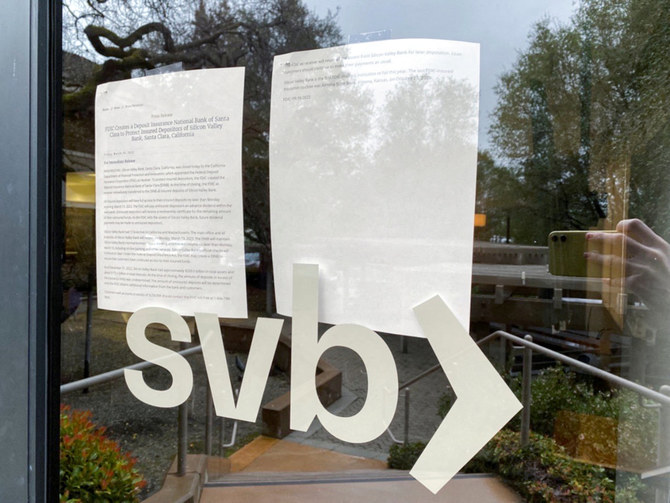
A locked door to a Silicon Valley Bank (SVB) location on Sand Hill Road is seen in Menlo Park, California, on March 10, 2023. (REUTERS/Jeffrey Dastin)
2 / 2
A Brinks armored truck sits parked in front of the shuttered Silicon Valley Bank (SVB) headquarters on March 10, 2023 in Santa Clara, California. (Getty Images/AFP)
Short Url
Updated 11 March 2023
Follow

Silicon Valley Bank is largest failure since financial crisis, billions stranded

  • California regulator closes SVB, appoints FDIC as receiver for later disposition of its assets
  • The collapse sent shockwaves through the startup community, which has come to view the lender as a source of reliable capital

Startup-focused lender SVB Financial Group became the largest bank failure since the financial crisis on Friday, in a sudden collapse that roiled global markets and stranded billions of dollars belonging to companies and investors.
California banking regulators closed the bank, which did business as Silicon Valley Bank, on Friday and appointed the Federal Deposit Insurance Corporation (FDIC) as receiver for later disposition of its assets.
The main office and all branches of Silicon Valley Bank will reopen on March 13 and all insured depositors will have full access to their insured deposits no later than Monday morning, the FDIC said.
But 89 percent of the bank’s $175 billion in deposits were uninsured as the end of 2022, according to the FDIC, and their fate remains to be determined.
Companies such as video game maker Roblox Corp. and streaming device maker Roku Inc. said they had hundreds of millions of deposits at the bank. Roku said its deposits with SVB were largely uninsured, sending its shares down 10 percent in extended trading.
Technology workers whose paychecks relied on the bank were also worried about getting their wages on Friday. An SVB branch in San Francisco showed a note taped to the door telling clients to call a toll-free telephone number.
The FDIC said it would seek to sell SVB’s assets and that future dividend payments may be made to uninsured depositors.
At times in the past, the FDIC has moved quickly, even striking deals to sell major banks over the weekend.
SVB did not respond to calls for comment.

The collapse sent shockwaves through the startup community, which has come to view the lender as a source of reliable capital.
The bank’s customers were met with locked doors on Friday. A client dashboard was down, a UK-based client of the bank told Reuters.
Dean Nelson, CEO of Cato Digital, was on a line outside of SVB Santa Clara headquarters, hoping to get answers. Nelson said he was worried about the company’s ability to pay employees and cover expenses.
“Access to the cash is the biggest problem for the majority of the companies here. If you’re a startup, cash is king. The cash and the workflow, to be able to have the runway is critical.”
The problems at SVB, which quickly escalated after the bank said on Wednesday it would raise money, underscore how a campaign by the US Federal Reserve and other central banks to fight inflation by ending the era of cheap money is exposing vulnerabilities in the market. The worries walloped the banking sector.

US banks have lost over $100 billion in stock market value over the past two days, with European banks losing around another $50 billion in value, according to a Reuters calculation. Regional banks sold off on Friday.
US lenders First Republic Bank and Western Alliance said on Friday their liquidity and deposits remained strong, aiming to calm investors as their shares fell. Others such as Germany’s Commerzbank issued unusual statements to reassure investors.
Some analysts forecast more pain for the sector as the episode spread concern about hidden risks in the banking sector and its vulnerability to the rising cost of money.
“There could be a bloodbath next week as banks are in trouble, the short sellers are out there and they are going to attack every single bank, especially the smaller ones,” said Christopher Whalen, chairman of Whalen Global Advisers.
US Treasury Secretary Janet Yellen met with banking regulators on Friday expressed “full confidence” in their abilities to respond to the situation, Treasury said.
The White House on Friday said it had faith and confidence in US financial regulators, when asked about the failure of SVB. Cecilia Rouse, who chairs the Council of Economic Advisers, said the US banking system was fundamentally stronger than it was during the 2008 financial crisis.
“The first bank failure since 2020 is a wake-up call,” said Matthew Goldberg, an analyst at Bankrate.

The genesis of SVB’s collapse lies in a rising interest rate environment. As higher interest rates caused the market for initial public offerings to shut down for many startups and made private fundraising more costly, some SVB clients started pulling money out.
To fund the redemptions, SVB sold on Wednesday a $21 billion bond portfolio consisting mostly of US Treasuries, and said it would sell $2.25 billion in common equity and preferred convertible stock to fill its funding hole.
Its stock collapsed and depositors started to panic. SVB scrambled this week to reassure its venture capital clients their money was safe. By Friday, the collapsing stock price had made its capital raise untenable and sources said the bank tried to look at other options, including a sale, until regulators stepped in and shut the bank down.
After the FDIC announcement, employees received an email from the company saying they would be contacted by officials about employment and compensation, according to a source who declined be identified. As of Friday evening, there had not been any further communication from the company or the FDIC, the source said.
The last FDIC-insured institution to close was Almena State Bank in Kansas, on October 23, 2020.


Building bridges: Saudi Arabia leads Gulf-Asia tech leap

Updated 43 min 36 sec ago
Follow

Building bridges: Saudi Arabia leads Gulf-Asia tech leap

ALKHOBAR: Saudi Arabia is forging new academic connections with Asia as the Kingdom’s Vision 2030 accelerates reforms in education and innovation.

Two academics — Prof. Eman AbuKhousa, a data science professor at the University of Europe for Applied Sciences in Dubai, and Prof. Hui Kai-Lung, acting dean of the HKUST Business School in Hong Kong —emphasize that the Kingdom’s transformation is reshaping the development of artificial intelligence and fintech talent across the region.

For AbuKhousa, responsible AI is not just about technology; it is fundamentally about intention. “It is about aligning technology with human values: ensuring fairness, transparency, and accountability in every system we build.”

She highlighted that the Middle East’s heritage of trust and ethics gives the region a competitive advantage. “Institutions should embed ethics and cultural context into AI education and create multidisciplinary labs where engineers collaborate with social scientists and ethicists,” she said.

At the University of Europe for Applied Sciences in Dubai, AbuKhousa trains students to question data, identify bias, and integrate integrity into innovation. 

Asian universities like HKUST play a growing role in cross-border education partnerships with Saudi institutions.

“Educators must model responsible use by explaining how data is sourced and decisions are made,” she explained. “Ultimately, responsible AI is less about algorithms than about intention; teaching future innovators to ask not only ‘Can we?’ but ‘Should we?’”

She further noted:“Saudi Arabia’s Vision 2030 has turned digital education into a national movement placing technology and innovation at the heart of human development.”

AbuKhousa emphasized the transformative opportunities for women in the Kingdom: “Today, Saudi female students are designing models, leading AI startups, and redefining what digital leadership looks like.”

Prof. Hui views this transformation through the lens of fintech. “Fintech is deeply embedded in Vision 2030, serving as a key enabler of its three pillars: a vibrant society, a thriving economy, and an ambitious nation,” he said.

Hui stressed that Saudi Arabia’s investment capacity and modern regulatory framework “create a conducive environment for innovation.” Having collaborated with Aramco, The Financial Academy, and Prince Mohammed Bin Salman College of Business and Entrepreneurship, he highlighted the strategic potential of the Kingdom’s young population. “The Kingdom has one of the youngest populations in the world, with a median age below 30,” he said. 

Opinion

This section contains relevant reference points, placed in (Opinion field)

“This demographic presents a tremendous opportunity for higher education to shape future leaders, and our collaborations in Saudi Arabia are highly targeted to support this goal.”

AbuKhousa argued that universities must lead innovation rather than follow it. “Universities must evolve from teaching institutions into innovation ecosystems,” she said. “The real bridge between research and industry lies in applied collaboration: joint labs, shared data projects, and co-supervised capstones where students solve live industry challenges.”

“At UE Dubai, we’ve introduced an Honorary Senate of Business Leaders to strengthen that bridge, bringing decision-makers directly into the learning process,” she added.

DID YOU KNOW?

Vision 2030 has made digital education central to Saudi Arabia’s development strategy.

Women in Saudi Arabia are now designing AI models and leading startups.

Universities are transforming into innovation ecosystems bridging research and industry.

Cross-border collaborations with Hong Kong and Dubai are accelerating fintech and AI growth.

Hui noted that cross-border cooperation between Hong Kong and Saudi Arabia is growing rapidly. “Saudi Arabia’s scale, strategic location, and leadership in the Arab world offer Hong Kong an ideal partner,” he said. “Hong Kong’s academic and regulatory experience can help the Kingdom fast-track its digital transformation.”

He highlighted lessons from Hong Kong’s fintech journey. “Hong Kong’s fintech journey offers critical lessons for Saudi Arabia, particularly in creating a balanced ecosystem for innovation,” he said. “Education and regulation are both important. We need education at all levels and beyond schools to expose people to these ideas; having diverse and rich experiences also helps, as the education needs to be supplemented by real-life implementation and usage experience. That is what Hong Kong can offer.”

AbuKhousa emphasized that women’s participation in technology must extend beyond access to influence. “Empowering women in technology begins with reimagining representation: from inclusion to influence,” she said. “We need more women not only learning tech, but leading teams, designing systems, and shaping AI policy. Institutions must normalize women’s presence in decision-making spaces and provide visible mentorship networks to counter imposter syndrome.”

Both experts agreed that innovation must remain human-centered and accountable. “As AI becomes integral to financial systems, governments must strike a careful balance between innovation, data ethics, and compliance,” Hui said. “Establishing clear regulatory frameworks and transparency standards is crucial.”

AbuKhousa concurred, emphasizing the role of education in AI adoption: “Educators must position generative AI as a thinking partner, not a shortcut. The goal is to teach students how to use AI critically, not merely that they can.”

Hui predicts that “AI, blockchain, and cybersecurity will be transformative forces in the region’s financial sector.” AbuKhousa sees a similar momentum in education: “The Gulf is entering a defining phase where AI becomes the backbone of education and workforce development.”

The experts concluded that the Kingdom’s digital transformation, anchored in Vision 2030, is connecting classrooms, industries, and continents through human-centered innovation.