

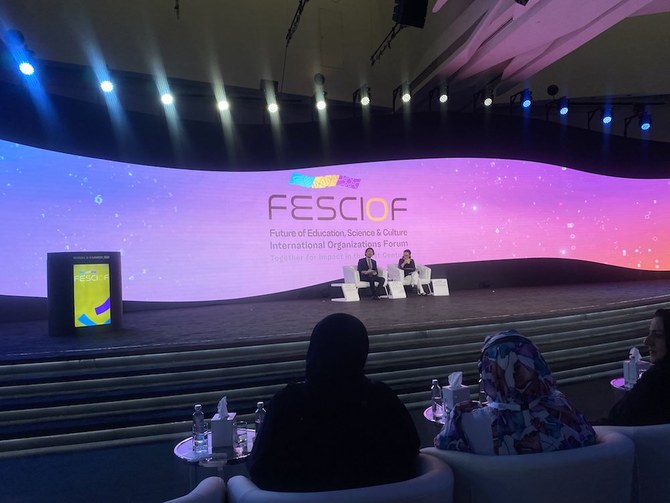

RIYADH: Promoting education and culture is key to confronting the world’s challenges and inspiring change, a panel at the Future of Education, Science, and Culture International Organizations Forum in Riyadh was told.
Lydia Ruprecht, global citizenship education team leader and program specialist at UNESCO, along with other experts, spoke on the panel titled: “Culture and Education Together for Sustainable Development.”
She said: “Education can certainly play a big role in equipping people with the knowledge and skills to transform lives, economies and societies. Thus, achieving sustainable development goals.”
However, education is not the only engine for transformation, she added.
“Culture also plays a major role in shifting mindsets and societies. Culture underpins and drives the state’s development, and is a renewable resource that it can inspire profound change in all domains,” she said.
Ruprecht and Ke Leng, program coordinator of cultural policies and development at UNESCO’s culture sector, shed light on the nexus between culture and education and UNESCO’s role in reinforcing the relationship.
Bringing culture and education together creates a dynamic mix that can accelerate change, they said.
“For example, a cultural approach to education can improve the quality of learning by enhancing its relevancy to local needs and context.”
Education allows the development of new talents and building of an innovative and adaptive workforce for creative industries, the pair said.
Ruprecht said: “Culture, arts and creativity are the core competencies needed today for the evolving job market and are important assets for sustainable development and growth, and fostering creativity.”
Even at the smallest individual scale, interdisciplinary competencies improve employability at large in the long term as the world experiences rapid technological change, the UNESCO officials said.
At the request of UNESCO members in 2021, the organization developed an intersectoral program on learning for diversity, strengthening the synergies between culture and education to nurture inclusive, sustainable and resilient societies.
Leng said: “This is the first-ever attempt of the organization to strengthen the ties between the entire culture and education sectors and to develop close working ties in the exchange of knowledge, expertise and experience.”
There is great potential in seeing education through a cultural lens he added.
“It is precisely for this reason that the revision of the UNESCO 1974 Recommendation concerning education for international understanding, cooperation and peace and education related to human rights and fundamental freedoms incorporates this dimension … building on the cultural conventions adopted since 1974,” said Leng.
At the policy level, the decision to build a framework for culture and arts education was initiated by the UAE.
“It (the UAE) requested the organization to revise the existing framework of arts education to consider these emerging issues, the ever-evolving culture and creative sector, to contribute to expandomg job opportunities in the industries,” said Leng.
A world conference on culture and arts education is set to be convened by the director-general of UNESCO, hosted by the UAE, that will see the adoption of the framework in the Arab region.


