

New UK asylum policy threatens Afghan lives: ex-interpreter

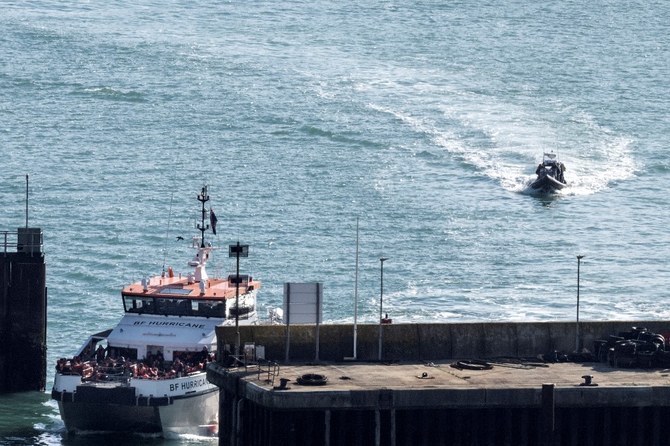
Above, BF Hurricane arrives in Dover carrying migrants picked up in the English Channel on Oct. 18, 2022. The UK government’s proposal would see migrants choosing the cross-channel route lose any right to claim asylum. (AFP file photo)
Short Url
Updated 09 March 2023
Follow

New UK asylum policy threatens Afghan lives: ex-interpreter

  • Rafi Hottak, who served with British Army, says many of his colleagues remain trapped in Afghanistan
  • UK government figures suggest over 71,000 Afghan asylum applications remain pending

LONDON: Proposals by the UK government to toughen its stance on migrants will risk the lives of Afghans who worked with the British Army, a former interpreter has warned.

Rafi Hottak, 36, who was wounded in an explosion while helping British soldiers fighting the Taliban in Helmand province, told Metro newspaper that many of his former colleagues would suffer as a result of new laws that would make entering the UK by small boat across the English Channel illegal.

The proposals, laid out by Prime Minister Rishi Sunak, would see migrants choosing the cross-channel route lose any right to claim asylum in the UK, and make them liable for swift deportation.

Hottak, who came to the UK in 2011 after receiving threats from the Taliban, said many others like him remain in Afghanistan hiding from the group, which swept to power following the withdrawal of US-led coalition forces in August 2021.

“We are losing precious lives every day and most of them are people who have served the NATO forces in Afghanistan,” Hottak said.

“If the existing schemes do not include them, they are forced to flee the country and claim asylum.

“Now, if asylum routes are closed, it means the UK government is taking their fundamental human right away and telling them, ‘I will not save your life even if you have served the NATO forces and I would rather you are killed by the terrorist Taliban’.”

The UK has welcomed over 21,000 Afghans via two schemes since the Taliban returned to power. However, at least 4,300 people with leave to travel to the UK remain stuck in Afghanistan.

According to Ministry of Defence figures, over 71,000 applications made by Afghans to claim asylum in Britain have not been processed.


Pope Leo XIV calls for global truce on Christmas Day

Updated 4 sec ago
Follow

Pope Leo XIV calls for global truce on Christmas Day

  • Pope Leo expressed “great sadness” that “apparently Russia rejected a request” for truce

CASTEL GANDOLFO: Pope Leo XIV on Tuesday called for a global truce on Christmas Day, expressing “great sadness” that “apparently Russia rejected a request” for one.
“I am renewing my request to all people of good will to respect a day of peace — at least on the feast of the birth of our Savior,” Leo told reporters at his residence in Castel Gandolfo near Rome.
Russia invaded Ukraine in February 2022 and has repeatedly rejected calls for a ceasefire saying it would only give a military advantage to Ukraine.
“Among the things that cause me great sadness is the fact that Russia has apparently rejected a request for a truce,” the pope said.
Referring to conflicts in general, Leo said: “I hope they will listen and there will be 24 hours of peace in the whole world,” he added.
Ukraine on Tuesday pulled out troops from a town in the east of the country after fierce battles with Russian forces as relentless strikes by Moscow killed three civilians and cut power to thousands in freezing winter temperatures.
There was no sign of an imminent breakthrough after top negotiators from both Russia and Ukraine were in Miami last weekend for separate meetings with US officials seeking a deal to end almost four years of fighting.
Pope Leo met with Ukrainian President Volodymyr Zelensky earlier this month.
Asked if he would accept Zelensky’s invitation to visit Ukraine, Leo later said “I hope so,” but cautioned it was not possible to say when such a trip would be possible.
He also said that seeking peace in Ukraine without European diplomatic involvement was “unrealistic” and warned US President Donald Trump’s proposed peace plan risked a “huge change” in the transatlantic alliance.