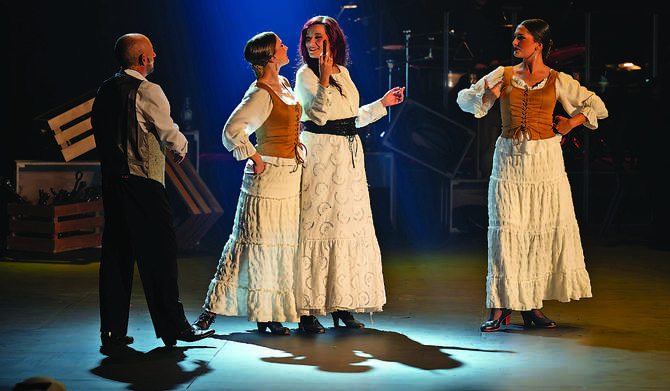

DHAHRAN: As part of King Abdulaziz Center for World Culture’s “Ithra Cultural Days: Spain,” held until Jan. 31, the theater was ignited with fiery passion this week when “Carmen: A Spanish Flamenco Experience” concluded its three-night run.
The Ithra stage was set ablaze with storytelling through movement, sounds and costumes as the packed crowd cheered on.
When the singing began, subtitles in Arabic and English could be seen at the very top of the stage.

The Ithra stage was set ablaze with storytelling through movement, sounds and costumes as the packed crowd cheered on. (Supplied)
“‘Carmen: A Spanish Flamenco Experience’ is a captivating flamenco ballet that combines the intensity and passion of flamenco with the power of Bizet’s iconic opera,” the brochure given out at the performance reads.
Taking place in 19th-century Seville, Spain, a dynamic ensemble of dancers brought to life the legendary characters of an independent factory worker, Carmen, and Don Jose, a soldier, through powerful and expressive flamenco choreography.
Supported by a live orchestra, choir and a number of soloists, the performance immersed the audience in the dramatic and vibrant spirit of the era.
HIGHLIGHTS
• Flamenco combines dance, live music and singing, but the flamboyant and visual aspect is perhaps the most striking.
• Supported by a live orchestra, choir and a number of soloists, the ‘Carmen’ performance immersed the audience in the dramatic and vibrant spirit of the era.
This new adaptation of Bizet’s score introduces innovative flamenco elements that were previously untapped.
It transcends the traditional interpretations often associated with Carmen and reimagines the story within the realities of a more contemporary society.

The Ithra stage was set ablaze with storytelling through movement, sounds and costumes as the packed crowd cheered on. (Supplied)
“Carmen” seamlessly merged fiery flamenco music and classical ballet, shaped by the signature style of David Gutierrez, offering a modern take on the classic narrative.
Gutierrez, who gave some of the most powerful renditions on stage, is the director of the Barcelona Flamenco Ballet, established in 2017 and now known as one of Spain’s foremost flamenco dance companies on the international scene. Gutierrez is also the CEO of Barcelona Flamenco Events.
Ithra was in for a treat with Gutierrez dynamic and striking as Escamilo, the bullfighter; Carmen Orts playing the charming Carmen; and the vivacious Carlos Ruiz as Don Jose.

The Ithra stage was set ablaze with storytelling through movement, sounds and costumes as the packed crowd cheered on. (Supplied)
The corps de ballet consisted of Natalia Marina, Isabel Ponce, Carla Martinez, Maria Garcia, Yeray Fonseca, Mar Sanchez and Alicia Gutierrez.
Guitarists Perez and Jordi Centeno, singer Joel de Pepa, and percussion by Raul Manchon offered the sonic sounds that carried the narrative to newer heights.
Maestro Vicente Arino was on hand as well as producer Jaime Trancoso to ensure that the flamenco elements were not lost in translation.

The Ithra stage was set ablaze with storytelling through movement, sounds and costumes as the packed crowd cheered on. (Supplied)
They spoke to the audience following the performance, alongside Energy Radio’s Danyah Al-Natour, who hosts “Mornings with Danny.”
“A lot of us experienced flamenco for the very first time tonight,” Al-Natour said.
“I think flamenco, as you saw, is a very passionate, powerful art. And with flamenco, you can express all the main feelings of humans,” Arino said.

The Ithra stage was set ablaze with storytelling through movement, sounds and costumes as the packed crowd cheered on. (Supplied)
Flamenco combines dance, live music and singing, but the flamboyant and visual aspect is perhaps the most striking.
Since audiences at Ithra merely had a glimpse of what flamenco culture can be, the Spanish group encouraged Saudi audiences to go to Spain themselves to see it up-close.
“Obviously, the dancing is the most visual and attractive maybe but if you want to learn flamenco, please come to my museum,” Trancoso said.