

Al-Sharaa calls on Syrian Kurds not to believe sedition narratives

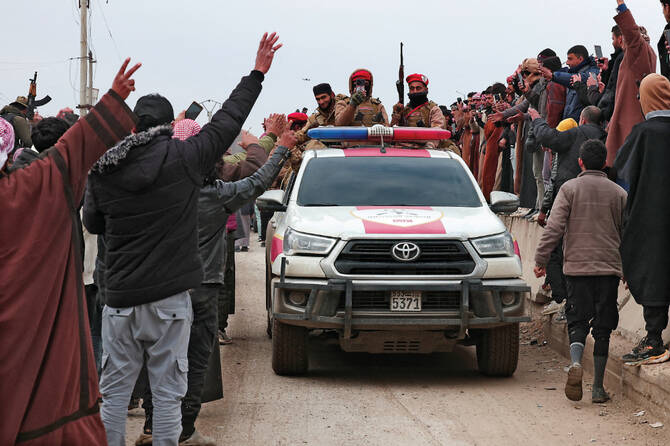
People welcome the Syrian Arab Army on Saturday following the withdrawal of the Kurdish-led Syrian Democratic Forces in Maskanah, Syria. (Reuters)
Short Url
Updated 18 January 2026
Follow

Al-Sharaa calls on Syrian Kurds not to believe sedition narratives

  • Iraqi Kurdistan leader hails Syrian decree
  • US urges halt to ‘offensive actions’ between Aleppo and Raqqa

DAMASCUS: President Ahmad Al-Sharaa has issued a decree affirming that Syrian Kurdish citizens are an integral and authentic part of the Syrian people, and that their cultural and linguistic identity is an inseparable component of Syria’s unified and diverse national identity.

The decree is the first formal recognition of Kurdish national rights since Syria’s independence in 1946.
The decree designates Kurdish as a “national language” that can be taught in public schools in areas where the minority community is heavily represented.
Al-Sharaa also made the Kurdish New Year, Nowruz, which falls on March 21, an official holiday.
The president of Iraq’s Kurdistan region, Nechirvan Barzani, welcomed the new decree. Barzani described the move as a significant political and legal step toward building a new Syria. 
In a televised address announcing the decree, President Al-Sharaa urged Kurds to “actively participate in building this nation,” vowing to “guarantee” their rights.
Al-Sharaa called on Syrian Kurds not to believe narratives of sedition, urging them to return safely and to take part fully in building Syria as one homeland that embraces all its citizens, announcing the issuance of a special decree guaranteeing Kurdish rights and specific cultural considerations.
President Al-Sharaa said that there is no superiority for an Arab over a Kurd, nor a Turk, nor anyone else, except through piety and personal integrity, regardless of one’s ethnicity.
“I urge all those who were forcibly displaced from their lands to return safely and securely, without condition or restriction other than laying down arms,” said Al-Sharaa.
Meanwhile, US Central Command urged ‌Syrian ‌government ‌forces ⁠to cease ‌offensive actions between Aleppo and Tabqa ⁠in ‌northern Syria.
The US call came as Operation Command of the Syrian Arab Army published several maps identifying specific locations in Raqqa and Tabqa, urging residents to keep away from those areas.
Operations Command warned civilians to avoid sites being used by PKK militias and remnants of the defunct regime, described as allies of the SDF organization, as bases for launching terrorist operations against Syrians and their army.


The UN says Al-Hol camp population has dropped sharply as Syria moves to relocate remaining families

Updated 15 February 2026
Follow

The UN says Al-Hol camp population has dropped sharply as Syria moves to relocate remaining families

  • Forces of Syria’s central government captured the Al-Hol camp on Jan. 21 during a weekslong offensive against the SDF, which had been running the camp near the border with Iraq for a decade

DAMASCUS: The UN refugee agency said Sunday that a large number of residents of a camp housing family members of suspected Daesh group militants have left and the Syrian government plans to relocate those who remain.
Gonzalo Vargas Llosa, UNHCR’s representative in Syria, said in a statement that the agency “has observed a significant decrease in the number of residents in Al-Hol camp in recent weeks.”
“Syrian authorities have informed UNHCR of their plan to relocate the remaining families to Akhtarin camp in Aleppo Governorate (province) and have requested UNHCR’s support to assist the population in the new camp, which we stand ready to provide,” he said.
He added that UNHCR “will continue to support the return and reintegration of Syrians who have departed Al-Hol, as well as those who remain.”
The statement did not say how residents had left the camp or how many remain. Many families are believed to have escaped either during the chaos when government forces captured the camp from the Kurdish-led Syrian Democratic Forces last month or afterward.
There was no immediate statement from the Syrian government and a government spokesperson did not respond to a request for comment.
At its peak after the defeat of IS in Syria in 2019, around 73,000 people were living at Al-Hol. Since then, the number has declined with some countries repatriating their citizens. The camp’s residents are mostly children and women, including many wives or widows of IS members.
The camp’s residents are not technically prisoners and most have not been accused of crimes, but they have been held in de facto detention at the heavily guarded facility.
Forces of Syria’s central government captured the Al-Hol camp on Jan. 21 during a weekslong offensive against the SDF, which had been running the camp near the border with Iraq for a decade. A ceasefire deal has since ended the fighting.
Separately, thousands of accused IS militants who were held in detention centers in northeastern Syria have been transferred to Iraq to stand trial under an agreement with the US
The US military said Friday that it had completed the transfer of more than 5,700 adult male IS suspects from detention facilities in Syria to Iraqi custody.
Iraq’s National Center for International Judicial Cooperation said a total of 5,704 suspects from 61 countries who were affiliated with IS — most of them Syrian and Iraqi — were transferred from prisons in Syria. They are now being interrogated in Iraq.