

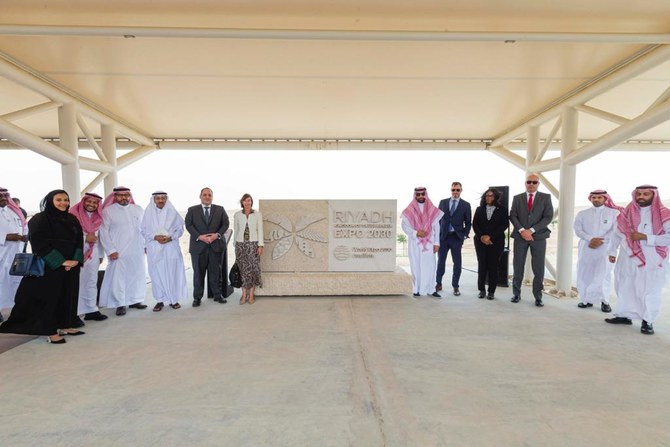

RIYADH: Members of the Bureau International des Expositions enquiry mission have visited the proposed site of Riyadh Expo 2030.
During their trip, they were shown the masterplan for the venue which will cover 6 million square meters.
Accompanied by the chief executive officer of the Royal Commission for Riyadh City, Fahd Abdulmohsen Al-Rasheed, at the King Abdullah Financial District Metro Station, they were introduced to the efficient, sustainable, and high-tech public transport system at the heart of the city’s infrastructure plan.
The delegation also got a chance to discuss the significance of Riyadh’s future mobility plans.

Al-Rasheed said: “We are integrating the metro in the capital’s intracity infrastructure, ensuring its connectivity to the main sites and accommodation hubs within Riyadh, as part of the city’s mobility initiatives within the Riyadh sustainability strategy.
“Such investments in the capital’s infrastructure demonstrate the support of our leadership, and of all government institutions, behind the Riyadh Expo 2030 candidacy.”
The BIE members took a ride on line four of the soon-to-be-launched, 176-kilometer Riyadh Metro network, which will serve the future Riyadh Expo 2030 site.
Saudi Minister of Transport and Logistics Services Saleh bin Nasser Al-Jasser, and Director General of Saudia Group Ibrahim Al-Omar joined delegates for lunch.

During an address at the lunch, Al-Jasser said: “The whole country is undergoing transformation, and the transport and logistics sector has a key role to play.
“We have already launched five public transit bus networks across the country and have developed an intercity bus service network covering 200 cities and governorates. The Kingdom ranks first on the Global Competitive Road Connectivity Index, next to the US and Spain.
“We will increase the Kingdom’s air transport capacity to be able to handle 330 million travellers by 2030, while serving 250 destinations. Moreover, road and metro links will directly connect the Expo site to the airport and the rest of the city.”
The enquiry team also held talks with representatives of the Saudi Public Investment Fund at its head office in KAFD. They discussed the willingness of the PIF to partner with foreign companies in areas including construction, cultural programming, and events management, to deliver the best-possible World Expo.
Minister of State for Foreign Affairs and Envoy for Climate Affairs Adel Al-Jubeir also met delegation members and told them that the Kingdom aimed to host the first World Expo to go beyond carbon neutrality and to achieve a net overall positive impact.
He said that Expo 2030 would contribute to the Saudi Green Initiative and the sustainability strategy for Riyadh, and that everything would be done “to ensure Riyadh Expo 2030 follows the values of environmental protection.”
The visit concluded with a dinner attended by senior government officials and RCRC officials at Riyadh Downtown, where the delegation experienced the historic district of Al-Daho.


