LONDON: A UK Iranian health worker endured hours of surgery and was left with shotgun pellets lodged in his body after Iranian security forces fired at him using live ammunition at point-blank range in an attempt to “end his life,” The Guardian reported.
In an interview, the man, who declined to be named for safety reasons, said that he underwent more than 17 hours of surgery to save his life, and that five pellets remain in his body.
His account was confirmed by two senior UK doctors who witnessed his treatment in hospital.
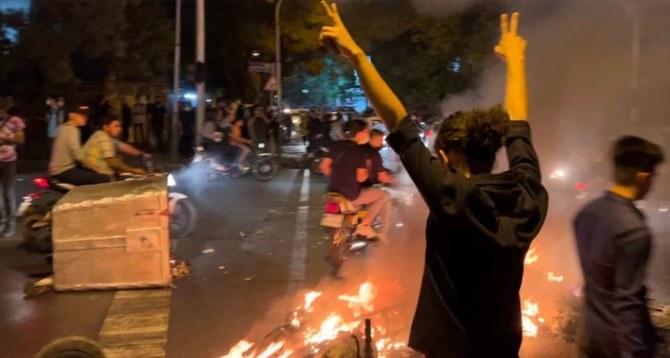
The man traveled to Tehran in October last year to visit family, but soon joined growing anti-government street protests that followed the death of 22-year-old Mahsa Amini.
He was fired at in a protest at the end of October after attempting to help a teenage girl who was being assaulted by local security officers.
The man said that after he realized he was unable to help the girl, he began to walk away. But a plainclothes officer then hit him with a baton, and he was left lying on the ground while slipping out of consciousness.
It was then that the man saw at least two police officers firing at him with shotguns.
Shotgun pellets caused severe wounds across the man’s body, but he decided to avoid checking in to a local hospital out of fear of being arrested by authorities.
After his initial wounds were treated by local protesters using torn-up clothing as bandages, he was taken by taxi to a family home, where a team of colleagues performed life-saving surgery.
The man said: “I nearly died in the process of treatment and had multiple complications such as (with my) ileum, blood clots or low (blood oxygen) saturation, as well as fractures to my ribs.
“I only survived because fearless people helped me on the scene and brave doctors in Iran took extreme risks for my survival.”
The makeshift team managed to remove several pellets, and a further two were removed after the man returned to the UK.
However, five pellets remain deeply lodged in his body, and could cause significant nerve damage if removed.
The man has been left unable to work as a result of his injuries.
He said: “I would regard this treatment of an unarmed and nonviolent protester such as myself as equivalent to a war crime,” he said.
“My treatment was really extreme and my best guess is that I am not the only person who has been hit like that, but maybe not every one was lucky enough to survive to report how they have been treated.”
Richard Kuper, an orthopedic consultant who examined the man’s injuries after his return to the UK, said: “It does appear that he was assaulted in a way that (shows) the Iranian security services clearly were trying to end his life.
“It seems they nearly succeeded, and if it had not been for the management received by a friend he may well not be here today.”


![]()

UK Iranian health worker suffers near-fatal shotgun injury in Tehran protests
Short Url
https://arab.news/6bvee
UK Iranian health worker suffers near-fatal shotgun injury in Tehran protests
- Man left with five pellets lodged in body after officers ‘clearly try to end his life’
- ‘I only survived because fearless people helped me and brave doctors took extreme risks for my survival,’ The Guardian told


Latest updates


© 2026 SAUDI RESEARCH & PUBLISHING COMPANY, All Rights Reserved And subject to Terms of Use Agreement.