

Iran announces jail terms of up to 10 years to intimidate protesters

1 / 2
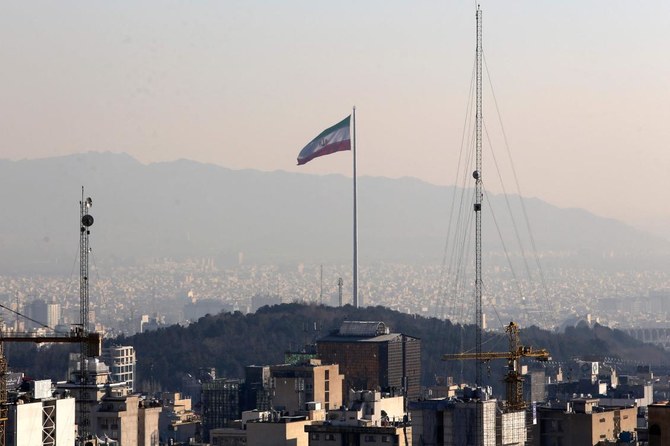
A general view shows the Iranian capital Tehran on January 7, 2023, with the Iranian flag waving in the wind. (AFP)
2 / 2
Pedestrians walk on a sidewalk in front of a mural showing the late Iranian revolutionary founder Ayatollah Khomeini, right, Supreme Leader Ayatollah Ali Khamenei, left, and Basij paramilitary force, at Enqelab-e-Eslami (Islamic Revolution) street, in downtown Tehran, Iran, Saturday, Jan. 7, 2023. (AP)
Short Url
Updated 09 January 2023
Follow

Iran announces jail terms of up to 10 years to intimidate protesters

  • Regime divided on response to months of popular unrest, say analysts
  • “The conflicting messages we are getting from the Iranian regime suggest an internal debate”

TEHRAN: Iran’s judiciary announced on Sunday four people had been jailed for up to 10 years for calling for strikes in support of ongoing nationwide protests against the regime.

It is the first time the judiciary has announced prison sentences for such an act during demonstrations triggered by the death of Mahsa Amini at the hands of the morality police in September. Activists used social media early last month to call for a three-day nationwide strike in support of the protesters. 

The judiciary’s Mizan Online news website said that the four defendants had been jailed for between one and 10 years. They were not identified and may still appeal.

Mojtaba Ghahramani, head of the judiciary for Iran’s southern province of Hormozgan, told Mizan that the four were sentenced principally “for having incited drivers to strike,” and for vandalism.


Demonstrators take part in a rally in London on Sunday to protest against the Iranian regime. Massive protests began in September after the death of Mahsa Amini at the hands of morality police. (AFP)

“None of the defendants is a driver or has anything to do with the transport sector,” he said. “One was sentenced to 10 years’ imprisonment and another to five years for forming a group with the aim of disrupting national security,” Ghahramani said.

Two others were jailed for a year and fined for “disturbing public order and destroying truck windows,” he said.

On Dec. 5 local media reported that authorities sealed a jewelry shop and restaurant in Tehran belonging to footballer Ali Daei, after he backed the protesters’ strike calls.

Four men, including two on Saturday, have been executed for killing and wounding security force members in connection with the protests.

The protests began in September after Amini, 22, died after being arrested in Tehran for violating the country’s strict dress code. They have since spread across Iran to become one of the greatest threats to the regime since the revolution.

Analysts say that Iran’s leaders are divided on their response, shifting between repression and what they believe to be conciliatory gestures to try to quell dissent.

“The conflicting messages we are getting from the Iranian regime suggest an internal debate on how to deal with ongoing protests,” said Nader Hashemi, director of the Center for Middle East Studies at the University of Denver.

“In most authoritarian regimes, there are hawks and doves” who disagree on how repressive the state should be during crises, he said.

Afshin Shahi, associate professor in Middle Eastern studies at Keele University in the UK, said the regime “doesn’t seem to have a clear strategy” in response to public anger.


More than 80 countries condemn new Israeli rules in West Bank, invoke the ‘New York Declaration’

Updated 6 sec ago
Follow

More than 80 countries condemn new Israeli rules in West Bank, invoke the ‘New York Declaration’

  • Surrounded by nations’ representatives, Palestinian envoy Riyad Mansour reads statement at UN HQ denouncing the measures as ‘contrary to Israel’s obligations under international law’
  • Critics say the steps — including expansion of Israeli settlements, legalization of outposts, direct land purchases by settlers, removal of oversight — amount to de facto annexation

NEW YORK CITY: More than 80 countries and several international organizations on Tuesday condemned what they described as unilateral decisions and measures taken by Israeli authorities with the aim of expanding their “unlawful” presence in the occupied West Bank.
Surrounded by more than 80 representatives of the nations and groups, Riyad Mansour, the permanent observer of the State of Palestine to the UN, read a joint statement in which they said: “Such decisions are contrary to Israel’s obligations under international law and must be immediately reversed.”
Israel this month approved significant new measures that tighten its control of the occupied West Bank, focusing in particular on accelerating the process of registering land in a part of the territory known as Area C as “state property.”
The new steps, which critics say amount to de facto annexation, include the legalization of outposts, expansion of Israeli settlements, authorization for direct land purchases by settlers, and the removal of oversight on such transactions.
In their statement, the countries and organizations stressed their “strong opposition to any form of annexation.”
They continued: “We reiterate our rejection of all measures aimed at altering the demographic composition, character and status of the Palestinian territory occupied since 1967, including East Jerusalem.
“Such measures violate international law, undermine the ongoing efforts for peace and stability in the region, run counter to the comprehensive plan, and jeopardize the prospect of reaching a peace agreement ending the conflict.”
They reaffirmed their determination “to take concrete measures in accordance with international law, and in line with the relevant UN resolutions and the July 19 advisory opinion of the International Court of Justice, to help realize the right of the Palestinian people to self-determination, and to counter the illegal settlement policy in the occupied Palestinian territory, including East Jerusalem, and policies and threats of forcible displacement.”
This stance is reflected, they said, in the 2025 New York Declaration, a UN-endorsed initiative proposed, following a conference in July 2025, by France and Saudi Arabia with the aim of reviving efforts to achieve a two-state solution to the conflict between Israel and Palestine.
“We reiterate that a just and lasting peace on the basis of the relevant UN resolutions, the Madrid terms of reference, including the principle of land for peace, and the Arab Peace Initiative, ending the Israeli occupation that began in 1967 and implementing the two-state solution — where two democratic states, an independent and sovereign Palestine and Israel, live side by side in peace and security within their secure and recognized borders on the basis of the 1967 lines, including with regard to Jerusalem — remains the only path to ensure security and stability in the region,” they added.