



RAMALLAH: Palestinians have denounced a draft Israeli law to execute Palestinians found guilty of terrorism, which passed its first stage in the Israeli Knesset this week.
The legislation, proposed by Internal Security Minister and leader of the extremist Jewish Power party Itamar Ben-Gvir, cleared its preliminary reading on Wednesday and is expected to pass the second and third stages to become law.
Palestinians consider it steeped in racism, while some members of Israel’s security services have warned that the law would motivate rather than deter more attacks on Israelis.
It has already faced opposition from Israeli human rights institutions and calls for the country’s supreme court to strike it down as inconsistent with international and humanitarian laws.
Qadura Faris, the president of the Palestinian Prisoners Club, told Arab News that a specific death penalty would serve no purpose other than to expose Israel as a “backward, fascist, apartheid state, living in the past.”
“This law only targets Palestinians. This is a new confirmation that there are two laws in the same geographical area: one for the Israelis and the other for the Palestinians. This is racism,” he said.
He added that the death penalty would “not add to our worries … we are extrajudicially killed daily without reason … [Israel] carries out extensive executions against Palestinians daily outside the law.
“We know that Ben-Gvir’s insistence on proposing this law comes within the framework of a process of blackmail.”
Rawhi Fattouh, the head of the Palestinian National Council, agreed, saying: “Israel does not need laws to carry out field executions against our people as it practices it daily and with false pretexts.”
Israel currently uses a life sentence equivalent to 99 years of imprisonment against Palestinians who kill Israelis. There are more than 550 inmates in Israeli prisons sentenced under this law.
Yousef Jabarin, a lecturer and former member of the Israeli parliament, told Arab News that the law was a result of fierce competition between extreme right-wing Israeli politicians to look the most draconian.
Jabarin said that even if the law was passed, there was a possibility that the supreme court would refuse it.
Maj. Gen. Qadri Abu Bakr, head of the commission for detainees and ex-prisoners affairs, said that Palestinian activists did not fear execution and that “Israel would pay the price for approving the law.”
The Palestinian Foreign Ministry has called on the US to arrest David Ben-Zion, the deputy head of the Settlement Council in the occupied West Bank who is currently in the US.
The ministry said that Ben-Zion called on Israeli settlers to attack Hawara town in the days before hundreds went on the rampage earlier this week.
It said an arrest would be far more significant than asking Prime Minister Benjamin Netanyahu to apologize for his minister’s “disgusting” comments.
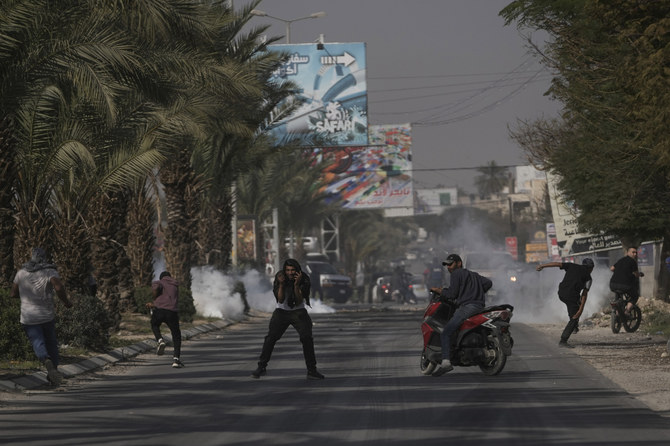
Meanwhile, a comprehensive strike took place in Jericho and the Jordan Valley in protest at the killing of Mahmoud Hamdan, 22, who died during the Israeli army’s incursion into the Aqbat Jabr camp on Tuesday.
Israeli troops and settlers have killed 67 Palestinians since the beginning of the year, including 13 children, and four elderly.


