Israel cracks down on rampaging settlers but Palestinians say it is ‘not enough’

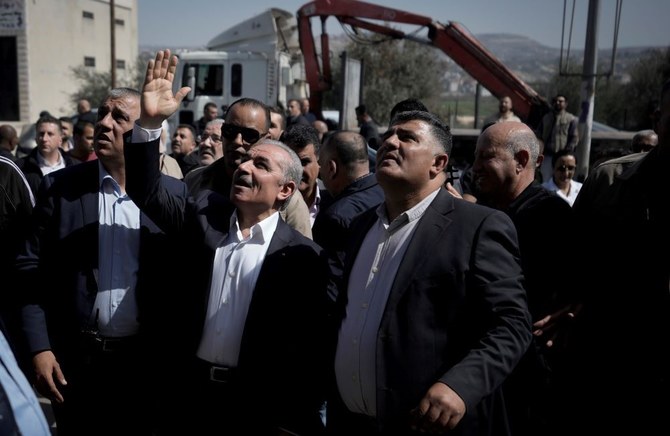
Palestinian PM Mohammad Shtayyeh surveys the damage after a rampage by settlers in Huwara, near the West Bank city of Nablus, Wednesday, March 1, 2023. (AP Photo)
Short Url
Updated 02 March 2023
Follow

Israel cracks down on rampaging settlers but Palestinians say it is ‘not enough’

  • Palestinian PM Mohammad Shtayyeh sees "an organized crime perpetrated by the Israeli government and carried out by the settlers’
  • Israeli general denounced the settler riots as a pogrom 'carried out by outlaws'

RAMALLAH: Israeli police finally arrested 10 people on Wednesday in connection with a deadly rampage by settlers through a Palestinian town in the occupied West Bank.

The arrests came after three days of inaction following Monday’s incident in Hawara, when one Palestinian died as hundreds of settlers torched cars and homes, and amid unprecedented criticism by the senior Israeli military chief in the area.

Maj. Gen. Yehuda Fuchs, head of the Israeli army’s Central Command, said his forces had prepared for the possibility of a settler attack but had been surprised by the intensity of the violence.

Fuchs said the rampage was a “shameful” incident carried out by lawbreakers who “acted not according to the values I grew up with or the values of the state of Israel, and not according to the values of Judaism.”
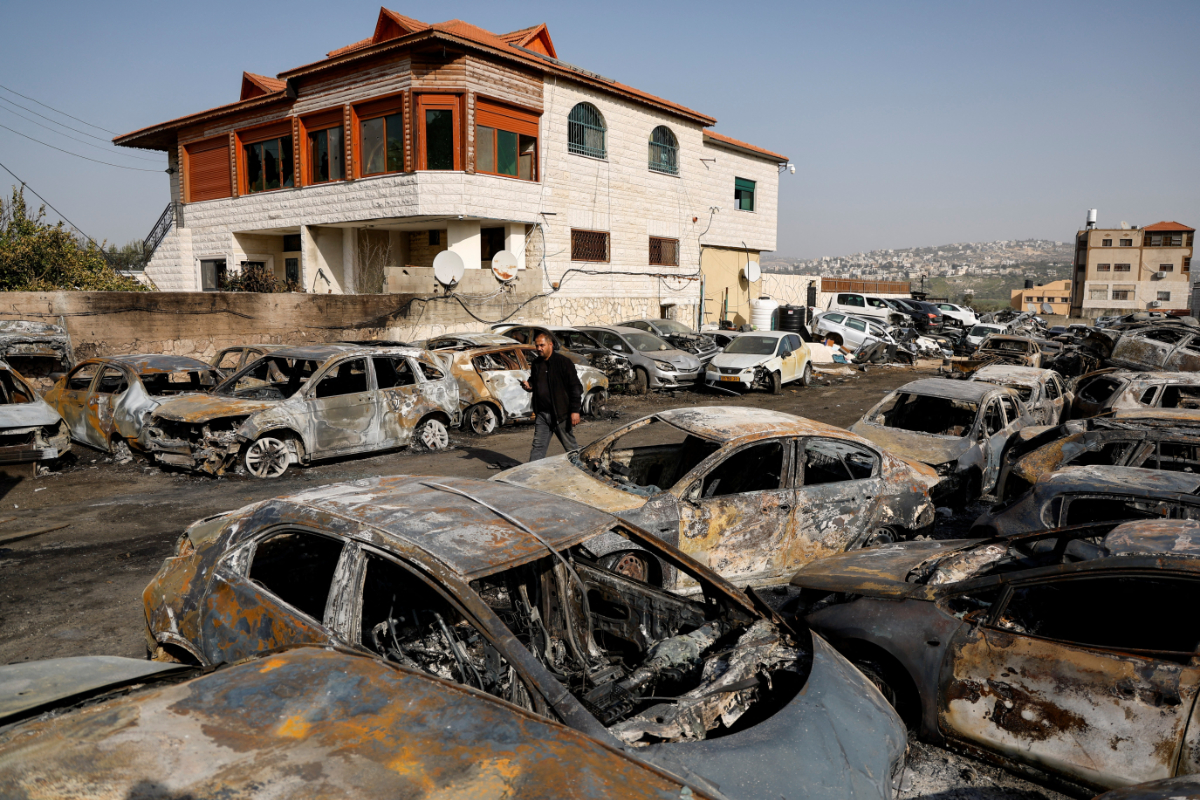


A view of cars burnt in an attack by Israeli settlers, following an incident where a Palestinian gunman killed two Israeli settlers, near Hawara in the Israeli-occupied West Bank on Feb. 27, 2023. (Reuters)

“The incident in Hawara was a pogrom carried out by outlaws,” he said. “We were not prepared for a pogrom of this magnitude, with many dozens of people.” 

Pogrom is a word that describes an organized act of mass violence targeting a particular ethnic or religious group. The term had been used to refer to ethnic mob attacks against Jews in eastern Europe in the 19th and early 20th centuries.

Fuchs said: “We are currently in a period without security coordination with the Palestinian Authority. We will see what happens in the coming days.”

Shops in Hawara remained closed on Wednesday, by order of the army, amid a heavy Israeli military presence.

On a visit to the town, Palestinian Prime Minister Mohammed Shtayyeh said the arrests were not enough. “We see an organized crime perpetrated by the Israeli government and carried out by the settlers,” he said.


ALSO READ: Why West Bank violence between Israelis and Palestinians rages on despite US mediation


Hawara’s mayor, Mueen Al-Dumaidi, told Arab News that Shtayyeh had visited to take stock of the situation and assess the damage. People who lost property in the settler attacks are demanding compensation from the Palestinian Authority, including new homes. Shtayyeh has formed a committee to assess the losses and promised the government would help people to the full extent of its capabilities.

“There are 52 families whose homes were completely burned down, 40 cars were torched, in addition to the destruction of the municipality’s property, two trucks and a bulldozer,” Al-Dumaidi said.

He said the Israeli army had divided the town into five security zones and banned residents from moving between them. Troops were deployed on rooftops along the main street to prevent clashes between Palestinians and settlers.

Opinion

This section contains relevant reference points, placed in (Opinion field)

People were gripped by fear and panic, Al-Dumaidi said, and settlers had tried to attack a house on Wednesday. “Now, after the world has condemned the Israeli army’s failure to prevent settlers from attacking the Palestinians, the Israelis admit their mistake,” he said.

He described the situation in Huwara as “terrible,” saying the Israeli army has divided it into five security zones and forbidden residents from moving between them. Troops are deployed on rooftops along the main street through the town to prevent any friction or clashes between residents and settlers.

Palestinians have formed protection committees in Huwara who stay awake all night to protect homes and town property from further attacks. Al-Dumaidi said the job of committee members is to warn residents of any attack, not to engage in a fight.

Meanwhile, Palestinian and Israeli sources have expressed fears that violence will again flare in the West Bank before the start of the holy month of Ramadan, which begins in about three weeks.
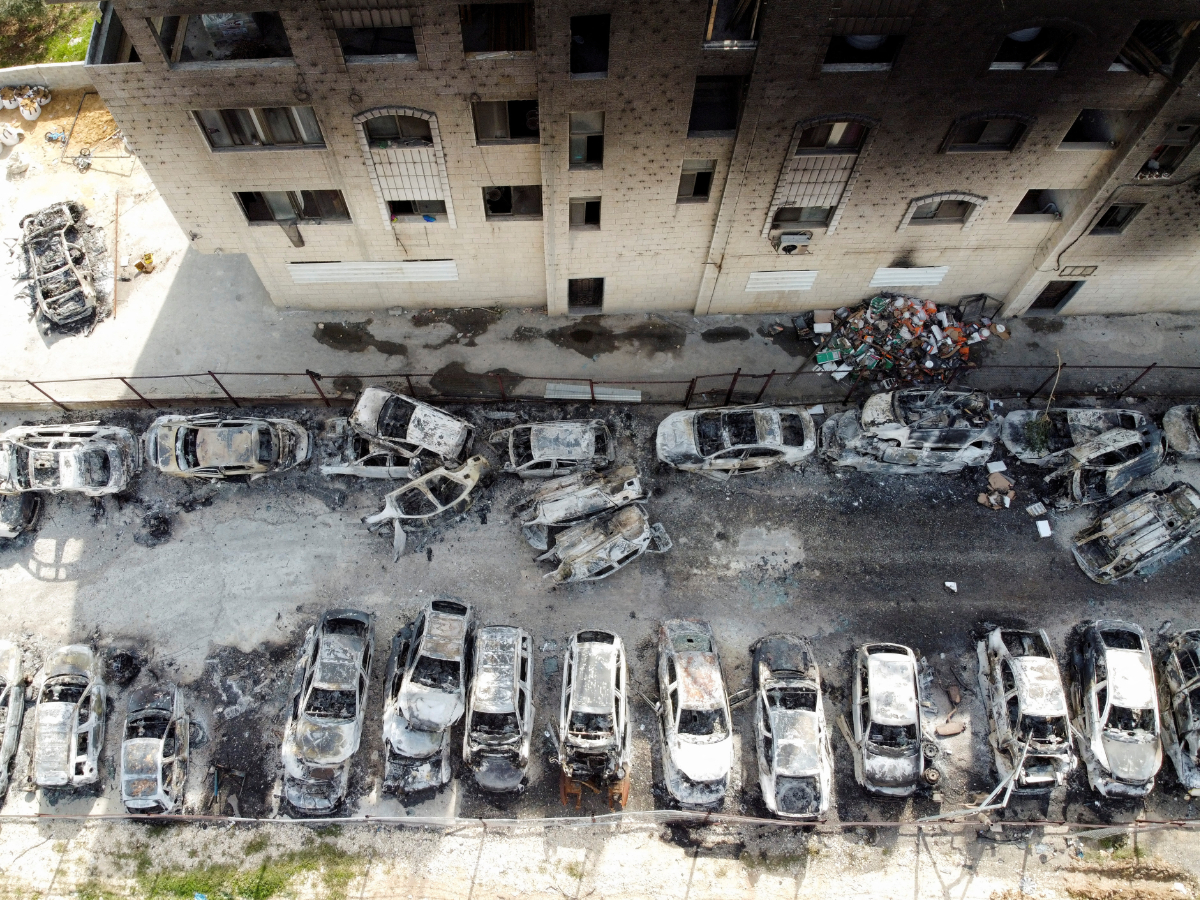


An aerial view shows a building and cars burnt in an attack by Israeli settlers near the Palestinian town of Hawara in the Israeli-occupied West Bank on Feb. 27, 2023. (REUTERS)

Amer Hamdan, a human rights activist from Nablus, told Arab News that he has noticed an apparent change in the behavior of the Israeli army toward Palestinians since the new right-wing Israeli government came to power in late December. The soldiers, he said, tolerate attacks by settlers against the Palestinians.

“If the army had the intention to act, it would move quickly and deal firmly with the settlers before they could carry out their arson attacks,” he added.

Hamdan said he has avoided traveling to Ramallah since the latest settler attacks for fear of being targeted by settlers, or soldiers at the military checkpoints that are dotted along the road.

“I do not want to be the next martyr,” he added.

In another development, Israeli forces raided the Humsa Bedouin community in Tubas Governorate in the northern Jordan Valley and demolished homes, according to Moataz Bisharat, who is in charge of the area.

Hussein Al-Shaikh, the Palestine Liberation Organization’s executive committee chief, said draft legislation on the death penalty for Palestinian prisoners found guilty of terrorism, which is passing through the Israeli Knesset, reflects an approach steeped in “racism and colonial thought.” The government-backed law passed its preliminary reading in the Israeli parliament on Wednesday.

Al-Shaikh said the party that should be tried for its crimes is the occupation, not the people suffering under the occupiers and their oppression.

Public Security Minister Itamar Ben-Gvir’s ultranationalist Jewish Power faction has promoted the death sentence bill as a means of deterring would-be Palestinian attackers after a more than year-long surge in violence that shows no signs of abating.

Critics say the death penalty is immoral, antithetical to Jewish principles, and will not serve as a deterrent.

The proposed law would allow the death penalty for a person who killed an Israeli “as an act motivated by racism or hostility toward the public” and “with the aim of harming the state of Israel and the revival of the Jewish people in its land.”

Limor Son Har-Melech, the ultranationalist settler lawmaker proposing the bill, told Kan public radio that “it is just and most moral that someone who murders Jews, and just because they’re Jews” is sentenced to death.

The bill passed by a vote of 55-9 in a preliminary reading. Most of the opposition, along with some of Netanyahu’s ultra-Orthodox allies, were not present for the vote.

(With AP)

Decoder

Pogrom

It is a word that describes an organized act of mass violence targeting a particular ethnic or religious group. The term had been used to refer to ethnic mob attacks against Jews in eastern Europe in the 19th and early 20th centuries. On March 1, 2023, Maj. Gen. Yehuda Fuchs, head of the Israeli army’s Central Command, described the Feb. 28, 2023, rampage by Jewish settlers in the Palestinian town of Hawara as a "pogrom carried out by outlaws."


How a perfect storm of crises pushed Iran into acute, nationwide water scarcity

Updated 10 sec ago
Follow

How a perfect storm of crises pushed Iran into acute, nationwide water scarcity

  • Experts warn Iran faces “water bankruptcy” after decades of drought, heavy overuse, and mismanagement
  • Areas may become uninhabitable, displacing millions and creating cascading social, economic and security pressures

LONDON: During the summer, Israeli Prime Minister Benjamin Netanyahu addressed Iranians directly in a video on social media, promising that Israeli water technology would reach the country “once the regime is deposed.”

The appeal echoed a similar message made during the June 12-day war, drawing a sharp rebuke from Iran’s President Masoud Pezeshkian, who dismissed the offer as “an illusion.”

The unusual appeal nevertheless highlights a stark reality that the Iranian state and its citizens are now struggling to confront: a spiraling water crisis that shows no sign of easing, driven by years of drought, crumbling infrastructure, and chronic mismanagement.

Lake Urmia, once Iran’s largest lake and the Middle East’s biggest saltwater body, has almost completely dried up, with satellite images showing the 4,000-year-old “turquoise jewel” turned into a vast salt plain, fuelling salt storms, ecosystem collapse and serious public health risks.

This picture taken on December 8, 2018 shows a general view of recreational boats along the shore of the salt lake of Urmia and Shahid Kalantari causeway crossing it, in the northwest of Iran which had been shrinking in one of the worst ecological disasters of the past 25 years. (AFP)

Yet the most potent symbol of the emergency is now Tehran, where dam reserves have plunged so low that in early November Pezeshkian warned the capital’s 15 million residents could face rationing and even evacuation if rains failed to arrive by late November.

“Iran has been suffering from a chronic water problem, what we call water bankruptcy, for a number of years, and the symptoms of that have appeared in different parts of the world,” Kaveh Madani, director of the UNU Institute for Water, Environment and Health, told Arab News.

“However, this is the first time the capital and metropolis of more than 15 million people is facing this issue. This is the richest city, the most influential in terms of politics, being impacted. And that shows how serious the problem is.”

Rural areas and farmland have long been on the front line, but amid the worst drought in six decades, exceptionally low rainfall is now hitting cities as well.

Despite 3-4 millimeters of rain in early December, Tehran province remains around 97 percent below normal levels for this time of year.

ERA5 data analysed by Dr. Mojtaba Sadegh of Boise State University shows autumn precipitation this year at just 13.9 millimeters, compared with a historical peak of 257.6 millimeters in 1994, while many major reservoirs have fallen to single-digit capacity.

But today’s crisis is neither a sudden twist of fate nor confined to Tehran; it is the predictable outcome of what experts have long warned is “water bankruptcy” after decades of withdrawing more water than nature can replenish and draining strategic aquifers.

Madani described a “failing state being driven by human decisions, decades of poor management, lack of foresight, and overreliance on engineering solutions that were only seeking increasing water supply, like building more dams or transferring water from one location to another.

“The moment you increase supply, then demand increases would follow because growth is further encouraged, and then the problem keeps coming back. That’s a typical fix that backfires,” he added.

In May, during his visit to Saudi Arabia, US President Donald Trump criticized Iran’s “corrupt water mafia” for engineering droughts and emptying riverbeds — a charge many Iranians saw not as a revelation but an overdue validation of what activists and experts have long warned.

Pezeshkian recently conceded that “past mistakes” have left Iran with shrinking options, while Isa Kalantari, former vice president and head of the Department of Environment, warned that the drought poses “a more dangerous threat to Iran than Israel.”

Independent Iran scholar Alireza Nader told Arab News: “I would describe it as a man-made disaster. Because, yes, Iran is an arid country, and there is drought, but the government in Iran had decades to prepare for this eventuality, which it actually created.”

Nader explained that “as long as you have this closed economic system, where the state makes the decisions and the state exploits Iran’s natural and mineral resources to empower itself, you’re going to have this sort of ‘water mafia’ that relies on construction to make money,” something he described as a dangerous “self-perpetuating system.”

Opaque contracts and weak oversight have fueled the problem.

Since the 1979 revolution, and especially during the reconstruction drive that followed the Iran-Iraq war of 1980-88, the country has built roughly 600 dams of various sizes, up from only about 20-30 modern dams before 1979.

This boom — averaging about 20 new dams a year over several decades — has turned Iran into one of the world’s most aggressive dam‑building states.

Framed as a way to meet rising water demand, it also enriched a small circle of firms and insiders, including Khatam Al‑Anbiya, the construction arm of the Islamic Revolutionary Guard Corps, which critics accuse of siphoning off billions in public funds through dam and inter‑basin transfer projects, deepening what many now call “water corruption.”

Combined with reckless agricultural expansion, these policies have devastated ecosystems, worsened shortages and uprooted communities across Iran, particularly in areas like Balochistan, one of the country’s poorest regions, where 62 percent of the population lacks access to safe drinking water.

Desperate farmers have resorted to over‑pumping groundwater, often illegally, draining aquifers and causing the land to sink, a largely irreversible process known as land subsidence.

“This is an issue of water governance,” said Nader. “This is not a political system that can take care of the people and can take care of the environment, and the last 46 years have shown that it is a system that has caused this problem. Iran is literally sinking because of the water disaster. The ground is subsiding.”

A University of Leeds study has identified 106 subsiding regions spanning 12,120 square miles — around 2 percent of Iran. In Tehran and surrounding areas, where aquifers have been pushed to their limits, the ground is sinking by up to 31 centimeters a year — enough to wreck infrastructure and prompt talk of eventual evacuation.

“If we assume that they’re going to move, where are they going to move?” asked Madani. 

Drinking water can still be provided through tankers and other means, such as redirecting water from resource-intensive activities such as agriculture.

Indeed, agriculture is a key culprit. Iran is one of the Middle East’s leading producers of wheat, pistachios, watermelons and cucumbers, all highly water‑intensive crops. In 2025, the sector accounted for more than 90 percent of all water allocation.

“The country can produce more strategic food with less water and less land area, provided that it can find alternative opportunities for the farmers,” said Madani, himself a former deputy head of Iran’s Department of Environment.

While oil still brings in the most revenue, agriculture is a core economic and strategic sector, employing about 14.8 percent of the workforce.

Yet despite the environmental damage it causes, the government plans to increase agricultural exports by 20-25 percent to prop up an economy strained by international sanctions — measures that have themselves worsened the water crisis.

“Foreign companies and individuals can’t invest in improving Iran’s water governance,” said Nader. “What the sanctions also do is choke off Iran from expertise and technology that is necessary to fix this environmental issue.”

He argued there is no quick fix, but that repairing leaking pipes, especially in Tehran, would be a crucial first step. Citizens, he added, can also act individually and collectively to confront a crisis that is now “existential.”

If large areas become uninhabitable, Nader warned, millions of Iranians could be forced to leave, leading to what he called “the collapse of Iran as a civilization” and, eventually, of the regime itself.

The impact, he added, does not stop at Iran’s borders but affects the “entire Middle East” and could reach “Europe and America much more quickly than we realize.”

Madani, however, sketched a less apocalyptic future. To tackle “water bankruptcy,” he argued, Iran must pursue politically painful reforms, above all decoupling its economy from water by creating jobs for farmers in other sectors — a difficult task while the state remains in “resistance mode” under sanctions.

He noted that although climate stress and migration can fuel tensions and security risks, the link is complex and shaped by many other factors, making precise forecasts speculative.

“We don’t know how wet or dry this year would be, and whether there would be some relief, but whatever it is, it’s not going to address the human-made policy-related problems,” said Madani.

What is certain, he added, is that a “quick evacuation is not possible.” Instead, authorities might rely on temporary measures already used for pollution or power crises — extending weekends, closing schools and offices, and encouraging people to leave the city for short periods to ease pressure on the system.

“If you only have a few days or a few weeks of water left, that’s a practice that can function and can be helpful.”