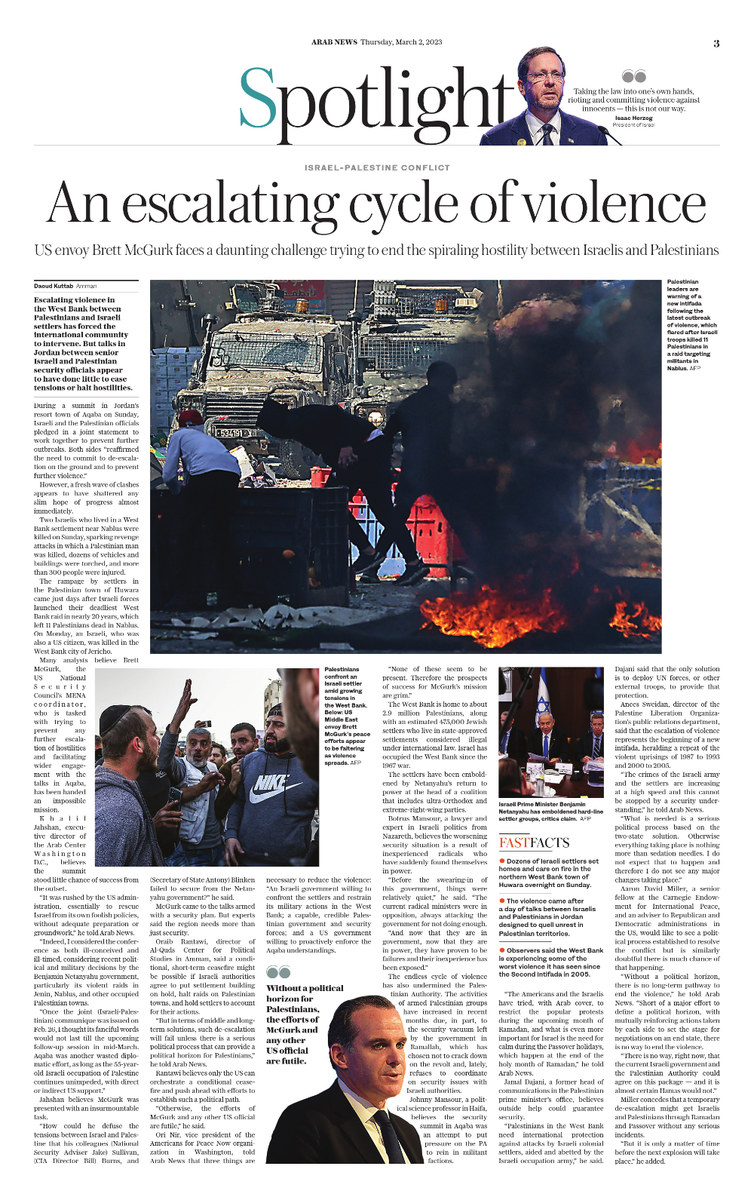

AMMAN: Persistent clashes in the West Bank between Palestinians and Israeli settlers have forced the international community to intervene. But talks in Jordan between senior Israeli and Palestinian security officials appear to have done little to ease tensions or halt hostilities.
During a summit in Jordan’s resort town of Aqaba on Sunday, Israeli and the Palestinian officials pledged in a joint statement to work together to prevent further outbreaks. Both sides “reaffirmed the need to commit to de-escalation on the ground and to prevent further violence.”
However, a fresh wave of clashes appears to have shattered any slim hope of progress almost immediately.
Two Israelis who lived in a West Bank settlement near Nablus were killed on Sunday, sparking revenge attacks in which a Palestinian man was killed, dozens of vehicles and buildings were torched, and more than 300 people were injured.
The rampage by settlers in the Palestinian town of Huwara came just days after Israeli forces launched their deadliest West Bank raid in nearly 20 years, which left 11 Palestinians dead in Nablus. On Monday, an Israeli, who was also a US citizen, was killed in the West Bank city of Jericho.
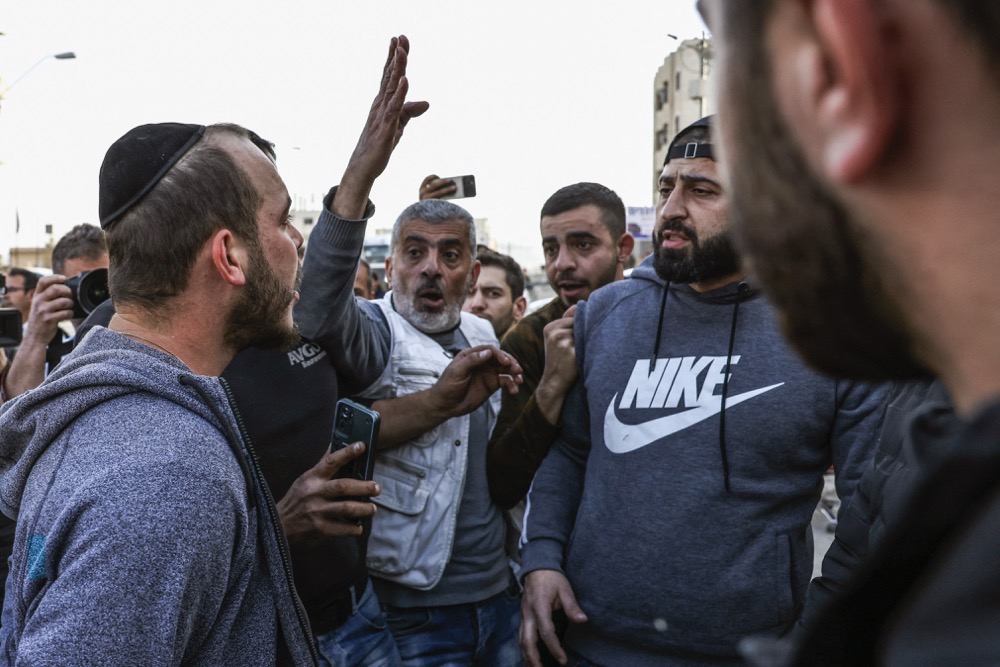
Palestinians confront an Israeli settler amid growing tensions in the West Bank. (AFP)
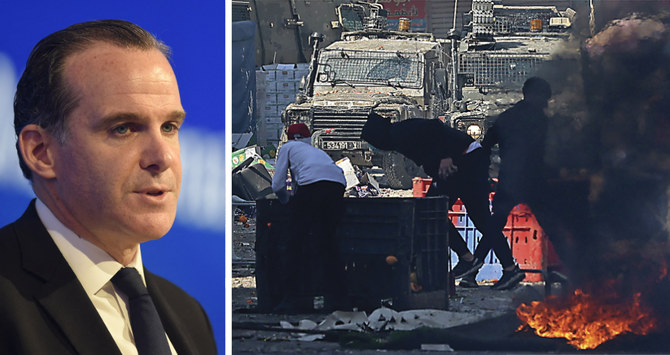
Many analysts believe Brett McGurk, the US National Security Council’s Middle East and North Africa coordinator, who is tasked with trying to prevent any further escalation of hostilities and facilitating wider engagement with the talks in Aqaba, has been handed an impossible mission.
Khalil Jahshan, executive director of the Arab Center Washington D.C., believes the summit stood little chance of success from the outset.
“It was rushed by the US administration, essentially to rescue Israel from its own foolish policies, without adequate preparation or groundwork,” he told Arab News.
“Indeed, I considered the conference as both ill-conceived and ill-timed, considering recent political and military decisions by the Benjamin Netanyahu government, particularly its violent raids in Jenin, Nablus, and other occupied Palestinian towns.
“Once the joint (Israeli-Palestinian) communique was issued on Feb. 26, I thought its fanciful words would not last till the upcoming follow-up session in mid-March. Aqaba was another wasted diplomatic effort, as long as the 55-year-old Israeli occupation of Palestine continues unimpeded, with direct or indirect US support.”
Jahshan believes McGurk was presented with an insurmountable task.
“How could he defuse the tensions between Israel and Palestine that his colleagues (National Security Adviser Jake) Sullivan, (CIA Director Bill) Burns, and (Secretary of State Antony) Blinken failed to secure from the Netanyahu government?” he said.
McGurk came to the talks armed with a security plan. But experts said the region needs more than just security.
Oraib Rantawi, director of Al-Quds Center for Political Studies in Amman, said a conditional, short-term ceasefire might be possible if Israeli authorities agree to put settlement building on hold, halt raids on Palestinian towns, and hold settlers to account for their actions.
“But in terms of middle and long-term solutions, such de-escalation will fail unless there is a serious political process that can provide a political horizon for Palestinians,” he told Arab News.
Rantawi believes only the US can orchestrate a conditional ceasefire and push ahead with efforts to establish such a political path.
“Otherwise, the efforts of McGurk and any other US official are futile,” he said.
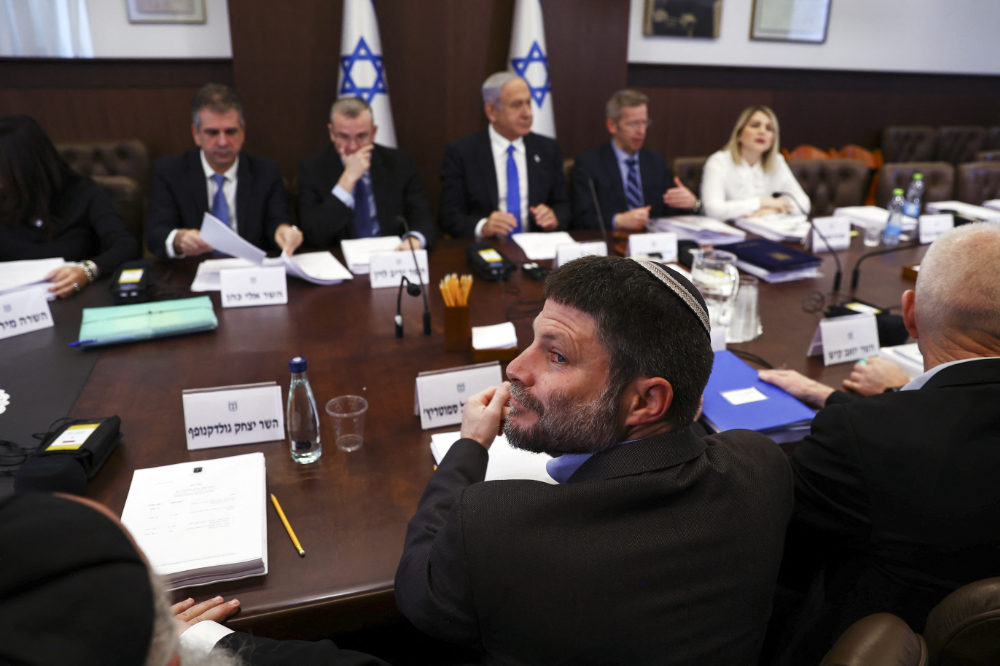
Israeli Prime Minister Benjamin Netanyahu has emboldened hard-line settler groups, critics claim. (AFP)
Ori Nir, vice president of the Americans for Peace Now organization in Washington, told Arab News that three things are necessary to reduce the violence: “An Israeli government willing to confront the settlers and restrain its military actions in the West Bank; a capable, credible Palestinian government and security forces; and a US government willing to proactively enforce the Aqaba understandings.
“None of these seem to be present. Therefore the prospects of success for McGurk’s mission are grim.”
The West Bank is home to about 2.9 million Palestinians, along with an estimated 475,000 Jewish settlers who live in state-approved settlements considered illegal under international law. Israel has occupied the West Bank since the 1967 war.
The settlers have been emboldened by Netanyahu’s return to power at the head of a coalition that includes ultra-Orthodox and extreme-right-wing parties.
Botrus Mansour, a lawyer and expert in Israeli politics from Nazareth, believes the worsening security situation is a result of inexperienced radicals who have suddenly found themselves in power.
“Before the swearing-in of this government, things were relatively quiet,” he said. “The current radical ministers were in opposition, always attacking the government for not doing enough.
“And now that they are in government, now that they are in power, they have proven to be failures and their inexperience has been exposed.”
Johnny Mansour, a political science professor in Haifa, told Arab News a lot of work is needed to restore a state of relative stability.
“What is needed for quiet to return is a decision for a total cessation of both Israelis’ aggressive actions on the ground, and the verbal violence spoken by radical Israeli ministers,” he said.
FASTFACTS
• Dozens of Israeli settlers set homes and cars on fire in the northern West Bank town of Huwara overnight on Sunday.
• The violence came after a day of talks between Israelis and Palestinian in Jordan designed to quell unrest in Palestinian territories.
• Observers said the West Bank is experiencing some of the worst violence it has seen since the Second Intifada in 2005.
“What is needed is to give people hope but this is far away now. Palestinians are not only under occupation, they are being humiliated so they have little to lose by revolting.”
Hani Masri, director of the Masarat think tank in Ramallah, believes the key to reducing violence lies in halting all settlement-expansion activity, not changing the status quo in Al-Aqsa, stopping punitive demolitions of Palestinian houses, and preventing the creeping annexation of Palestinian land.
“We know that this will be rejected by Israel, and therefore there is no escaping a confrontation with this Kahanist (Zionist extremist) government that is seeking to annex, Judaize, and force people out,” he told Arab News.
Zaha Hassan, a human rights lawyer and a fellow of the Middle East Program at the Carnegie Endowment for International Peace, told Arab News that much of the violence is driven by Israeli authorities and their raids on Palestinian towns and refugee camps.
“For the current violence to decrease, the Israelis need to believe that there are costly repercussions,” she said.
“The US has many policy tools it could deploy. It has to make Israel believe it will use them. Instead, the Biden administration has done the opposite. Even a UN Security Council resolution condemning settlements is fought by the US, tooth and nail.”
The endless cycle of violence has also undermined the Palestinian Authority. The activities of armed Palestinian groups have increased in recent months due, in part, to the security vacuum left by the government in Ramallah, which has chosen not to crack down on the revolt and, lately, refuses to coordinate on security issues with Israeli authorities.
Johnny Mansour believes the security summit in Aqaba was an attempt to put pressure on the Palestinian Authority to rein in militant factions.
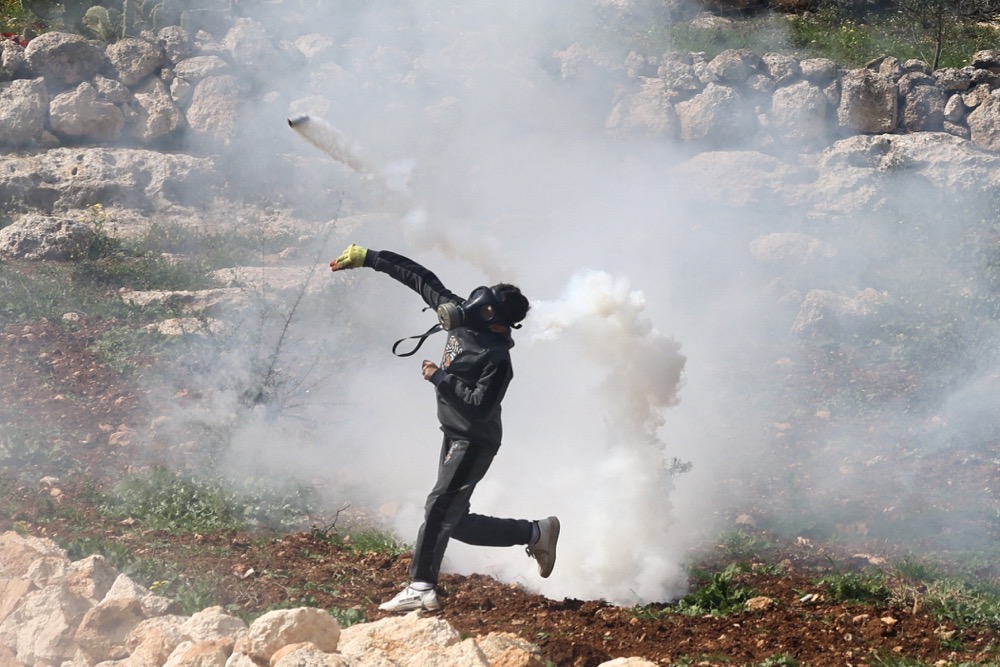
A fresh wave of clashes appears to have shattered any slim hope of progress. (AFP)
“The Americans and the Israelis have tried, with Arab cover, to restrict the popular protests during the upcoming month of Ramadan, and what is even more important for Israel is the need for calm during the Passover holidays, which happen at the end of the holy month of Ramadan,” he said.
Some analysts point out that there are many tools other than violent resistance that the Palestinians could utilize to strengthen their position, especially in terms of engagement with the international community.
Mohammad Zahaika, a political activist in the Sawahreh neighborhood of East Jerusalem, supports a nonviolent response.
“What is needed is a popular, nonviolent protest that can lead up to civil disobedience,” he told Arab News. “People here in East Jerusalem realize that they need to find ways to neutralize the powerful Israeli war machine and widen the gulf that is already going on in Israel.”
He believes Ramadan, which will begin toward the end of March, could be the perfect time for popular protests that might challenge right-wing Israelis who, he says, have no interest in a peaceful resolution. He concedes, however, that much of the Palestinian public supports a strategy of armed resistance.
“What we need is for external forces to be involved and even to provide protection and intervention to the Palestinian population. Only this way can the extremists be deterred,” Zahaika added.
Rifaat Kassis, an elected member of the city council in Beit Sahour, agrees that Ramadan would be a good opportunity to promote unity.
“The Palestinian Authority is in a difficult situation, whether things escalate or calm down,” he told Arab News. “What is needed is for a popular movement to be launched that attempts to unify Palestinians. This is a golden opportunity to unite all groups of Palestinians.”
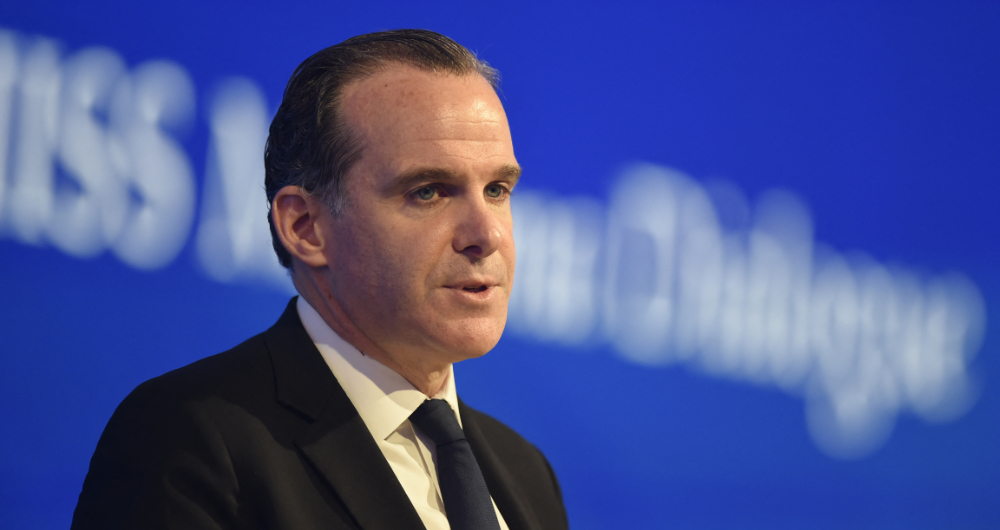
US Middle East envoy Brett McGurk’s peace efforts appear to be faltering as violence spreads. (AFP)
Jamal Dajani, a former head of communications in the Palestinian prime minister’s office, believes outside help could guarantee security.
“Palestinians in the West Bank need international protection against attacks by Israeli colonial settlers, aided and abetted by the Israeli occupation army,” he told Arab News.
He said the Palestinian Authority has failed to protect its people and so the only solution is to deploy UN forces, or other external troops, to provide that protection.
“If not, more pogroms will be committed and Palestinians will be forced to defend themselves, regardless of their affiliation, or no affiliation,” Dajani added.
The actions of Israeli authorities show they are intent on reshaping the West Bank and destroying the possibility of a viable Palestinian state, and with it any hope of lasting peace through a two-state solution, he said.
“Security discussions are about providing security to Israeli settlers and not to Palestinians,” he added.
Anees Sweidan, director of the Palestine Liberation Organization’s public relations department, said the escalation of violence represents the beginning of a new intifada, heralding a repeat of the violent uprisings of 1987 to 1993 and 2000 to 2005.
“The crimes of the Israeli army and the settlers are increasing at a high speed and this cannot be stopped by a security understanding,” he told Arab News.
“What is needed is a serious political process based on the two-state solution. Otherwise everything taking place is nothing more than sedation needles. I do not expect that to happen and therefore I do not see any major changes taking place.”
Aaron David Miller, a senior fellow at the Carnegie Endowment for International Peace, and an adviser to Republican and Democratic administrations in the US, would like to see a political process established to resolve the conflict but is similarly doubtful there is much chance of that happening.
“Without a political horizon, there is no long-term pathway to end the violence,” he told Arab News. “Short of a major effort to define a political horizon, with mutually reinforcing actions taken by each side to set the stage for negotiations on an end state, there is no way to end the violence.
“There is no way, right now, that the current Israeli government and the Palestinian Authority could agree on this package — and it is almost certain Hamas would not.”
Miller concedes that a temporary de-escalation might get Israelis and Palestinians through Ramadan and Passover without any serious incidents.
“But it is only a matter of time before the next explosion will take place,” he added.