

Pakistan warns of safety risks of strikes on Iran nuclear sites, urges diplomacy

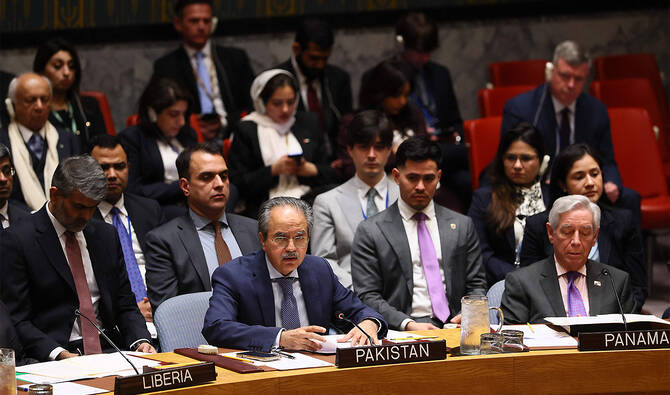
mbassador Asim Iftikhar Ahmad, Permanent Representative of Pakistan to the UN, speaks during a United Nations Security Council meeting on the situation in the Middle East at the United Nations headquarters in New York City. on March 11, 2026 (AFP)
Short Url
Updated 41 min 37 sec ago
Follow

Pakistan warns of safety risks of strikes on Iran nuclear sites, urges diplomacy

  • The development comes after reports suggested US-Israeli strikes had hit some of the nuclear sites in Iran
  • Asim Ahmad reaffirms Pakistan’s support for the resolution of the Iran nuclear issue through peaceful means

ISLAMABAD: Pakistan’s permanent representative to the United Nations (UN), Asim Iftikhar Ahmad, on Thursday warned of safety risks of possible strikes by the United States and Israel on Iranian nuclear sites, urging diplomacy to resolve the issue.

The statement followed two weeks of US-Israeli strikes on Iran that have killed top Iranian civilian and military officials and provoked counterattacks from Tehran against US interests in Gulf countries.

It came after some international media reports suggested that US-Israeli strikes, which followed months of failed negotiations over Iranian nuclear program, had hit some of the nuclear sites in Iran.

Speaking at a Security Council briefing, Ambassador Ahmad said as the ongoing situation that started with the unprovoked and unwarranted attacks on Iran have “deeply impacted the context of the Iranian nucleophile.”

“Regrettably, the breakdown of diplomacy on the Iranian nuclear issue has further complicated an already complex matter that has been on a downward slide for the last few months,” he said.

“We have condemned all use of force, targeting of civilian infrastructure, and strikes on nuclear sites under IAEA (International Atomic Energy Agency) safeguards. Strikes against nuclear facilities carry huge environmental and safety risks for the population and people all around the region.”

Ambassador Ahmad reaffirmed Pakistan’s support for the resolution of the Iran nuclear issue through peaceful means.

“Diplomacy and dialogue should be the guiding principles for achieving a negotiated settlement of all contentious issues in accordance with the rights, obligations, and responsibilities of the parties concerned,” he said.

“Only an objective, fair, and rules-based discussion can advance that objective.”


Pakistan downs drones near Kohat after Kabul accuses Islamabad of deadly airstrikes

Updated 6 sec ago
Follow

Pakistan downs drones near Kohat after Kabul accuses Islamabad of deadly airstrikes

  • The exchange marks a sharp escalation in a conflict that began last month when Islamabad launched aerial campaign inside Afghanistan
  • Pakistani official says there is just one consistent demand from the Afghan side: ‘stop supporting terrorists, harboring their leadership’

ISLAMABAD: Pakistan on Friday said it had conducted “precision strikes” against militant camps and support infrastructure inside Afghanistan, with the Taliban authorities saying the strikes had hit civilians and damaged infrastructure in capital Kabul and other border provinces. 

The latest exchange marks a sharp escalation in a conflict that began last month when Islamabad launched a sustained aerial campaign inside Afghanistan, saying it was targeting sanctuaries of the Tehreek-e-Taliban Pakistan (TTP), a militant group responsible for a surge in attacks within Pakistan. The Afghan government denies the allegations.

A Pakistani security official confirmed on Friday that the strikes were carried out last night, destroying “four key locations,” including infrastructure of a corps headquarters and an ammunition dump in Kabul, a militant training camp in Kandahar, an oil storage facility in Kandahar, and a militant camp in Paktia. 

“The message is clear: no let-up, no negotiations, and no delegation sent by Pakistan,” the official, who requested anonymity, told Arab News. “There is just one consistent demand from the Afghan Taliban regime: stop supporting terrorists and harboring terrorist leadership or face the consequences.” 

However, the Taliban government said the strikes had hit non-military targets, with Taliban spokesman Zabihullah Mujahid stating on X that the bombardment hit Kabul, Kandahar, Paktia, and Paktika provinces. 

“With the continued airstrikes and crimes, once again the Pakistani military regime has bombed Kabul, Kandahar, Paktia, Paktika, and some other areas, destroying civilian homes in some places, which martyred women and children,” Mujahid said, adding that in some instances, the strikes hit “empty deserts and vacant spots.” 

In Kabul, police spokesman Khalil Zadran told AFP that the strikes killed four people and wounded 15 others, noting that residential homes were among the buildings hit. 

The Taliban further alleged that a strategic fuel depot in the southern city of Kandahar was destroyed.

“The Pakistani military regime’s aircraft set fire to the fuel storage of Kam Air, a private airline company, near Kandahar International Airport. This company supplies fuel to civilian airlines and United Nations aircraft,” Mujahid stated, adding that the “oppression will not go unanswered.” 

In response, the Afghan Ministry of National Defense claimed its Air Force targeted strategic Pakistani military centers in the Kohat area of Khyber Pakhtunkhwa on Friday morning. 

“During the strikes, the Kohat military fort was hit. Additionally, the command center for Durand Line combat operations and the office of the fort’s commander were precisely targeted,” the Afghan Ministry of National Defense said, adding that the strikes caused “heavy human casualties.” 

However, Pakistani security officials disputed the Taliban’s account of a successful strike, stating that the attack involved “rudimentary drones” that were effectively intercepted. 

“Afghan Taliban-backed FAK (TTP) terrorists tried to use three rudimentary drones in Kohat; however, the drones were effectively brought down,” said one official. “Due to falling debris, two civilians were injured.” 

Afghan and Pakistani forces have also clashed repeatedly at the border in recent weeks, hampering trade and forcing nearby residents to leave their homes. Casualty claims from both sides are difficult to verify independently.