

Saudi model Hala Abdallah, Palestinian influencer Julia Hussein turn heads in Milan

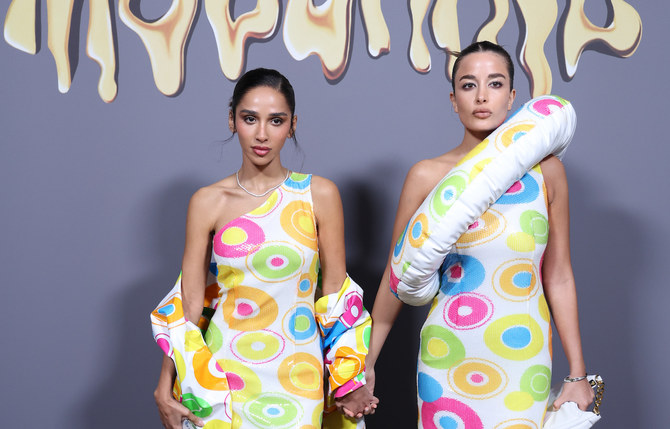
Saudi model and influencer Hala Abdallah and Palestinian social media star Julia Hussein turned heads in matching playful outfits. (Getty Images)
Short Url
Updated 24 February 2023
Follow

Saudi model Hala Abdallah, Palestinian influencer Julia Hussein turn heads in Milan

DUBAI: Saudi model and influencer Hala Abdallah and Palestinian social media star Julia Hussein this week attended Italian fashion label Moschino’s show in style at Milan Fashion Week.

The two turned heads in matching playful outfits, wearing single-shouldered form-fitting dresses with colorful circle designs. The Arab stars made a statement by wearing inflated floats, designed by Moschino, to top off their look.

They both kept their hair in slicked-back buns to show off their stylish outfits.


A post shared by HALA (@thehala)

“Two cover girls,” wrote Abdallah on Instagram, while Hussein posted: “Arriving to Moschino low key.”

Abdallah and Hussein were joined by Tunisian actress Rym Saidi Breidy who also attended the show.

Designer Jeremy Scott’s latest Moschino collection was a little less literal than usual, but that is not to say it was subtle.

Scott switched from surrealism to punk, declaring his intentions with exaggerated spiked wigs worn by all the models. Opening looks played with the influences of Salvador Dali, with houndstooth patterns that appeared to be melting, and wavy hemlines on jackets and skirts giving the same surrealist effect.

The looks then veered into pure punk with jackets and skirts covered with spikes and accented with mesh, adorned with bejeweled broaches for an aristo-punk vibe, which culminated with a tulle princess dress worn with bejeweled opera gloves. Shoes featured zig-zag heels.

Dutch Moroccan Egyptian model Imaan Hammam walked the runway in two different looks.

The first was a black leather jacket with gold detailing and matching shorts that were layered over fishnet stockings.

For her second look, she cut a stylish figure in a two-piece set — a tube top shaped like a large belt, and a floor-length zip-up leather skirt.

Hammam has been busy in Milan, also walking for Max Mara and Etro. The in-demand model wore a structured green dress with a halter neck and cape during the Max Mara show, and for Etro stepped on the runway in a beige knit dress with fringe detailing at the knee, with a brown and beige scarf wrapped around her shoulders, a black purse and black knee-high boots.


Riyadh takes shape at Tuwaiq Sculpture Symposium 2026

Updated 16 January 2026
Follow

Riyadh takes shape at Tuwaiq Sculpture Symposium 2026

RIYADH: This season, one of Riyadh’s busiest streets has taken on an unexpected role.

Under the theme “Traces of What Will Be,”sculptors are carving granite and shaping reclaimed metal at the seventh Tuwaiq Sculpture Symposium, running from Jan. 10 to Feb. 22.

The symposium is unfolding along Prince Mohammed bin Abdulaziz Road, known locally as Al‑Tahlia, a name that translates to desalination. The choice of location is deliberate.

The area is historically linked to Riyadh’s early desalination infrastructure, a turning point that helped to shift the city from water scarcity toward long‑term urban growth.

Twenty‑five artists from 18 countries are participating in this year’s event, producing large‑scale works in an open‑air setting embedded within the city.

The site serves as both workplace and eventual exhibition space, with sculptures remaining in progress throughout the symposium’s duration.

In her opening remarks, Sarah Al-Ruwayti, director of the Tuwaiq Sculpture Symposium, said that this year new materials had been introduced, including recycled iron, reflecting a focus on sustainability and renewal.

She added that the live-sculpting format allowed visitors to witness the transformation of raw stone and metal into finished artworks.

Working primarily with local stone and reclaimed metal, the participating artists are responding to both the material and the place.

For Saudi sculptor Wafaa Al‑Qunaibet, that relationship is central to her work, which draws on the physical and symbolic journey of water.

“My work … presents the connection from the salted water to sweet water,” Al‑Qunaibet told Arab News.

Using five pieces of granite and two bronze elements, she explained that the bronze components represented pipes, structures that carry saline water and allow it to be transformed into something usable.

The sculpture reflected movement through resistance, using stone to convey the difficulty of that transition, and water as a force that enables life to continue.

“I throw the stone through the difficult to show how life is easy with the water,” she said, pointing to water’s role in sustaining trees, environments and daily life.

Formally, the work relies on circular elements, a choice Al‑Qunaibet described as both technically demanding and socially resonant.

“The circle usually engages the people, engages the culture,” she said. Repeated circular forms extend through the work, linking together into a long, pipe‑like structure that reinforces the idea of connection.

Sculpting on site also shaped the scale of the piece. The space and materials provided during the symposium allowed Al‑Qunaibet to expand the work beyond her initial plans.

The openness of the site pushed the sculpture toward a six‑part configuration rather than a smaller arrangement.

Working across stone, steel, bronze and cement, American sculptor Carole Turner brings a public‑art perspective to the symposium, responding to the site’s historical and symbolic ties to desalination.

“My work is actually called New Future,” Turner told Arab News. “As the groundwater comes up, it meets at the top, where the desalination would take place, and fresh water comes down the other side.”

Her sculpture engages directly with the symposium’s theme by addressing systems that often go unseen. “Desalination does not leave a trace,” she said. “But it affects the future.”

Turner has been sculpting for more than two decades, though she describes making objects as something she has done since childhood. Over time, she transitioned into sculpture as a full‑time practice, drawn to its ability to communicate across age and background.

Public interaction remains central to her approach. “Curiosity is always something that makes you curious, and you want to explore it,” she said. Turner added that this sense of discovery is especially important for children encountering art in public spaces.

Saudi sculptor Mohammed Al‑Thagafi’s work for this year’s symposium reflects ideas of coexistence within Riyadh’s evolving urban landscape, focusing on the relationships between long‑standing traditions and a rapidly changing society.

The sculpture is composed of seven elements made from granite and stainless steel.

“Granite is a national material we are proud of. It represents authenticity, the foundation, and the roots of Saudi society,” Al‑Thagafi told Arab News.

“It talks about the openness happening in society, with other communities and other cultures.”

That dialogue between materials mirrors broader social shifts shaping the capital, particularly in how public space is shared and experienced.

Because the sculpture will be installed in parks and public squares, Al‑Thagafi emphasized the importance of creating multi‑part works that invite engagement.

Encountering art in everyday environments, he said, encouraged people to question meaning, placement, simplicity and abstraction, helping to build visual‑arts awareness across society.

For Al‑Thagafi, this year marked his fifth appearance at the symposium. “I have produced more than 2,600 sculptures, and here in Riyadh alone, I have more than 30 field works.”

Because the works are still underway, visitors can also view a small on‑site gallery displaying scaled models of the final sculptures.

These miniature models offer insight into each artist’s planning process, revealing how monumental forms are conceived before being executed at full scale.

As the symposium moves toward its conclusion, the completed sculptures will remain on site, allowing the public to encounter them in the environment that shaped their creation.