

Saudi deputy interior minister to ‘soon’ visit Pakistan to sign Makkah Route agreement

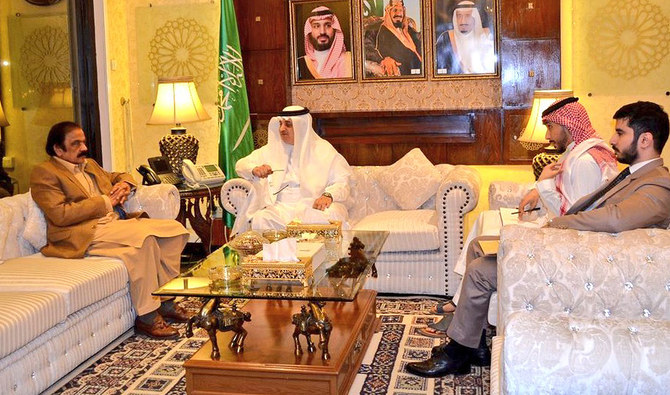
Interior Minister Rana Sanaullah (left) gestures during a meeting with Saudi Arabia’s Ambassador to Pakistan Nawaf bin Said Al-Malki (second left) at the Saudi embassy in Islamabad on February 20, 2023. (Photo courtesy: Twitter/KSAembassyPK)
Short Url
Updated 21 February 2023
Follow

Saudi deputy interior minister to ‘soon’ visit Pakistan to sign Makkah Route agreement

  • Interior Minister Rana Sanaullah discusses bilateral issues with Saudi Arabia’s Ambassador to Pakistan Nawaf bin Said Al-Malki
  • Makkah Route initiative would ensure Hajj pilgrims are facilitated with easy, hassle-free immigration facilities, says interior ministry

ISLAMABAD: Saudi Arabia’s deputy interior minister would “soon” visit Pakistan to sign the Makkah Route agreement, Pakistan’s interior ministry confirmed on Monday.

The Makkah Route initiative is part of Saudi Arabia’s Guests of God Service Program, which King Salman bin Abdulaziz Al Saud inaugurated in 2019 as part of the Saudi Vision 2030. As per the initiative, Hajj pilgrims are issued visas, and provided other services, such as baggage facilities, at their respective countries’ airports.

The Hajj is a spiritual journey that every Muslim adult must undertake once in his lifetime, to the holy sites in Makkah and Madinah, if he is financially and physically able to do so. It is one of the important five pillars of the Islamic faith.

Last year, Pakistani pilgrims traveled through the Makkah Route initiative for the second consecutive year. The program also includes Malaysia, Indonesia, Morocco, and Bangladesh.

On Monday, Pakistan’s Interior Minister Rana Sanaullah met Saudi Arabia’s ambassador to Pakistan, Nawaf bin Said Al-Malki, at the Saudi embassy in Islamabad. The two discussed bilateral issues, matters of mutual interest, and reviewed progress on the Makkah Route initiative, the interior ministry said.

“The Saudi deputy interior minister would “soon” visit Pakistan to sign the agreement,” the ministry said. It added that both sides had agreed to finalize the agreement and ensure it is “completely functional.”

“Under this project, Hajj pilgrims would be provided easy and hassle-free immigration facilities,” the statement added. “This initiative will soon be started from [Pakistan’s] major cities.”

At Sanaullah’s insistence, the Saudi ambassador assured him Riyadh would take steps to ensure the early release of Pakistani prisoners from Saudi jails.

The interior minister acknowledged Al-Malki’s efforts to strengthen bilateral relations between the two countries. “Pakistan and Saudi Arabia enjoy historical, long-standing, and brotherly ties with one another,” he said.

Last month, Saudi Arabia restored Pakistan’s pre-coronavirus Hajj quota of 179,210 pilgrims and abolished the upper age limit of 65 years to perform the annual pilgrimage.


Pakistan says inflation to remain within 5-6 percent range in January

Updated 27 January 2026
Follow

Pakistan says inflation to remain within 5-6 percent range in January

  •  Current account projected to remain in deficit, says Finance Division in monthly economic outlook
  •  Pakistan suffered a financial crisis in 2023, marked by inflation of 38 percent, depleted forex reserves

KARACHI: Inflation is expected to remain within the 5-6 percent range in January, Pakistan’s Finance Division said in its monthly economic outlook report on Tuesday, saying that the country’s economy is well positioned to sustain growth momentum in FY2026. 

Consumer Price Index (CPI) inflation was recorded at 5.6 percent year-on-year (YoY) basis in December 2025 as compared to 6.1 percent in November 2025 and 4.1 percent in December 2024. 

“Inflation is expected to remain within the range of 5.0-6.0 percent in January,” the Finance Division said. 

“On the external front, the current account is projected to remain in a deficit; however, robust remittance inflows and steady performance in IT and services exports are likely to cushion external pressures.”

The report said that the “positive trajectory” of the economy reflects the impact of the government’s prudent policies, ongoing structural reforms and easing of monetary conditions due to subsiding inflationary pressures.

Earlier, Pakistan’s finance ministry adviser Khurram Schehzad said S&P Global Market Intelligence’s latest macroeconomic forecast for Pakistan broadly aligns with projections issued by the State Bank of Pakistan, signaling easing inflation, manageable external balances and a gradual recovery in economic growth.

The assessment came amid stabilizing macroeconomic indicators after Pakistan went through a prolonged financial crisis marked by record inflation of 38 percent, depleted foreign exchange reserves and repeated balance-of-payments pressures, culminating in emergency support from the International Monetary Fund.

Tighter monetary policy, fiscal consolidation and external financing have since helped stabilize prices and ease pressure on the external account, prompting more measured assessments from international credit rating agencies.

“S&P’s projections broadly align with SBP’s outlook, with slight differences on growth and the current account but a shared assessment of easing inflation and gradual economic improvement,” Schehzad said in a statement.

According to S&P, inflation is expected to average 5.1 percent in 2026 and edge up slightly to 5.6 percent in 2027, staying within the SBP’s projected range of 5 percent to 7 percent over the next two years.

On the external front, S&P forecast a current account deficit of 0.5 percent of gross domestic product in 2026, broadly in line with the central bank’s expectation that the deficit will remain between 0 percent and 1 percent of GDP in the fiscal year.

Economic growth is projected to strengthen gradually, with S&P forecasting real GDP growth of 3.5 percent in fiscal year 2026, rising to 4.4 percent the following year. The SBP has projected growth of 3.75 percent to 4.75 percent for FY26.

Both S&P and SBP projections echo the government’s assessment that macroeconomic conditions are stabilizing, as Pakistan seeks to attract foreign investment and push toward export-led growth.