Bird man in Turkiye vows to tend to flock after quake

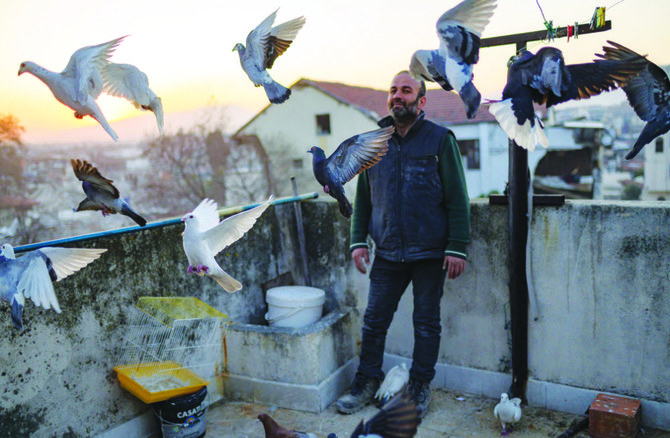
Murat Guzel scatters bird food on the roof of a restaurant where he worked before the earthquake in Antakya. (AFP)
Short Url
Updated 21 February 2023
Follow

Bird man in Turkiye vows to tend to flock after quake

  • Two large white and brown birds nestle in a dovecote made of wire mesh and wood, while more than 20 others perch on a ledge in anticipation of food

Murat Guzel scatters bird feed on the roof as the sun sets over the Antakya restaurant at which he used to work before the earthquake that destroyed the southern Turkish city.
Birds, mostly pigeons, some motley and scruffy, others pristine and plump, scrabble for the feed as Guzel, 40, calls to them.
“We take care of our birds the way we take care of our children — and will continue to look after them,” he says.
On the rooftop above Antakya’s old town, he now keeps 40 birds following last week’s 7.8-magnitude quake, having taken 110 back to the village he now calls home.
To reach the birds, Guzel walks through a debris-littered pantry, now covered with jam jars smashed during the tremors, up a narrow staircase to the rooftop of the traditional Turkish townhouse.
Two large white and brown birds nestle in a dovecote made of wire mesh and wood, while more than 20 others perch on a ledge in anticipation of food.
Before the quake that shattered tracts of southeastern Turkiye and northern Syria killing more than 43,000 people, Guzel was the cook at the Antakya Breakfast House where guests would eat olives and cheese in the courtyard of the 300-year-old building.
“There’s five of us at home, and the five of us came out safe and sound,” he said after they were caught up in the quake in Antakya.
Guzel has three children aged nine, 15 and 17 — the youngest of whom, Eren, has inherited his father’s interest in birds.
“Every morning we come to our birds and feed them (and) attend to their food, feathers and illnesses,” he said.
The building, reinforced with steel girders and escaped with only cosmetic damage, is surrounded by destroyed homes and businesses in the heart of the city’s historical quarter.
Guzel gently grips a snow-colored pigeon he called “white rose” and explains how healthy wings are vital to the bird’s survival.
Diggers and excavators picking through ruined buildings could be heard nearby.
His father became a bird fancier before he was born but gave up the hobby following Guzel’s arrival.
Pigeon keeping is a popular hobby in southeastern Turkiye, particularly among the Kurdish community, and pigeon droppings are often used as fertilizer for watermelons.
Guzel and his brother gave each other a bird when he was just 15 — and have built up their collection since. “Our love for animals is something else, we like animals as much as humans ... maybe more,” he said.
Three or four regular avian visitors have disappeared in the wake of the quake, but have been replaced by 50 more as, he assumes, their keepers were killed.
Initially, Guzel was mostly interested in carrier pigeons but now looks after a variety — like humans “some are very handsome and some are very ugly.”
Guzel, who has a salt and pepper beard and wears a body warmer and jumper, said his birds help to reduce stress when he sits with them.


Israel begins demolishing residential buildings in West Bank camp

Updated 4 sec ago
Follow

Israel begins demolishing residential buildings in West Bank camp

  • The 25 buildings were home to about 100 families in the Nur Shams refugee camp
  • Israeli military claims demolitions are part of effort to root out armed groups in northern areas of the territory
NUR SHAMS, occupied West Bank: Israeli bulldozers began demolishing 25 buildings housing Palestinians in a refugee camp on Wednesday, in what the military said was an effort to root out armed groups in northern areas of the occupied West Bank.
The buildings, home to some 100 families, are in the Nur Shams camp, a frequent site of clashes between Palestinian militants and Israeli forces.
Israeli military bulldozers and cranes tore through the structures early Wednesday, sending thick plumes of dust into the air, an AFP journalist reported. Many residents watched from a distance.
The military said the demolitions were part of an operation against militants.
“Following ongoing counterterrorism activity by Israeli security forces in the area of Nur Shams in northern Samaria, the commander of the Central Command, Major General Avi Bluth, ordered the demolition of several structures due to a clear and necessary operational need,” the military told AFP in a statement.
“Areas in northern Samaria have become a significant center of terrorist activity, operating from within densely populated civilian areas.”
Earlier this year, the military launched an operation it said was aimed at dismantling Palestinian armed groups from camps in northern West Bank — including Nur Shams, Tulkarem and Jenin.
“Even a year after the beginning of IDF operations in the area, forces continue to locate ammunition, weapons, and explosive devices used by terrorist organizations, which endanger IDF soldiers and impair operational freedom of action,” the military said on Wednesday.
Earlier in December, AFP reported residents of the targeted buildings retrieving their belongings, with many saying they had nowhere to go.
The demolitions form part of a broader Israeli strategy aimed at easing access for military vehicles within the densely built refugee camps of the West Bank.
Israel has occupied the Palestinian territory since 1967.
Nur Shams, along with other refugee camps in the West Bank, was established after the creation of Israel in 1948, when hundreds of thousands of Palestinians were displaced from their homes in what is now Israel.
With time, the camps they established inside the West Bank became dense neighborhoods not under their adjacent cities’ authority. Residents pass on their refugee status from one generation to the next.
Many residents believe Israel is seeking to destroy the idea of the camps themselves, turning them into regular neighborhoods of the cities they flank, in order to eliminate the refugee issue.