
ISTANBUL: The 7.8-magnitude earthquake that killed tens of thousands across Turkiye’s southeast has reignited fears of an even more catastrophic death toll if a long-feared one hits Istanbul.
Seismologists warn that a massive earthquake is likely to strike Turkiye’s biggest city — officially home to 16 million people but estimated to hold up to 20 million — by 2030.
The city lies on the northern edge of one of Turkiye’s main fault lines and is densely packed.
A 7.6-magnitude earthquake with an epicenter on the city’s eastern outskirts killed more than 17,000 people in 1999.
The number of Istanbulites has roughly doubled since then.
Independent urban scholar Murat Guney said carnage can be avoided if the government has the political will to relocate people from shoddy buildings filling the city’s shanty towns.
Guney said Istanbul had an ample supply of vacant properties just recently constructed and strong enough to withstand major jolts.
FASTFACT
Tunisia sent aid planes to Syria, including rescue and civil protection teams, which arrived at Aleppo airport under the control of the Syrian regime.
Procrastination could spell doom, he said.
“A major earthquake of up to 7.5 magnitude is expected in Istanbul. Such an earthquake may cause the death of hundreds of thousands of residents while estimates about the number of buildings that will totally collapse or be severely damaged range from 50,000 to 200,000,” said Guney.
“Those high-risk buildings, which are mostly squatter style and not resistant to earthquakes needed immediate transformation before they collapse even following a minor earthquake.
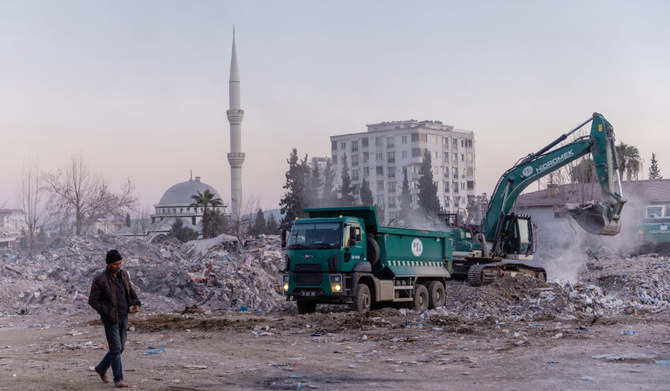
The Feb. 6 earthquake claimed the lives of more than 38,000 people in southeastern Turkiye and nearly 3,700 in neighboring Syria.
Officials say more than 55,000 buildings were either leveled or damaged beyond repair.
Its impact was felt across a part of Turkiye with approximately the same population as Istanbul.
Guney said Istanbul had around 1,166,000 residential buildings.
“Of these, 817,000 buildings (70 percent) were constructed before the 1999 earthquake, when there were no construction inspections regarding resistance to earthquakes,” he said.
But there was a sliver of good news: Guney said Istanbul had 150,000 earthquake-resistant properties built after 2008 that still stood empty.
“They either belong to the construction companies that are waiting for customers, or they are the second or third houses of the rich, who do not bother to rent those apartments,” Guney said.
“There is even no need for more construction in Istanbul,” he said.
“The number of empty buildings is sufficient to move in those who live in the high-risk buildings ... However, such a political decision has never been taken by the government.”
The 1999 quake prompted the government to impose a special levy that became known as the “earthquake tax.”
The money was meant to help make Turkish cities earthquake-proof.
“However, that tax money was not used properly and efficiently,” Guney said. “That special tax money was used to cover other government expenses.”
The Turkish government has issued no public breakdown of how that money has been spent.
“So far, the majority of the high-risk buildings were not covered by an urban transformation project,” Guney said.
.