



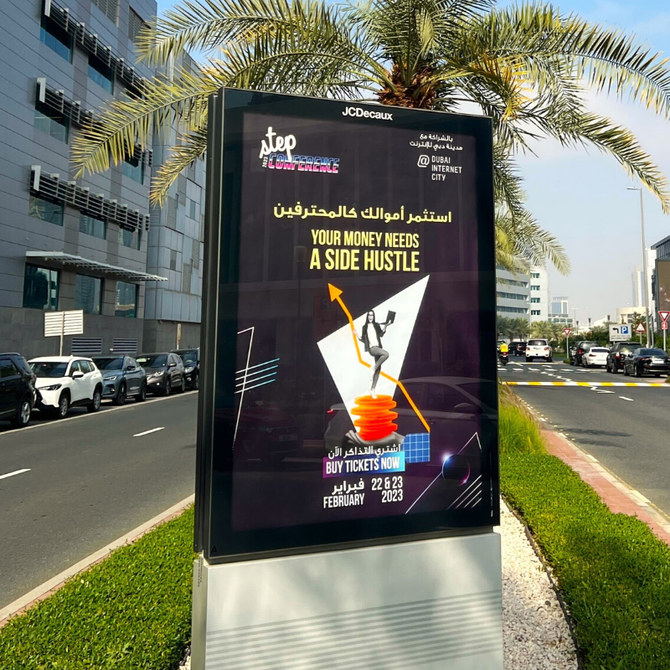
ChatGPT outperforms copywriters in STEP Conference’s outdoor adverts

1 / 5
Photo/Supplied
2 / 5
Photo/Supplied
3 / 5
Photo/Supplied
4 / 5
Photo/Supplied
5 / 5
Photo/Supplied
Short Url
Updated 22 February 2023
Follow

ChatGPT outperforms copywriters in STEP Conference’s outdoor adverts

  • It is why the company plans to continue using the AI tool and get at least one paid account that would be used across the team for “creating, summarizing and explaining content whenever needed,” Dargham explained

DUBAI: In an almost ominous foretelling of what the future might look like for creative industries, ChatGPT, the controversial OpenAI tool, has become the brains behind tech festival STEP Conference’s latest outdoor adverts.


The ads feature taglines like “Your money needs a side hustle,” “Save the planet, it’s the only one with good coffee,” “Art on the wall is so last century” and “Who needs football cards when you have digital cats?” among others.

Initially, STEP planned to use its agency Mink to create the ads, but both, the agency and STEP, “weren’t satisfied” with the taglines created by the agency and STEP’s internal team, Ray Dargham, founder of STEP Conference, told Arab News. “Then, we gave ChatGPT a try and they came out much better, so we went with it.”

The agency, however, was still responsible for designing the outdoor ads based on the taglines generated by ChatGPT.

In addition to the outdoor campaign, the company has also used the chatbot for “writing session briefs, creating social posts and writing copy and content in general,” he said.

For STEP’s team, the chatbot is “almost like an artificial intelligence assistant that makes them faster and more efficient at their job.”

It is why the company plans to continue using the AI tool and get at least one paid account that would be used across the team for “creating, summarizing and explaining content whenever needed,” Dargham explained.

One only has to look at movies like “Her” or “Ex Machina” to realize that neither the concept of AI and AI-powered chatbots nor the existential threat posed by them is new. Moreover, experts have argued that AI has created more jobs than it has erased, with one report stating that 85 percent of jobs that will exist in 2030 have not been invented yet.

When copywriters are replaced by chatbots, however, it is hard to recognize AI’s job creation capacity. And with other AI tools like Meta’s Open Pretrained Transformer, Microsoft’s Bing and Google’s Bard, the use of chatbots — and the threat to jobs — is likely to increase.

Dargham clarified that he does not plan to enforce the use of ChatGPT within the company, “but I think our team will naturally want to use it if they feel like it makes their lives easier.

“If you’re a copywriter, you have to constantly churn out copy and it’s not always easy to be creative,” he added.

For Dargham, ChatGPT and other AI tools are more complementary than competitive. But does he foresee such AI tools replacing human talent?

“I think AI tools will both complement and replace human talent. However, I also think that human talent will find more useful things to do,” he said.

He added: “Human creativity will always be extremely valuable.”


UAE outlines approach to AI governance amid regulation debate at World Economic Forum

Updated 22 January 2026
Follow

UAE outlines approach to AI governance amid regulation debate at World Economic Forum

  • Minister of State Maryam Al-Hammadi highlights importance of a robust regulatory framework to complement implementation of AI technology
  • Other experts in panel discussion say regulators should address problems as they arise, rather than trying to solve problems that do not yet exist

DUBAI: The UAE has made changes to 90 percent of its laws in the past four years, Maryam Al-Hammadi, minister of state and the secretary-general of the Emirati Cabinet, told the World Economic Forum in Davos on Wednesday.

Speaking during a panel discussion titled “Regulating at the Speed of Code,” she highlighted the importance of having a robust regulatory framework in place to complement the implementation of artificial intelligence technology in the public and private sectors.

The process of this updating and repealing of laws has driven the UAE’s efforts to develop an AI model that can assist in the drafting of legislation, along with collecting feedback from stakeholders on proposed laws and suggesting improvements, she said.

Although AI might be more agile at shaping regulation, “there are some principles that we put in the model that we are developing that we cannot compromise,” Al-Hammadi added. These include rules for human accountability, transparency, privacy and data protection, along with constitutional safeguards and a thorough understanding of the law.

At this stage, “we believe AI can advise but still (the) human is in command,” she said.

Authorities in the UAE are aiming to develop, within a two-year timeline, a shareable model to help other nations learn and benefit from its experiences, Al-Hammadi added.

Argentina’s minister of deregulation and state transformation, Federico Sturzenegger, warned against overregulation at the cost of innovation.

Politicians often react to a “salient event” by overreacting, he said, describing most regulators as “very imaginative of all the terrible things that will happen to people if they’re free.”

He said that “we have to take more risk,” and regulators should wait to address problems as they arise rather than trying to create solutions for problems that do not yet exist.

This sentiment was echoed by Joel Kaplan, Meta’s chief global affairs officer, who said “imaginative policymakers” often focus more on risks and potential harms than on the economic and growth benefits of innovation.

He pointed to Europe as an example of this, arguing that an excessive focus on “all the possible harms” of new technologies has, over time, reduced competitiveness and risks leaving the region behind in what he described as a “new technological revolution.”