
OpenAI launches ChatGPT $20-a-month subscription service

Since its launch in early December, ChatGPT has become a global phenomenon, attracting the attention of millions of users seeking to experiment with the technology. (OpenAI/File)
Short Url
Updated 02 February 2023
Follow

OpenAI launches ChatGPT $20-a-month subscription service

  • Paid model will help subsidies-free version
  • ChatGPT is fastest-growing consumer application in history

LONDON: ChatGPT parent company OpenAI announced on Wednesday it is launching a pilot subscription plan for its popular AI-powered chatbot, called ChatGPT Plus, for $20 per month.

As part of the premium plan, subscribers will receive access to ChatGPT even during peak times, faster responses, and priority access to new features and improvements.

The company said that the pilot version will initially be rolled out to a limited number of users on the waiting list but said it is planning to make the service available to the wider public in the near future.

The new subscription-based model will help to support the free version, the company said in a blog post.

Experts estimate that the AI-powered chatbot, which is capable of generating human-like text and interaction-style conversations, costs OpenAI at least $100,000 per day or $3 million per month to run.

Since its launch in early December, ChatGPT has become a global phenomenon, attracting the attention of millions of users seeking to experiment with the technology.

On Wednesday, a UBS study reported that the service reached an estimated 100 million monthly active users in January, making it the fastest-growing consumer application in history.

Besides the enthusiasm, the tool has also raised concerns and dilemmas including ethical challenges, copyright ownership, underlying prejudice and the question of authenticity.

In particular, ChatGPT has also raised questions about the facilitation of academic dishonesty and misinformation, prompting universities around the world to forbid students from using the tool to complete assignments and exams.

To address the issue, OpenAI released on Tuesday an “imperfect” tool designed to detect when written works are authored by artificial intelligence.


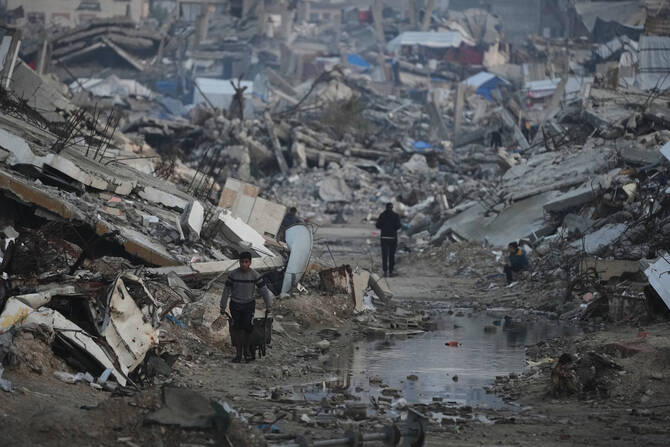
Foreign media group slams Israel for refusing to lift Gaza press ban

Updated 07 January 2026
Follow

Foreign media group slams Israel for refusing to lift Gaza press ban

  • Foreign Press Association expresses 'profound disappointment' with Israeli government’s response to a Supreme Court appeal
  • Israel has barred foreign journalists from independently entering the devastated territory since the war started

JERUSALEM: An international media association on Tuesday criticized the Israeli government for maintaining its ban on unrestricted media access to Gaza, calling the move disappointing.
The government had told the Supreme Court in a submission late Sunday that the ban should remain in place, citing security risks in the Gaza Strip.
The submission was in response to a petition filed by the Foreign Press Association (FPA) — which represents hundreds of journalists in Israel and Palestinian territories — seeking immediate and unrestricted access for foreign journalists to the Gaza Strip.
“The Foreign Press Association expresses its profound disappointment with the Israeli government’s latest response to our appeal for full and free access to the Gaza Strip,” the association said on Tuesday.
“Instead of presenting a plan for allowing journalists into Gaza independently and letting us work alongside our brave Palestinian colleagues, the government has decided once again to lock us out” despite the ceasefire in the territory, it added.
Since the outbreak of the Gaza war in October 2023, triggered by an attack on Israel by the Palestinian militant group Hamas, the government has barred foreign journalists from independently entering the devastated territory.
Instead, Israel has allowed only a limited number of reporters to enter Gaza on a case-by-case basis, embedded with its military inside the blockaded Palestinian territory.
The FPA filed its petition in 2024, after which the court granted the government several extensions to submit its response.
Last month, however, the court set January 4 as a final deadline for the government to present a plan for allowing media access to Gaza.
In its submission, the government maintained that the ban should remain in place.
“This is for security reasons, based on the position of the defense establishment, which maintains that a security risk associated with such entry still exists,” the government submission said.
The government also said that the search for the remains of the last hostage held in Gaza was ongoing, suggesting that allowing journalists in at this stage could hinder the operation.
The remains of Ran Gvili, whose body was taken to Gaza after he was killed during Hamas’s 2023 attack, have still not been recovered despite the ceasefire.
The FPA said it planned to submit a “robust response” to the court, and expressed hope the “judges will put an end to this charade.”
“The FPA is confident that the court will provide justice in light of the continuous infringement of the fundamental principles of freedom of speech, the public’s right to know and free press,” the association added.
The Supreme Court is expected to issue a ruling on the matter, though it is unclear when a decision will be handed down.
An AFP journalist sits on the board of the FPA.