

Imran Khan says ex-army chief Bajwa ‘violated oath’, asks president to initiate inquiry against him

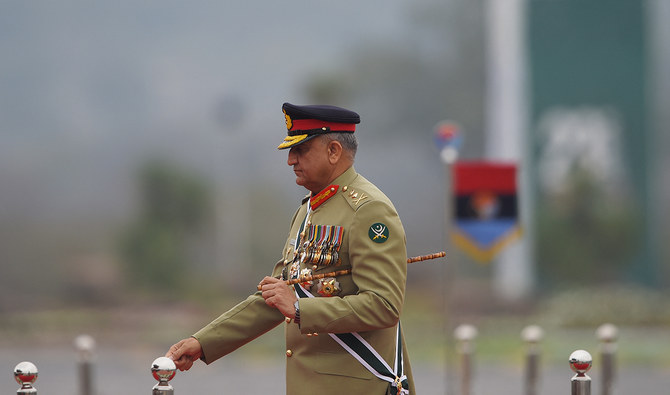
Former Pakistan Army Chief General (R) Qamar Javed Bajwa arrives to attend the Pakistan Day parade in Islamabad on March 23, 2019. (Photo courtesy: AFP/FILE)
Short Url
Updated 17 February 2023
Follow

Imran Khan says ex-army chief Bajwa ‘violated oath’, asks president to initiate inquiry against him

  • Khan writes letter to President Alvi, includes list of instances when Gen. Bajwa allegedly violated constitution
  • Interior minister, in indirect reference to Khan, says some people “piggybacked off establishment” but are now criticizing Bajwa

ISLAMABAD: Former prime minister Imran Khan on Thursday asked President Arif Alvi to order an “immediate inquiry” against ex-army chief, General Qamar Javed Bajwa, for allegedly violating the oath of his office repeatedly as well as the country’s constitution.

Ever since his ouster from power in April last year through a no-trust vote, Khan has been at loggerheads with the ex-army chief, arguably the most powerful post in the country. Khan blames Pakistan’s powerful military establishment for not saving his government. 

After months of blaming the US for triggering a regime change in Pakistan, Khan said this week that only Bajwa was responsible for his removal. The cricketer-turned-politician said that in light of the “evidence” he has come across recently, the former army chief— whom he referred to as a “super king“--somehow managed to convince Washington that Khan was anti-US

In a letter written to President Alvi dated February 14, Khan included a list of reasons in his attempt to prove how Bajwa repeatedly violated the constitution and demanded urgent action against him.

“Some very disturbing information has now come into the public domain whereby it is clear that Gen retd Bajwa as COAS violated his oath of [the] office repeatedly,” Khan wrote in the letter, a copy of which was posted on Pakistan Tehreek-e-Insaf’s official Twitter account on Thursday.

Khan explained in the letter that in conversation with a journalist, Bajwa had admitted that Khan was “dangerous to the country if he continued to stay in power”, adding that assuming the right to decide such a thing was a violation of his oath as given in Third Schedule Article 244 of the Constitution.

“Regardless of the merits of his claims in this case, he has also admitted he managed to get the NAB [National Accountability Bureau] case against Shaukat Tarin dismissed revealing that NAB was under his control — again a clear violation of the Constitutional oath because the army itself is a department under the Ministry of Defense and civilian official autonomous institutions do not come [under] military control,” the letter added.

Khan also claimed that Bajwa told a journalist that he was in possession of audio tapes that featured conversations between the former army chief and Khan. He said it was again a violation of his oath and fundamental human rights.

Towards the end of the letter, Khan also pointed out that Bajwa went against the government’s policy of “maintaining neutrality in the Russia-Ukraine War”.

“I would also point out that Chapter II of the Constitution describes the mandate of the Armed Forces and specifically refers to Articles 243 and 244. Therefore, it is your Constitutional duty as President and as Supreme Commander of the Armed Forces to take immediate action and institute an inquiry so as to establish whether such grave violations of the Constitution and oath of Office under the Constitution have taken place,” the letter said.

Commenting on Khan’s move, Interior Minister Rana Sanaullah said during a press conference that “these people piggybacked off the establishment’s shoulders” to be imposed on the nation.

“What are they doing to the establishment now? What kind of things is [Khan] saying about General Bajwa? And now they are also targeting the judiciary,” he said. 


Pakistani, Uzbek leaders urge business community to help achieve $2 billion trade target

Updated 4 sec ago
Follow

Pakistani, Uzbek leaders urge business community to help achieve $2 billion trade target

  • Pakistan and Uzbekistan have steadily increased economic ties in recent years, with bilateral trade volume reaching nearly $500 million
  • President Shavkat Mirziyoyev says business community is ‘most important bridge’ linking both nations, promising favorable business climate

ISLAMABAD: Pakistan Prime Minister Shehbaz Sharif and Uzbekistan President Shavkat Mirziyoyev on Friday urged businesspersons from both countries to help the two countries achieve a bilateral trade target of $2 billion within the next five years.

The two leaders made the call while addressing traders, industrialists from both countries at the Pakistan Uzbekistan Business Forum in Islamabad during President Mirziyoyev’s visit to the South Asian country.

Pakistan and Uzbekistan have steadily increased economic ties in recent years as Pakistan offers landlocked Central Asian states greater access to global markets, aiming to position itself as a regional transit hub.

Pakistan was the first Central Asian partner with which Uzbekistan signed a bilateral Transit Trade Agreement, along with a Preferential Trade Agreement in March 2022, covering 17 items, which became operational in 2023.

“We agreed that political goodwill must be matched by economic actions and words must be converted into implementation,” Sharif said, citing his visit to Tashkent last year which had helped brought annual bilateral trade to nearly $450 million.

“Today, ladies and gentlemen, we will strengthen last night’s protocol by signing another document today, which will give you vistas of opportunities to sit down together, B2B (business to business), have wonderful discussions with your counterparts and come to arrangements in terms of joint ventures, investments in Uzbekistan and Pakistan.”

Sharif was referring to the protocol signed between the two countries on Thursday to establish a joint working group to formulate a five-year action plan to take bilateral trade to $2 billion. Both sides also signed 28 agreements focused on areas such as defense cooperation, climate change, disaster risk reduction, disaster management, agriculture, exports of fruits, and mining and geosciences.

President Mirziyoyev said the increase in bilateral trade to half-a-billion dollars was an outcome of their talks held in Tashkent in Feb. last year.

“Over the course of very comprehensive and detailed discussions yesterday, we together decided that this is far [from] being enough,” he told businessperson from both countries.

The Uzbek president said business community is the “most important bridge” in linking the two nations and it was their job as heads of the state to ensure favorable conditions for them.

“Success of this agreement is in your hands,” he told the attendees, assuring them of eliminating any obstacles and bottlenecks in the process.

Later, Pakistan President Asif Ali Zardari conferred the Nishan-e-Pakistan, the highest civilian award of the country, on President Mirziyoyev at a televised ceremony.

The Nishan-e-Pakistan is awarded to individuals who have rendered services of highest distinction to the national interest of Pakistan and has often been conferred on visiting Heads of State as a mark of respect and friendship.