

Pakistan temporarily suspends visa issuance to Afghan nationals in European countries

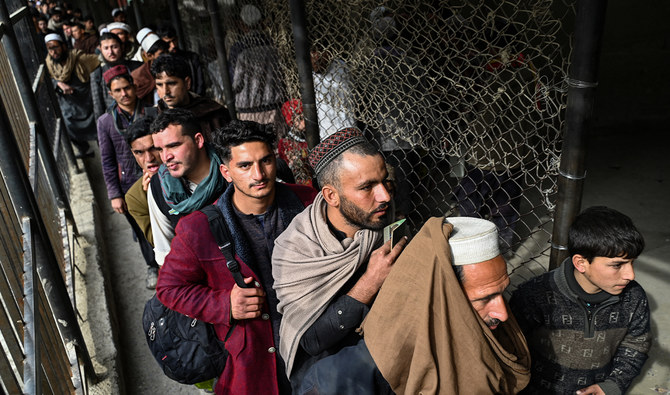
n this picture taken on February 2, 2023, Afghan men stand in queue inside a fenced corridor as they wait to cross into Pakistan at the zero point Torkham border crossing between Afghanistan and Pakistan, in Nangarhar province. (AFP/File)
Short Url
Updated 14 February 2023
Follow

Pakistan temporarily suspends visa issuance to Afghan nationals in European countries

  • The decision was taken after 1,600 visas were issued to Afghan nationals in Sweden who provided fake residence permits
  • The foreign office confirms the instruction was given after ‘glitches’ were identified in the system which were being resolved

ISLAMABAD: Pakistan’s foreign office confirmed on Monday it had instructed its diplomatic missions in Europe to temporarily stop issuing visas to Afghan nationals after identifying some “glitches” in the system.

According to some reports, the decision was taken after the Pakistan embassy in Sweden issued 1,600 visas to people of Afghan origin who provided fake Swedish residence permits with their applications.

Pakistan currently hosts more than 1.4 million registered Afghan refugees, though their actual number is believed to be far greater than that.

Many Afghan nationals also settled down in different European countries after the Taliban seized control of Kabul in August 2021. Some of them continue to visit Pakistan to meet their relatives.

“We have imposed a temporary freeze on the issuance of certain visas in some countries after identifying some glitches in the system,” Pakistan’s foreign office spokesperson Mumtaz Zahra Baloch told Arab News.

“These issues are being resolved,” she added.

Pakistan’s foreign ministry circulated a directive through email, a copy of which is seen by Arab News, instructing all its embassies in Europe to suspend all visa categories for Afghan nationals until further notice.

The letter was issued on February 8 and was addressed to the diplomatic missions in London, Glasgow, Bradford, Manchester, Birmingham, Madrid, Barcelona, Rome, Milan, Berlin, Frankfort, Lisbon, Athens, Vienna, Berne, Copenhagen, Oslo, Brussels, and the Hague.

Pakistan’s foreign office did not respond to questions regarding the 1,600 Afghan nationals who received visas on fake documents.


At UN, Pakistan warns India’s suspension of water-sharing treaty carries security implications

Updated 4 sec ago
Follow

At UN, Pakistan warns India’s suspension of water-sharing treaty carries security implications

  • Brokered in 1960, Indus Waters Treaty divides control of Indus basin rivers between India and Pakistan
  • Pakistan urges UN to ensure prevention of unilateral suspensions, enforcement of international treaties

ISLAMABAD: Pakistan’s UN Ambassador Asim Iftikhar Ahmad warned the international community this week that any unilateral suspension of the Indus Waters Treaty (IWT) by India carries with it humanitarian, peace and security implications.

India last year announced it was holding the IWT, mediated by the World Bank in 1960, “in abeyance” amid increasing political tensions with Islamabad. The IWT divides control of the Indus basin rivers between the two nuclear-armed neighbors.

It grants Pakistan rights to the Indus basin’s western rivers — Indus, Jhelum, and Chenab — for irrigation, drinking, and non-consumptive uses like hydropower, while India controls the eastern rivers — Ravi, Beas, and Sutlej — for unrestricted use but must not significantly alter their flow. India can use the western rivers for limited purposes such as power generation and irrigation, without storing or diverting large volumes, according to the agreement.

Speaking at the “Arria Formula Meeting of the Security Council on Upholding the Sanctity of Treaties for the Maintenance of International Peace and Security” on Saturday, Ahmad noted the IWT was regarded as one of the most resilient water-sharing treaties that had stood the test of time, crises and political tensions. 

“Any unilateral disruption to established water-sharing arrangements carries humanitarian, environmental, and peace-and-security implications, particularly for downstream 240 million people of Pakistan,” he said. 

“When the lifelines of millions are placed under unilateral discretion, the risks are not hypothetical — they are real and immediate.”

The Pakistani envoy reiterated that the treaty was not a “bilateral concern” but a test case for the international system. He said if a treaty designed to prevent disputes or conflicts is disregarded unilaterally, “then no agreement is truly insulated from politics or all kinds of machinations.” 

“Borders, demilitarized zones, trade corridors, and humanitarian arrangements all become more fragile,” Ahmad noted. 

He underscored that the UN and the Security Council have a vital role to play, which includes the prevention of unilateral suspensions and enforcement of treaties. 

“Compliance with treaties must therefore be regarded as a strategic imperative for conflict prevention and resolution,” he said. 

Pakistan has warned India that it will not let New Delhi stop or divert the flow of its rivers. Islamabad said last year it would consider any move on India’s behalf to hinder the flow of its waters as “an act of war.”

The two countries engaged in the worst fighting between them in decades in May last year after India blamed Pakistan for being involved in a militant attack on tourists in Indian-administered Kashmir. Islamabad denied it was involved and called for a credible probe into the incident. 

India and Pakistan pounded each other with missiles, drones, jets and exchanged artillery fire for four days before Washington brokered a ceasefire on May 10.