
CAIRO: More than a hundred years after the discovery of the Tomb of Tutankhamun archaeologists working at Egypt’s ancient sites are still making stunning discoveries, including the unveiling in January of a gold-laced mummy.
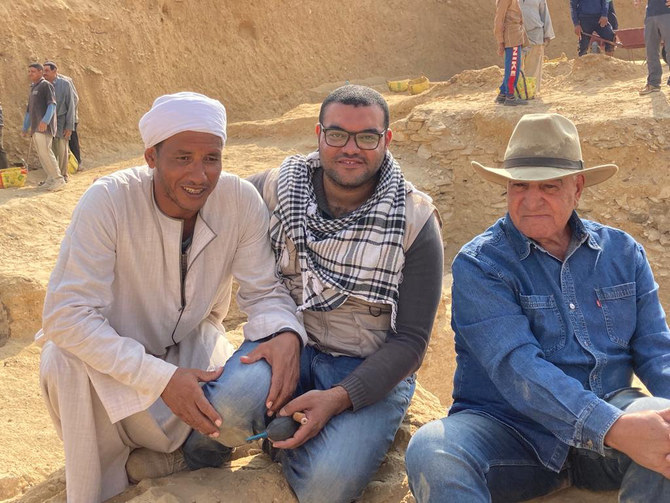
Dr. Zahi Hawass, the famed Egyptian archaeologist and former minister of state for antiquities affairs, recently announced a number of important new finds at Saqqara necropolis, a UNESCO World Heritage site south of the capital Cario.
“One of the major discoveries we made here was the sealed sarcophagus we found in a room deep inside a shaft that was 10 meters deep. It weighs almost three to four tons,” Hawass said announcing the finds.
“To see a mummy dated to the Old Kingdom in a good condition, this means it is really a good discovery. From the Old Kingdom we have one mummy of a king and it is shown inside the Imhotep Museum here in Saqqara, and other mummies that belong to the Old Kingdom are in a very bad condition unfortunately.”
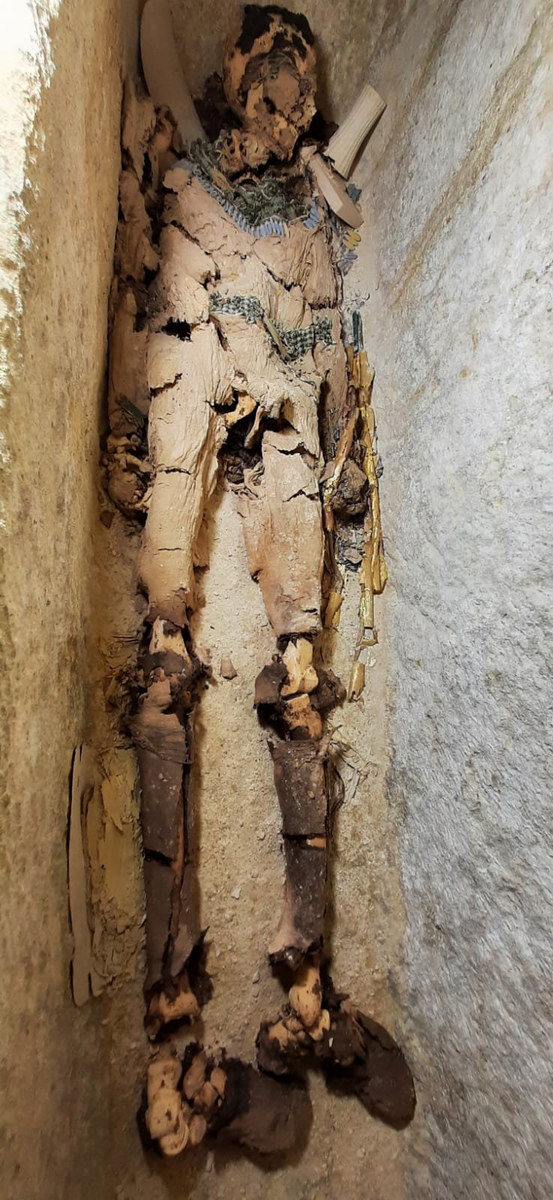
The oldest mummy. (Supplied)
Many stone and plaster vessels and artifacts were found around the sarcophagus. When it was examined, it was found to be completely sealed with mortar, just as the ancient Egyptians had left it 4,300 years ago. It was inscribed with the name Hekashepes.
“Most of the archaeological discoveries we find are most probably stolen and incomplete, but this time the discovery is considered to be complete. The well is completely sealed,” Ali Abu Dasheesh, an Egyptian archeologist and a member of the excavation team, told Arab News.
“Also, the gold leaf covering the mummy indicates that the kings that were living at that time were rich.”
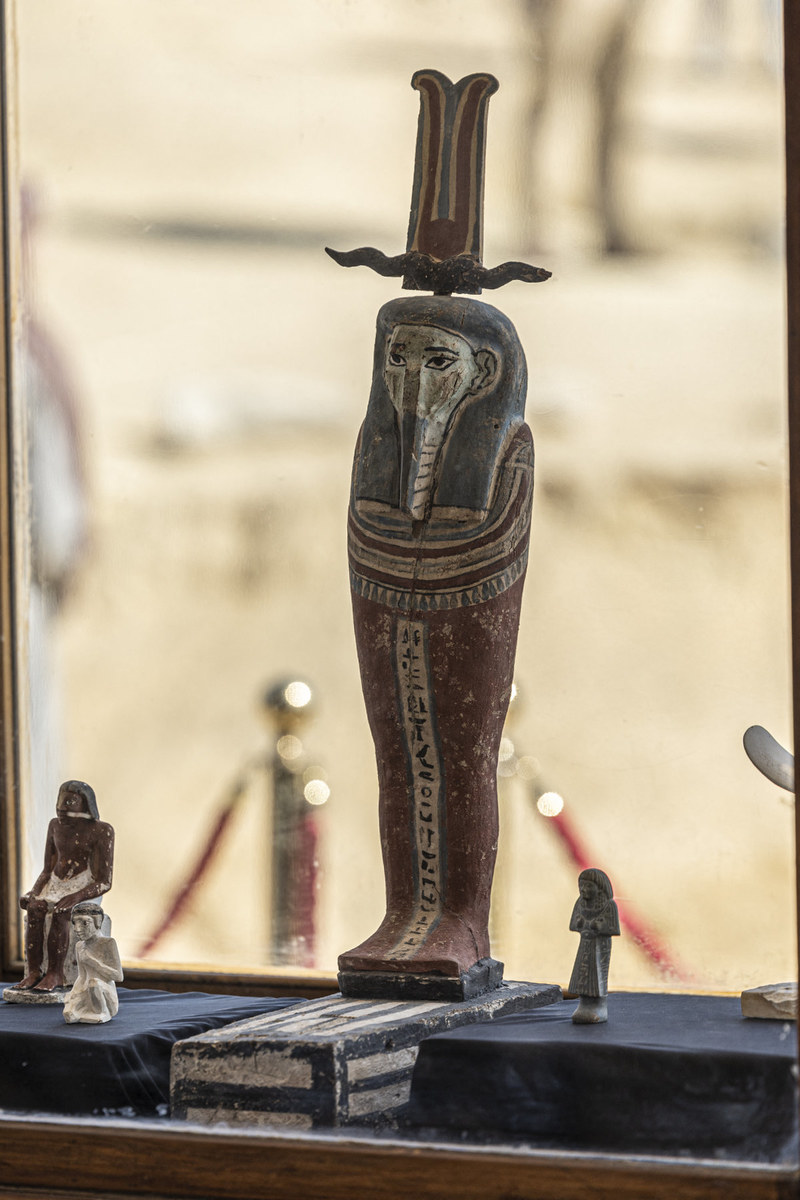
A gold-laced mummy and four tombs including of an ancient king's "secret keeper" were discovered at the Saqqara archaeological site south of Cairo on Jan. 26, 2023. (AP)
While some news outlets have described the discovery as the oldest known Egyptian mummy, that claim has been refuted. Hawass has since clarified to Live Science it is “the oldest complete mummy covered with gold.”
This does not undermine the discovery in any way. In addition to the layers of gold around him, the mummy wore a band on his head and a bracelet on his chest, signifying that he was a man of great wealth, Hawass told CNN.
The vast burial site at the ancient Egyptian capital Memphis, where the latest discoveries were made, is home to more than a dozen pyramids, animal graves and old Coptic monasteries.
The finds were made in the Gisr El-Mudir district, 24 km southwest of Cairo, in an area known as the Great Enclosure. The site is located a few hundred meters from the Buried Pyramid and the Step Pyramid of Djoser — the oldest stone pyramid complex dating back to the Third Dynasty (2667-2448 B.C.).
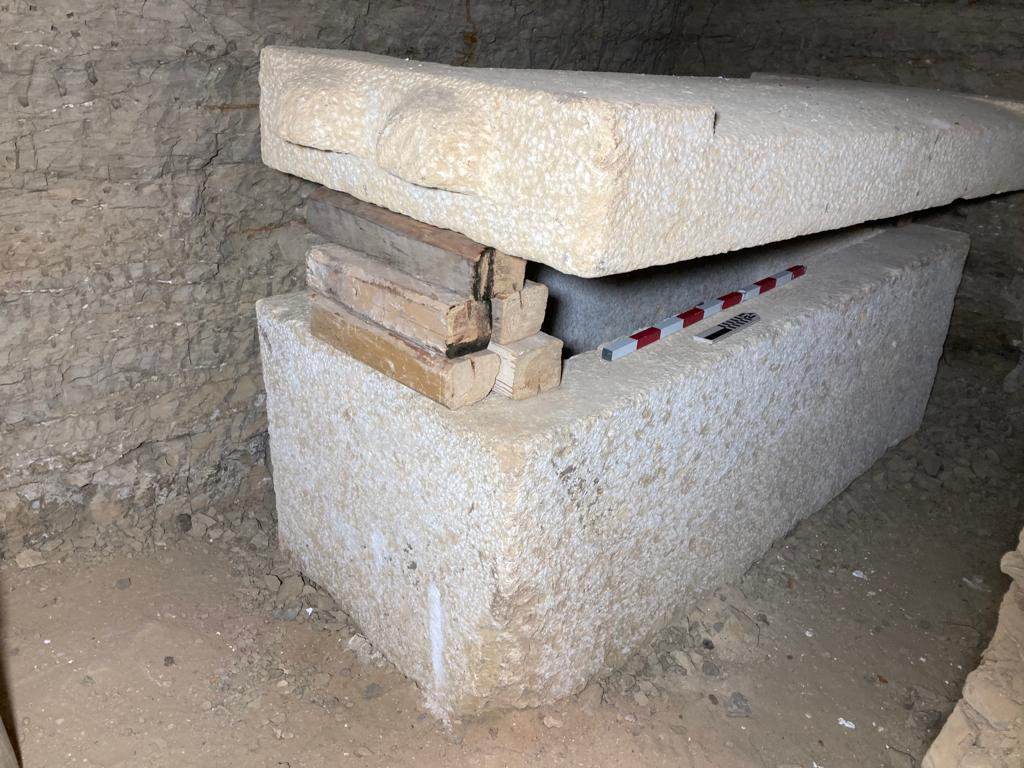
This sarcophagus was found sealed in a room deep inside a shaft that was 10 meters deep. It weighed more than three. (Supplied)
Among the recent discoveries were several tombs dating back to the Fifth and Sixth Dynasties.
The largest of these tombs belonged to Khnumdjedef, the last king of the Fifth Dynasty, decorated with scenes of daily life, with the original colors beautifully preserved.
The second largest tomb appears to have belonged to Meri, who was a priest, the pharaoh’s appointed “secret keeper” — a priestly title held by a senior palace official bestowing the power and authority to perform special religious rituals — and assistant to the commander of the great royal palace.
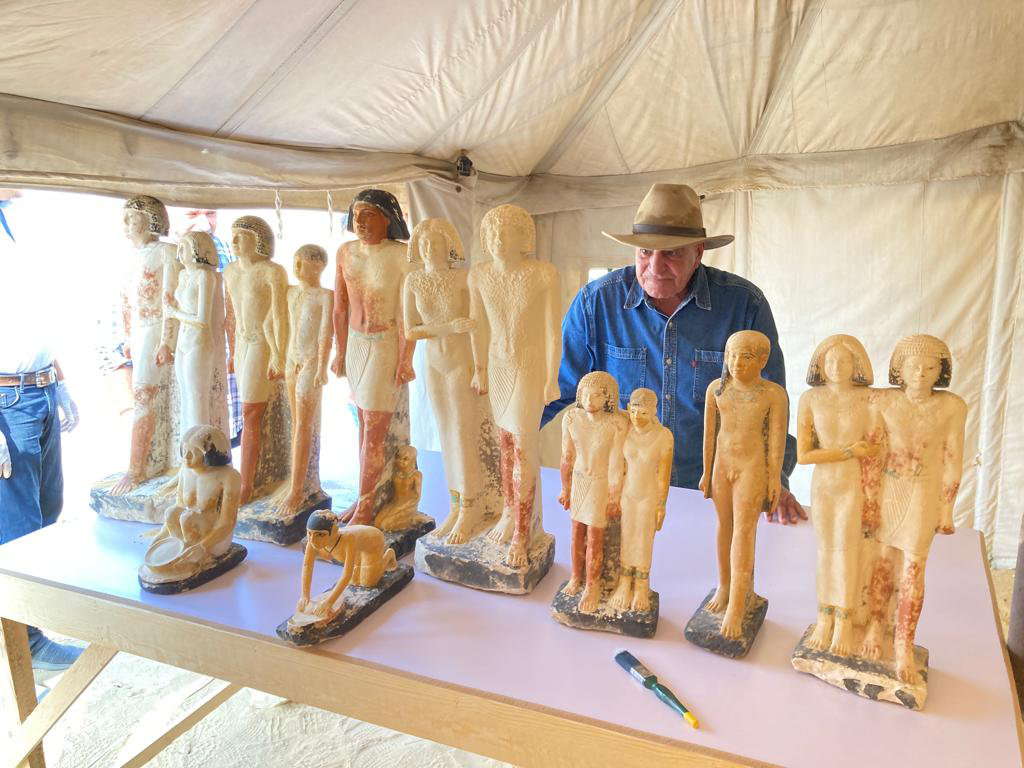
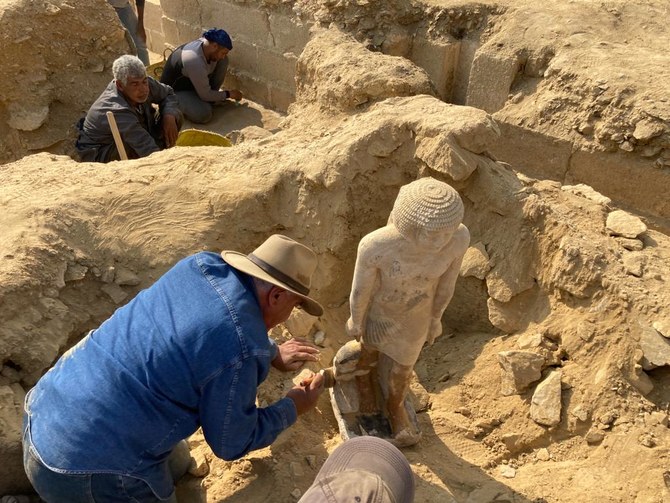
Zahi Hawas with the statues. (Supplied)
Another of the discoveries was a tomb for a priest in the pyramid complex of King Pepi I, which contained nine beautiful statues.
One represents a man and his wife holding his right leg and their daughter holding a goose. Another represents servants, while one depicts a woman baking. The expedition did not find any inscriptions that might identify the owners of these statues.
Archaeologies also found a false door near the site where the statues were discovered. The owner of the false door was named Messi (meaning “newborn” in old Egyptian), indicating Messi may have been the owner of the nine statues.
FASTFACTS
Saqqara contains ancient burial grounds of royalty, serving as the necropolis for the ancient Egyptian capital, Memphis.
Located 30 km south of Cairo in Giza governorate, Saqqara contains the Pyramid of Djoser and a number of mastaba tombs.
Saqqara remained an important complex for non-royal burials and cult ceremonies for more than 3,000 years.
The false door is considered a connection point between the tomb and the mummy itself.
Ancient Egyptians believed the spirits of those entombed would leave their burial chamber at sunrise and return at sunset. The door thereby acts as a gateway, with the mummy usually placed behind the door to allow the spirit easy access.
A fourth tomb is thought to have belonged to a judge and writer named Fetek. There were also several statues appearing to represent Fetek, located next to an offering table and a coffin containing his mummified remains.
The Saqqara archaeological region still holds many secrets waiting to be unlocked, according to Hawass.
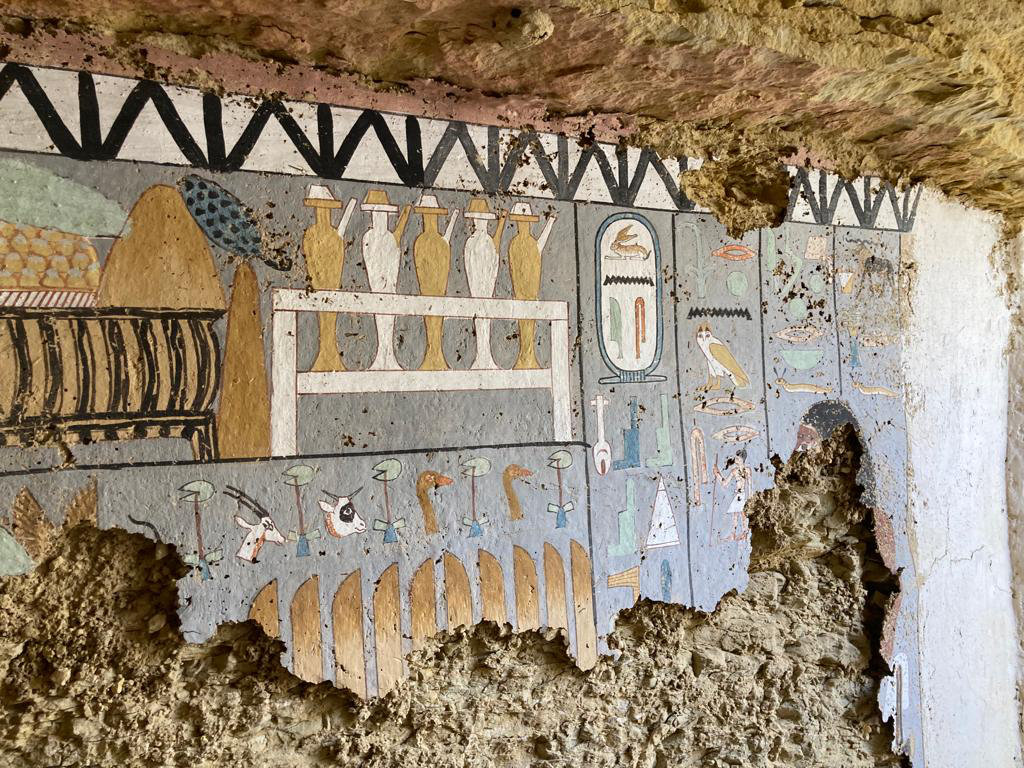
A wall documenting the daily life. (Supplied)
“The excavation work of the joint mission with the Egyptian Supreme Council of Antiquities discovered tombs dating back to the era of the Old Kingdom, which indicates the presence of a huge cemetery with many important tombs,” he said.
“We made major important discoveries in Saqqara. If you visit the Egyptian Museum, you will find a lot of the displayed statues for kings and individuals were discovered in Saqqara. My dream now is to discover the pyramid complex of King Houni, the last king in the Third Dynasty.”
Saqqara’s discoveries came just days after new findings near the southern city of Luxor. The Supreme Council of Antiquities reported the discovery of several burial sites from the New Kingdom era, dating from 1800 B.C. to 1600 B.C., in addition to the ruins of an ancient Roman city.
Archaeologists found residential buildings, towers and what they described as metal workshops, containing pots, tools and Roman coins.
Not all of Egypt’s latest discoveries are new finds. Recent digital scans of a mummy held in storage since 1916 have revealed secrets that had remained hidden for millennia.
Buried some 2,300 years ago, the mummy was uncovered at a southern Egypt cemetery and stored, undisturbed, in the basement of the Egyptian Museum in Cairo ever since.
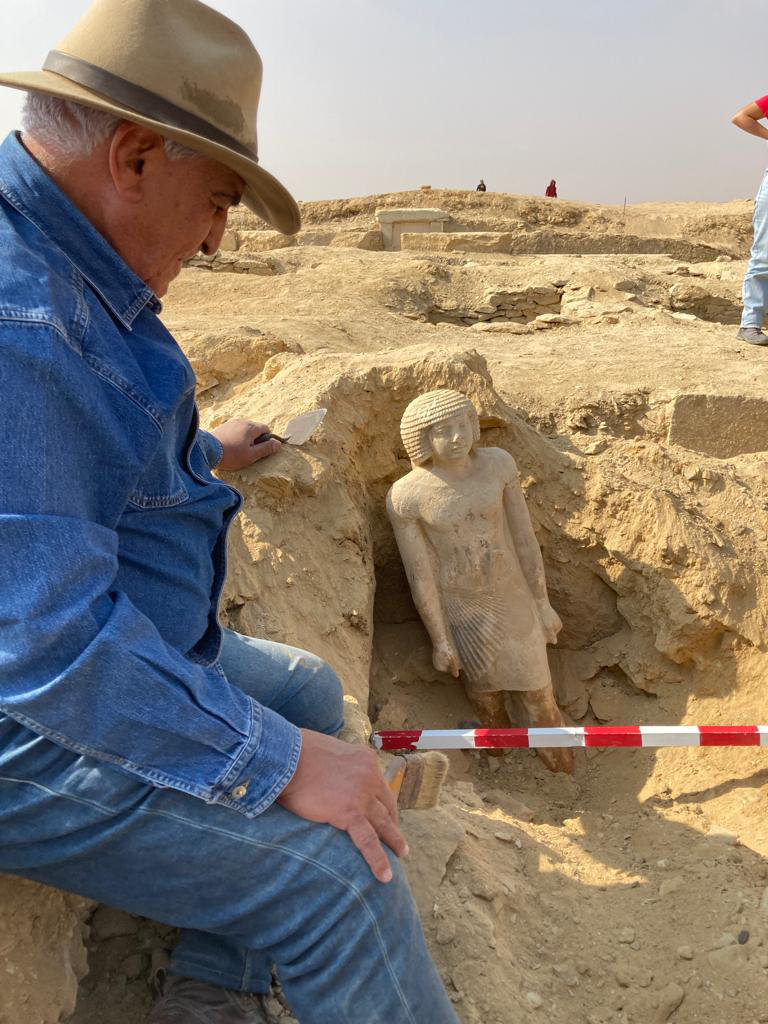
Saqqara remained an important complex for non-royal burials and cult ceremonies for more than 3,000 years. (Supplied)
Researchers used CT scans to learn more about the teen in a process known as “digital unwrapping.” Scientists say the boy was buried with a trove of 49 protective amulets, many of which are made of gold, earning him the nickname “Golden Boy.”
Elsewhere, archaeologists recently discovered a cache of 2,500-year-old mummified crocodiles near an undisturbed tomb at Qubbat Al-Hawa, a necropolis on the western bank of the Nile River, offering fresh perspectives on animal mummification practices.
In October 2020, a huge archeological discovery was made in Saqqara, which included 59 colorful wooden coffins were found inside burial wells, in addition to dozens of statues, amulets and other treasures.
“We documented this discovery and other ones and they will be revealed in a documentary film that will be aired on Netflix soon,” Abu Dasheesh told Arab News.
The latest archeological discoveries form a key component of Egypt’s attempts to revive its tourism industry after years of political unrest and the travel bans and restrictions of the COVID-19 pandemic.
The sector had started to recover from the pandemic, but was hit again by the effects of the Russian invasion of Ukraine. Along with Russia, Ukraine is a major source of tourists visiting the North African nation.
According to official figures, Egypt’s tourism industry accounts for 10 percent of GDP and about two million jobs.
The government’s plans — the crown jewel of which is the long-delayed inauguration of the Grand Egyptian Museum at the foot of the pyramids in Giza — aim to draw in 30 million tourists a year by 2028, up from 13 million before the pandemic.
Covering a site of almost 500,000 square meters, the new museum will house more than 100,000 artifacts from Egypt’s rich past, dating from prehistory through pharaonic times to the Greek and Roman periods.