

Pakistan swaps police head in province facing militant attacks

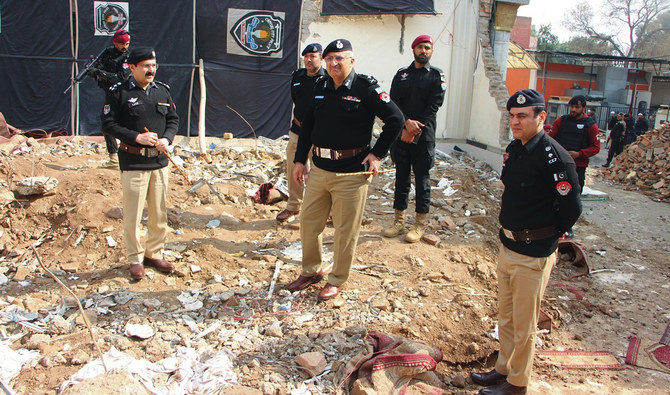
Newly appointed Khyber Pakhtunkhwa province's police chief Akhtar Hayat (center) inspects the damaged mosque following January 30 suicide blast inside the police headquarters in Peshawar on February 10, 2023. (Photo courtesy: KP Police)
Short Url
Updated 10 February 2023
Follow

Pakistan swaps police head in province facing militant attacks

  • Inspector general of Khyber Pakhtunkhwa police was changed after a suicide bombing in a police compound last month
  • The attack, which killed dozens of policemen, was followed by unprecedented protests by uniformed personnel of the force

PESHAWAR: Pakistan has replaced the police head in northwestern Khyber Pakhtunkhwa province where a suicide bomber killed more than 100 people at a police mosque last month, heightening fears of militant attacks elsewhere around the nation.

An official government notice this week said Akhtar Hayat would be posted as police chief, replacing Moazzam Jah Ansari who was in the role for about 18 months. No reason was given.

Police are on the frontlines of rising attacks in Pakistan, especially in Khyber Pakhtunkhwa, a restive northwestern province near the Afghan border.

The most active militant group in the area is the Pakistani Taliban, also called Tehreek-e-Taliban Pakistan (TTP).

Last month’s blast inside a fortified police compound in the regional capital Peshawar killed many police officers among the 100 fatalities in the city’s worst bombing in a decade.

That prompted unprecedented protests by police personnel.

Security threats have also been reported by embassies and authorities in Pakistan’s capital, Islamabad, which is a few hours’ drive from Peshawar.

The TTP has denied responsibility for the mosque attack, which no group has claimed so far.


Pakistan Supreme Court halts trial of prominent lawyer over alleged anti-military tweets

Updated 57 min 11 sec ago
Follow

Pakistan Supreme Court halts trial of prominent lawyer over alleged anti-military tweets

  • Top court orders lower court to pause proceedings after lawyers allege due-process breaches
  • Mazari-Hazir, husband face charges under cybercrime law that carry up to 14 years in prison

ISLAMABAD: Pakistan’s Supreme Court on Thursday halted the cybercrime trial of prominent human rights lawyer Imaan Mazari-Hazir and her husband, Hadi Ali Chattha, after their lawyers argued that a lower court had recorded witness testimony in their absence, violating due-process rules.

Mazari-Hazir, one of Pakistan’s most outspoken civil liberties lawyers, and Chattha are being prosecuted under the Prevention of Electronic Crimes Act (PECA) over posts on X that authorities say incited ethnic divisions and portrayed the military as involved in “terrorism.” Both reject the allegations. If convicted under the relevant PECA provision, they face a prison term of up to 14 years.

The case has drawn broad attention in Pakistan’s legal community because Mazari-Hazir, who has been repeatedly detained over her criticism of the security establishment, argues that the trial court ignored basic procedural guarantees despite her medical leave request. The case also comes as Pakistan faces sustained scrutiny over the use of PECA against activists, journalists and political dissenters, with lawyers arguing that lower courts often move ahead without meeting minimum fair-trial standards.

The couple’s lawyer, Riasat Ali Azad, said his clients filed a petition in the Supreme Court because the lower court had moved ahead improperly.

“Today, the Supreme Court of Pakistan has stayed the lower court proceedings, the trial court proceedings and has said that the [Islamabad] High Court should decide our pending revision petition for which a date has already been fixed,” he told reporters.

Azad said the violation was clear under Pakistan’s Code of Criminal Procedure, which requires evidence to be recorded in the presence of the accused.

“Yet, on that very day, evidence of four witnesses was recorded in their absence, and a state counsel was appointed to conduct cross-examination on their behalf,” he said. “All these things are against the right to a fair trial under Articles 10 and 10-A.”

A three-judge bench led by Justice Muhammad Hashim Khan Kakar ordered the trial court to pause proceedings and instructed the Islamabad High Court to hear the couple’s pending criminal revision petition first.

The trial had been scheduled to resume on Dec.15, but the Supreme Court’s stay now freezes proceedings before both the additional sessions judge and the special PECA court. 

The Islamabad High Court is expected to hear the criminal revision petition next week.

Chattha, who is also a lawyer, said the SC ruling underscored the need for procedural safeguards.

“It is a victory for the constitution and the law,” he said, arguing that the trial court had ignored their request to re-record witness statements in their presence.