

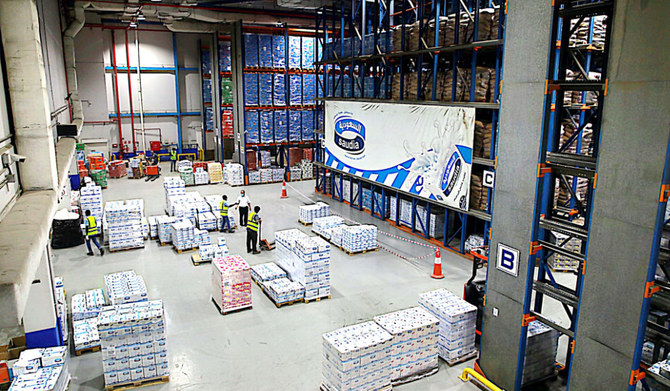
SADAFCO receives ISO certificate for CSR policy

Based in Jeddah, SADAFCO is a leader in the UHT milk and tomato paste markets.
Short Url
Updated 05 February 2023
Follow

SADAFCO receives ISO certificate for CSR policy

SADAFCO has received the ISO 26000:2010 conformance certificate for its strategic integration of corporate social responsibility policies into how the company operates. The announcement comes six months after the company’s board of directors recommended its CSR policy, which was subsequently approved by the general assembly on June 28, 2022.
The company received the certificate after putting into place the necessary structures, systems and governance to oversee the implementation of the policy.
“Receiving this certificate is another testament of SADAFCO’s commitment to making meaningful contributions and playing an active role in the countries it operates in,” the company said in a statement.

HIGHLIGHT

A dedicated task force has already been assigned to track the progress of SADAFCO’s CSR plans and programs on a periodic basis.

Patrick Stillhart, CEO of SADAFCO, said: “We are all very proud at SADAFCO to receive this certificate. It’s another major milestone for us as part of our ESG ambitions. CSR at SADAFCO is ingrained into the company culture and we look forward to continue having a leading role in supporting our people, environment and society.”
The company’s CSR policy outlines five key areas of focus:
• Supporting programs of charity and civil societies in the countries where the company operates.
• Cooperating with universities and academic institutions, supporting education programs and research aimed at adding value for the company and society.
• Participating in and supporting the establishment and operation of social, charitable and health centers.
• Sponsoring educational, health, economic and environmental events, programs and activities.
• Managing the environment, health, safety and security of the employees in accordance with the highest international practices and standards.
A dedicated task force has already been assigned to track the progress of SADAFCO’s CSR plans and programs on a periodic basis. In the last year alone, the company made some sizable contributions that resulted in meaningful impact across various initiatives such as COVID-19-related contributions, career fairs, sporting competitions, awareness initiatives, volunteering efforts and elderly care.
The company announced last year the signing of two strategic CSR agreements. The first was with Jeddah’s Social Responsibility Association and the second was with Future Industrial Strategies Initiatives. Both agreements were signed with a vision of long-term engagement.
SADAFCO’s CSR policies and approach are fully aligned with the UN’s Sustainable Development Goals and the Kingdom’s National Transformation Program, which is part of Saudi Vision 2030.


Jameel Research project at MIT tackles antimicrobial resistance

The ambitious project is led by Professor James J. Collins, third from left. Professor Collins and his team at MIT will develop
Updated 31 January 2026
Follow

Jameel Research project at MIT tackles antimicrobial resistance

Jameel Research, part of Abdul Latif Jameel International network, is sponsoring a research project in the Department of Biological Engineering and Institute for Medical Engineering and Science at the Massachusetts Institute of Technology, aimed at tackling the global public health crisis of antimicrobial resistance.
This ambitious, multi-disciplinary project is led by Professor James J. Collins, Termeer professor of medical engineering and science at MIT and faculty lead for life sciences at the MIT Jameel Clinic, the epicenter of artificial intelligence and health at MIT.
The project, spanning at least three years, will leverage the Collins’ lab’s cutting-edge strengths in synthetic biology and AI to create next-generation diagnostics.
The growing prevalence of antibiotic-resistant superbugs and a declining antibiotic pipeline has led to a global public health crisis. The US Centers for Disease Control and Prevention has predicted some 2 million infections and 23,000 deaths occur each year in the US alone, costing $55 billion. The World Bank predicts that up to $100 trillion of economic output may be at risk by 2050. The UK government-commissioned Review on Antimicrobial Resistance is projecting more than 10 million deaths worldwide per year by 2050 if the crisis is not addressed.
Professor Collins and his team at MIT are setting out to develop the next generation of antibacterials and rapid diagnostics to overcome AMR — using synthetic biology and advanced generative AI to deliver faster results and help control the use of antibiotics to where they can be effective.
With support from Jameel Research, the first phase of this project will develop and validate programmable antibacterials to overcome AMR in a range of bacterial pathogens. These AI-designed minibinders will be delivered by engineered microbes to neutralize key toxins and protein targets.
This directed design and engineering approach to antibiotic development technology advances a long-term vision to create programmable antibacterials to address the AMR crisis. This would then offer the potential for the more rapid development of medical countermeasures to emerging and re-emerging pathogens and a swifter response to future outbreaks and pandemics.
Mohammed Abdul Latif Jameel, KBE, chairman of Abdul Latif Jameel, said: “Antimicrobial resistance is one of the most urgent challenges we face today and addressing it will require ambitious science and sustained collaboration. We are pleased to support this new research, building on our long-standing relationship with MIT and our commitment to advancing research across the world, to strengthen global health and contribute to a more resilient future.”
“This project reflects my belief that tackling AMR requires both bold scientific ideas and a pathway to real-world impact,” Professor Collins said. “Jameel Research is keen to address this crisis by supporting innovative, translatable research at MIT.”
Jameel Research is advancing the work of pioneering pathfinders to create an extraordinary impact on a global scale.
This initial project holds the promise of rapidly developing medical countermeasures for emerging and re-emerging pathogens, offering a rapid response to future outbreaks and pandemics.
The new research project builds on the close and long-standing relationship between MIT and the Jameel family. This includes the MIT Jameel Clinic, which was co-founded in 2018 by MIT and Community Jameel, the international nonprofit organization founded by Mohammed Jameel, KBE, to advance science and learning for communities to thrive, and one of the Jameel family’s philanthropies.