ISLAMABAD: Pakistan’s army chief General Asim Munir praised Khyber Pakhtunkhwa police for playing a critical role in fighting extremist violence on Friday while visiting the site of a deadly suicide blast in Peshawar where over a hundred people were killed during a prayer congregation.
The incident took place when an explosion ripped through a crowded mosque in Peshawar’s police headquarters on Monday after a suicide bomber managed to enter the facility in police uniform.
Pakistan's army chief Asim Munir, third left, visits the site of Monday's suicide bombing in Peshawar, Pakistan, on February 3, 2023. (Photo courtesy: social media)
According to a statement released by the military’s media wing, ISPR, the army chief met with police personnel and praised their bravery in the “war against terrorism.”
“The [chief of army staff] said that KP police is one of the most brave and has fought as a Frontline force against terrorism,” the statement added.
He appreciated the morale of police personnel and paid tribute to the martyrs who “laid down their lives for the defence of motherland.”
“We as a nation together will root out this menace of terrorism till enduring peace and InSha Allah we shall achieve this,” General Munir was quoted as saying.
Earlier, Prime Minister Shehbaz Sharif chaired a high-level meeting to review the security situation of the country which agreed to adopt “a zero-tolerance policy against terrorism.”
“Those who attacked innocent citizens will be brought to justice,” he said in a Twitter post. “We will not allow anti-terror gains to be reversed.”
At Apex Committee meeting today, civil & military leadership expressed unflinching resolve to protect the people of Pakistan at any cost. Those who attacked innocent citizens will be brought to justice. We will not allow anti-terror gains to be reversed. 1/3
The prime minister said the participants of the meeting also considered proposals to revise the National Action Plan, announced in December 2014 to crack down on militant networks, and approved “a slew of measures to improve investigation, forensic & working of [counterterrorism departments].”
“The meeting agreed to institute implementation mechanism for the decisions,” he added.
QUETTA/ISLAMABAD: Dozens of militants and security personnel and policemen were killed as Pakistani security forces repulsed coordinated attacks by separatist militants in the southwestern Balochistan province, officials said on Saturday, in the latest incident of violence in the insurgency-hit region.
Separatist militants, affiliated with the Balochistan Liberation Army (BLA), launched “coordinated” attacks in several cities of Balochistan early Saturday, according to a senior police official, who requested anonymity.
The attacks in the provincial capital of Quetta began at around 6am with a powerful explosion, followed by intense gunfire that lasted for two hours along with multiple explosions. Residents of Dalbandin and Nuhski said they heard explosions and gunfire, while similar attacks were launched in Mastung, Gwadar, Pasni and Turbat.
A security official said Pakistani forces had repulsed the attacks and killed 37 “Indian-backed militants,” who were in continuous contact with “their handlers in Afghanistan.” Islamabad has frequently blamed such attacks on India and Afghanistan, an allegation consistently denied by Kabul and New Delhi.
“The terrorists of Fitna Al-Hindustan (Indian-backed Baloch separatist groups) launched coordinated attacks this morning at more than 12 locations, including Quetta, Noshki, Dalbandin, Pasni, and Gwadar,” the security official said.
“In these attacks, 37 terrorists have been eliminated. Throughout the operation, the terrorists were reportedly in continuous contact with their handlers in Afghanistan. Ten security personnel were martyred while few others were injured.”
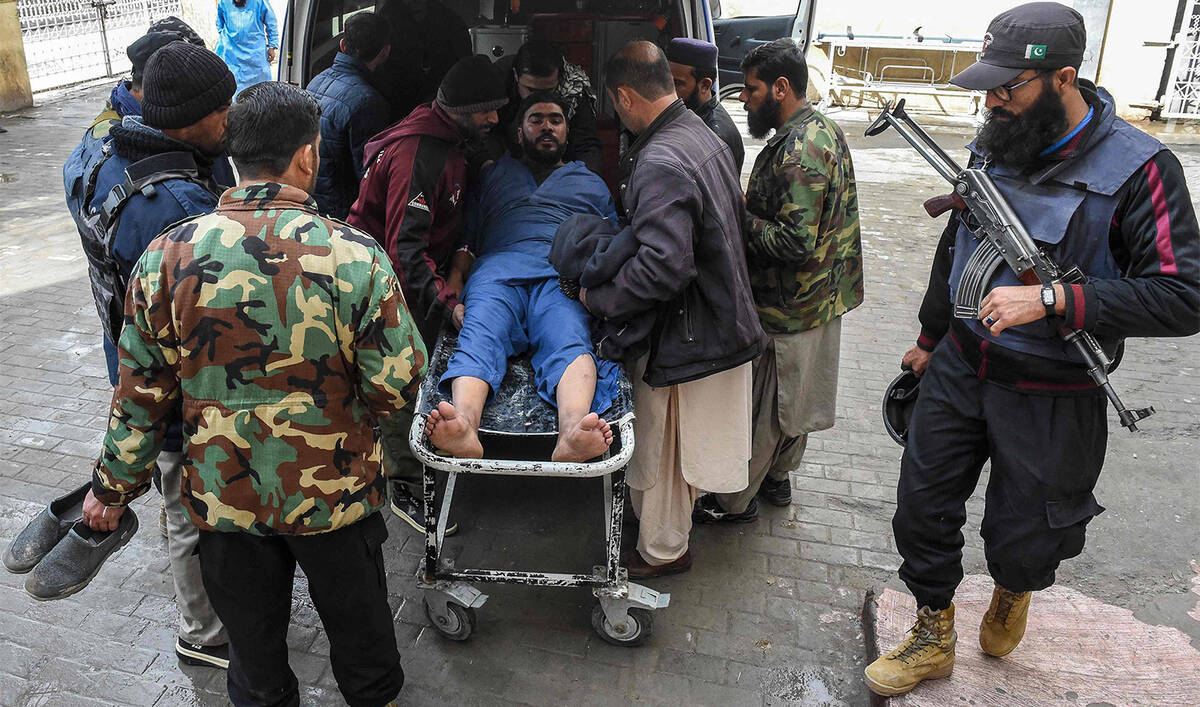
Security personnel shift an injured man at a hospital in Quetta on January 31, 2026, following an attack by Baloch separatists. Ethnic Baloch separatists launched "coordinated" attacks across Pakistan's Balochistan province on January 31, killing at least four policemen, officials said, the latest violence in insurgency-hit southwest region. (AFP)
A senior official at the Civil Hospital in Quetta told Arab News they had received 15 bodies, including nine policemen.
“Eight injured with bullet wounds were brought to the hospital,” said the official, who spoke on condition of anonymity. “Five of them were later shifted to the Combined Military Hospital (CMH) Quetta.”
Balochistan, which borders Iran and Afghanistan, is the site of a decades-long insurgency waged by Baloch separatist groups who often attack security forces and foreigners, and kidnap government officials.
Shahid Rind, the Balochistan chief minister’s aide for media and political affairs, said police and paramilitary Frontier Corps (FC) had foiled the attacks and were chasing the assailants.
“After the killing of more than 70 terrorists at different places in Balochistan in the last two days, terrorists have attempted to attack at a few places in Balochistan, which have been foiled by timely action by the police and FC,” he said on X.
“At present, the pursuit of the fleeing terrorists is underway. More details will be revealed very soon.”
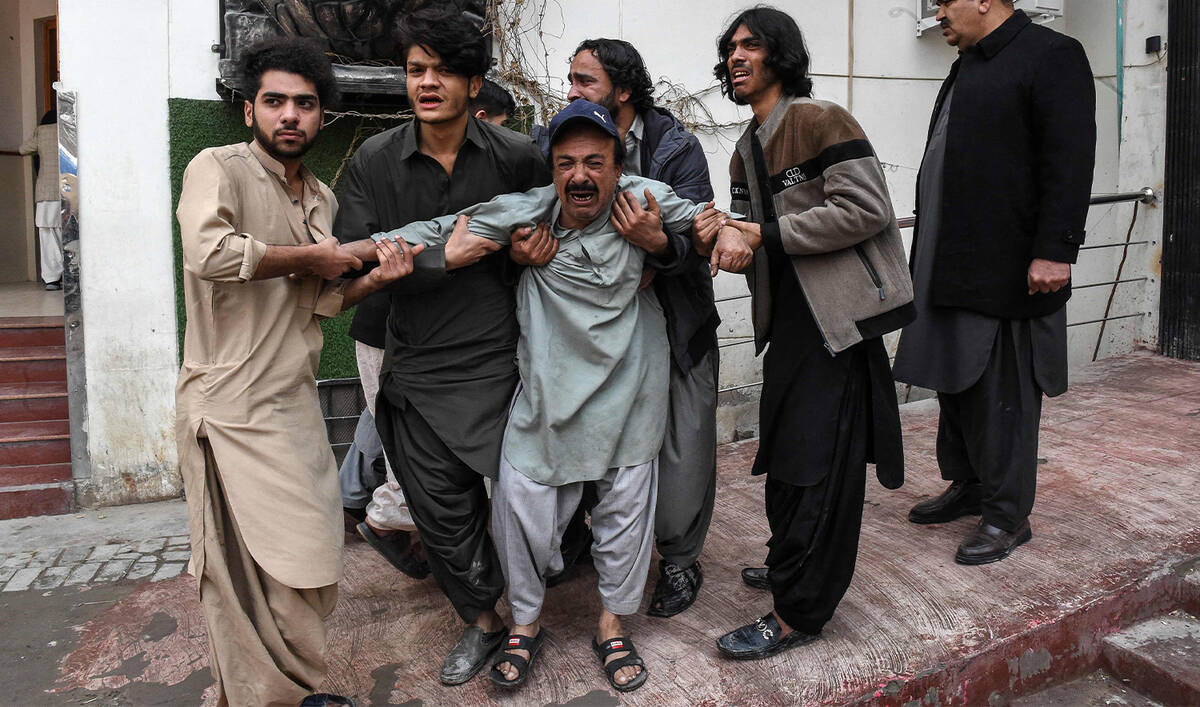
Family members mourn the death of a relative killed in an attack by Baloch separatists, at a hospital in Quetta on January 31, 2026. Ethnic Baloch separatists launched "coordinated" attacks across Pakistan's Balochistan province on January 31, killing at least four policemen, officials said, the latest violence in insurgency-hit southwest region. (AFP)
In a statement issued on Saturday, BLA said the group had launched ‘Operation Herof 2.0,’ which included a series of attacks in multiple cities of Balochistan.
Saturday’s attacks follow coordinated attacks carried out by the group in Aug. 2024 in various districts of Balochistan which killed dozens of people.
The separatists accuse the central government of stealing the region’s resources to fund development elsewhere in the country. The Pakistani government denies the allegations and says it is working for the uplift of local communities in Balochistan.
Pakistan Railways suspended train service from Balochistan to other parts of the country for a day, following Saturday’s attacks.
“Quetta-Peshawar bound Jaffar Express, and Quetta-Chaman passenger trains have been canceled due to the prevailing security situation in Balochistan,” Muhammad Kashif, the railways controller in Quetta division, told Arab News.