

Adani’s market losses top $100 billion as crisis shockwaves spread

1 / 2
Adani Group chairman Gautam Adani speaks at the World Congress of Accountants in Mumbai on Nov. 19, 22. (AFP file)
2 / 2
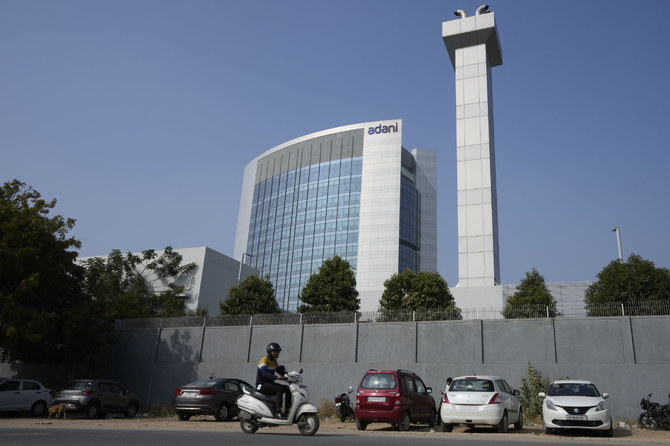
The Adani Corporate House in Ahmedabad, India. (AP File)
Short Url
Updated 03 February 2023
Follow

Adani’s market losses top $100 billion as crisis shockwaves spread

  • Mukesh Ambani of Reliance Industries is now Asia’s richest person as Adani Group chairman's net worth plunges
  • S&P Dow Jones Indices said it would remove Adani Enterprises from widely used sustainability indices

NEW DELHI/MUMBAI: Adani’s market losses swelled above $100 billion on Thursday, sparking worries about a potential systemic impact a day after the Indian group’s flagship firm abandoned its $2.5 billion stock offering.
Another challenge for Adani on Thursday came when S&P Dow Jones Indices said it would remove Adani Enterprises from widely used sustainability indices, effective Feb. 7, which would make the shares less appealing to sustainability-minded funds.
In addition, India’s National Stock Exchange said it has placed on additional surveillance shares of Adani Enterprises , Adani Ports and Ambuja Cements .
However, Adani Group Chairman Gautam Adani is in talks with lenders to prepay and release pledged shares as he seeks to restore confidence in the financial health of his conglomerate, Bloomberg News reported on Thursday.
The shock withdrawal of Adani Enterprises’ share sale marks a dramatic setback for founder Adani, the school dropout-turned-billionaire whose fortunes rose rapidly in recent years but have plunged in just a week after a critical research report by US-based short-seller Hindenburg Research.


ALSO READ: Who is Hindenburg, the firm targeting India’s Adani?


Aborting the share sale sent shockwaves across markets, politics and business. Adani stocks plunged, opposition lawmakers called for a wider probe and India’s central bank sprang into action to check on the exposure of banks to the group. Meanwhile, Citigroup’s wealth unit stopped making margin loans to clients against Adani Group securities.

The crisis marks an dramatic turn of fortune for Adani, who has in recent years forged partnerships with foreign giants such as France’s TotalEnergies and attracted investors such as Abu Dhabi’s International Holding Company as he pursues a global expansion stretching from ports to the power sector.
In a shock move late on Wednesday, Adani called off the share sale as a stocks rout sparked by Hindenburg’s criticisms intensified, despite it being fully subscribed a day earlier.
“Adani may have started a confidence crisis in Indian shares and that could have broader market implications,” said Ipek Ozkardeskaya, senior market analyst at Swissquote Bank.
Adani Enterprises shares tumbled 27 percent on Thursday, closing at their lowest level since March 2022.
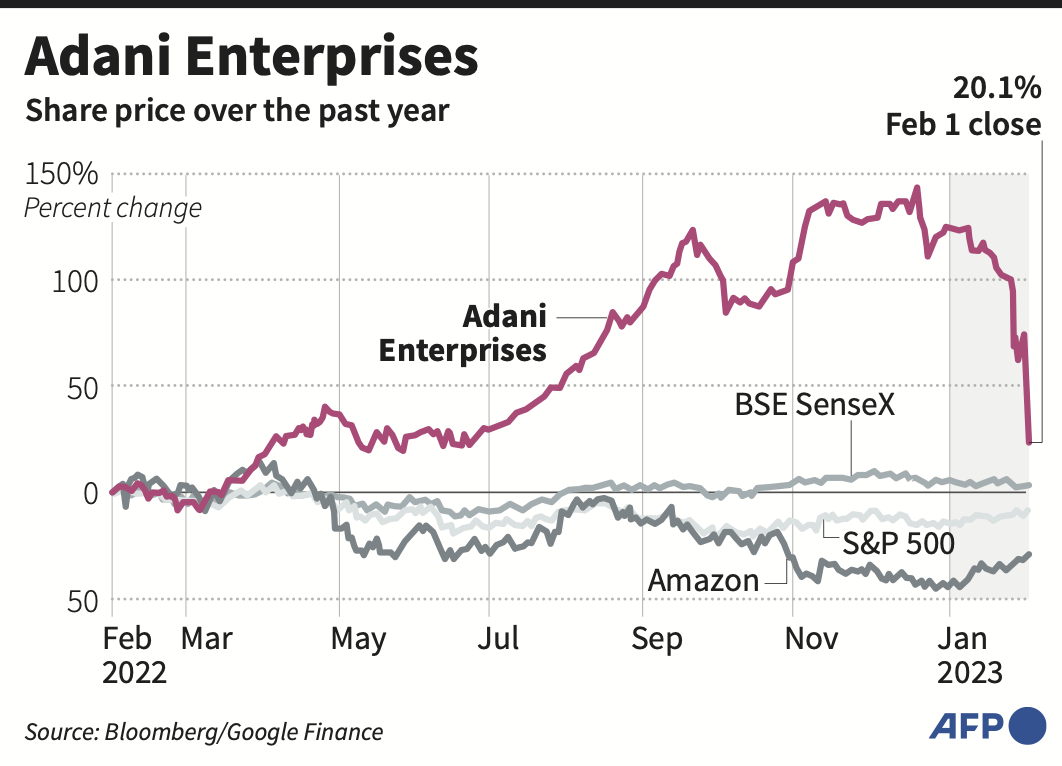
Other group companies also lost further ground, with 10 percent losses at Adani Total Gas, Adani Green Energy and Adani Transmission, while Adani Ports and Special Economic Zone shed nearly 7 percent.
Since Hindenburg’s report on Jan. 24, group companies have lost nearly half their combined market value. Adani Enterprises — described as an incubator of Adani’s businesses — has lost $26 billion in market capitalization.
Adani is also no longer Asia’s richest person, having slid to 16th in the Forbes rankings of the world’s wealthiest people, with his net worth almost halved to $64.6 billion in a week.
The 60-year-old had been third on the list, behind billionaires Elon Musk and Bernard Arnault.
His rival Mukesh Ambani of Reliance Industries is now Asia’s richest person.



Mukesh Ambani, chairman oil-to-telecom conglomerate Reliance Industries, is now Asia''s richest person. (AFP) file)


Broader concerns
Adani’s plummeting stock and bond prices have raised concerns about the likelihood of a wider impact on India’s financial system.
India’s central bank has asked local banks for details of their exposure to the Adani Group, government and banking sources told Reuters on Thursday.
CLSA estimates that Indian banks were exposed to about 40 percent of the $24.5 billion of Adani Group debt in the fiscal year to March 2022.
Dollar bonds issued by entities of Adani Group extended losses on Thursday, with notes of Adani Green Energy crashing to a record low. Adani Group entities made scheduled coupon payments on outstanding US dollar-denominated bonds on Thursday, Reuters reported citing sources.
“We see the market is losing confidence on how to gauge where the bottom can be and although there will be short-covering rebounds, we expect more fundamental downside risks given more private banks (are) likely to cut or reduce margin,” said Monica Hsiao, chief investment officer of Hong Kong-based credit fund Triada Capital.
In New Delhi, opposition lawmakers submitted notices in parliament demanding discussion of the short-seller’s report.
The Congress Party called for a Joint Parliamentary Committee be set up or a Supreme Court monitored investigation, while some lawmakers shouted anti-Adani slogans inside parliament, which was adjourned for the day.
Adani vs Hindenburg
Adani made acquisitions worth $13.8 billion in 2022, Dealogic data showed, its highest ever and more than double the previous year.
The canceled fundraising was critical for Adani, which had said it would use $1.33 billion to fund green hydrogen projects, airports facilities and greenfield expressways, and $508 million to repay debt at some units.
Hindenburg’s report alleged an improper use of offshore tax havens and stock manipulation by the Adani Group. It also raised concerns about high debt and the valuations of seven listed Adani companies.
The Adani Group has denied the accusations, saying the allegation of stock manipulation had “no basis” and stemmed from an ignorance of Indian law. It said it has always made the necessary regulatory disclosures.
Adani had managed to secure share sale subscriptions on Tuesday even though the stock’s market price was below the issue’s offer price. Maybank Securities and Abu Dhabi Investment Authority had bid for the anchor portion of the issue, investments which will now be reimbursed by Adani.
Late on Wednesday, the group’s founder said he was withdrawing the sale given the share price fall, adding his board felt going ahead with it “will not be morally correct.”


UAE, Kuwait and Egypt extend non-oil growth in December: PMI survey 

Updated 8 sec ago
Follow

UAE, Kuwait and Egypt extend non-oil growth in December: PMI survey 

RIYADH: Non-oil business activity across the UAE, Kuwait and Egypt expanded further in December, supported by rising new orders and steady demand, economy trackers showed. 

In its latest report, S&P Global revealed that the UAE’s Purchasing Managers’ Index eased slightly to 54.2 in December from a nine-month high of 54.8 in November, remaining firmly in expansion territory. 

A PMI reading above 50 indicates an expansion in non-oil business activity, while a figure below 50 signals contraction. 

The UAE’s non-oil sector performance aligns with broader trends across the Middle East and North Africa, where economies continue to pursue diversification efforts aimed at reducing reliance on crude revenues. 

Saudi Arabia led the PMI readings in the region in December, with the Kingdom recording 57.4, supported by rising new orders, continued growth in business activity and expanding employment. 

Commenting on the UAE data, David Owen, senior economist at S&P Global Market Intelligence, said: “The UAE non-oil sector concluded 2025 with a solid upturn, marking a year of robust but somewhat tempered growth in business conditions.” 

He added: “Positively, firms finished the year with two of their best months of activity growth, as the survey data suggested that sales were rising much faster compared to their low point in August.” 

According to the report, the pace of business expansion in December was among the fastest recorded during the year, with more than a quarter of surveyed companies reporting month-on-month increases in output. 

Surveyed non-oil firms attributed the growth in activity to rising new business intake, driven by improving market conditions, supportive government policies, increased customer numbers, and stronger international demand. 

Some companies reported subdued sales, citing intensifying competition and ongoing economic uncertainty. 

“Firms took encouragement from signs of increased customer spending, rising tourism, greater technology adoption and supportive government policies,” added Owen. 

Companies also reported mounting cost pressures in December, with survey data pointing to the fastest rise in overall input prices in 15 months. 

Respondents highlighted above-average increases in salary expenses, along with higher transport and maintenance costs. 

Cost pressures also affected inventory management, with firms reporting a notable decline in stock levels. 

Employment growth remained relatively subdued at the end of the fourth quarter, with hiring only marginal and weaker than in November. 

“December was also characterized by an acceleration of cost pressures and leaner inventory strategies, indicating that many firms were feeling the pinch on their balance sheets. Additionally, reports of heightened competition and challenges in finalizing new work highlighted ongoing headwinds for the non-oil sector as it heads into 2026,” added Owen. 

Looking ahead, companies remained optimistic, although confidence eased and was among the lowest levels seen in the past three years. 

In the same report, S&P Global said Dubai’s non-oil economy ended the year on a positive note, with the emirate’s PMI at 54.3 in December, slightly down from 54.5 in November. 

Kuwait confidence at 2-year high 

In a separate publication, S&P Global said business confidence among non-oil firms in Kuwait hit a two-year high in December. 

The country’s PMI rose to 54 in December from 53.4 in November, driven by sharp and accelerated increases in output and new orders. 

Marketing activities and the launch of new products were cited as key factors supporting growth during the month. 

New orders increased for the 35th consecutive month in December, with the pace of expansion the fastest since May. 

Although employment increased, hiring was not sufficient to prevent a further build-up in backlogs of work. 

“The Kuwaiti non-oil private sector has been building growth momentum through the final quarter of 2025 and is in a strong position as 2026 gets underway. In fact, companies are buoyant about prospects for the coming year, with business optimism among the highest since the survey began in 2018,” said Andrew Harker, economics director at S&P Global Market Intelligence. 

He added: “New orders continued to flow in quickly in December, and despite efforts by companies to expand their staffing levels accordingly, backlogged work accumulated to the largest extent on record. This suggests that output will need to be ramped up further in the months ahead.” 

Egypt stays in expansion zone 

In another report, S&P Global said Egypt’s PMI eased to 50.2 in December from a 61-month high of 51.1 in November. 

The index remained above the 50 thresholds for the second consecutive month, signaling a sustained improvement in the health of the non-oil private sector. 

Firms benefited from increased new orders in December, supporting a modest expansion in output, although growth in both areas slowed compared to the previous month. 

“Improvements in order books have been a clear factor behind strong business performances over the past few months,” said Owen. 

He added: “The uplift in sales arrived amid a softening of inflationary pressures in the Egyptian economy, which has enabled businesses and consumers to spend with more confidence. Adding to signs of growth spreading, firms’ purchases of inputs increased for the first time in ten months.” 

Non-oil companies in Egypt reported a renewed decline in employment during December, with most firms citing difficulties in replacing staff who had left. 
The overall reduction in employment was the sharpest in 13 months, though it remained modest. 

Despite improving business conditions, firms expressed caution toward future activity. 

The outlook for the next 12 months was neutral in December, reflecting subdued confidence during the latter half of 2025. 

“The overall upturn in business conditions was softer in December compared to one month ago, suggesting this growth trend should be treated with caution. Firms also face continued uncertainties in the domestic and global sphere, which has made them hesitant to show optimism,” added Owen.