Pope condemns “poison of greed” stoking conflict in Congo

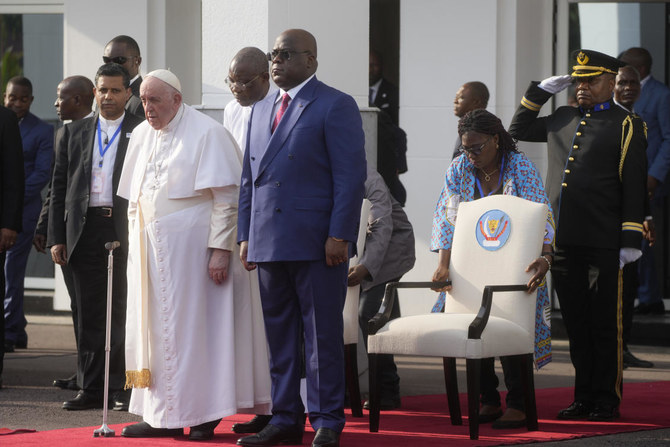
Pope Francis arrives with President of the Democratic Republic of the Congo Felix-Antoine Tshisekedi Tshilombo for a welcome ceremony at the “Palais de la Nation” in Kinshasa on Jan. 31, 2023. (AP)
Short Url
Updated 31 January 2023
Follow

Pope condemns “poison of greed” stoking conflict in Congo

  • The 86-year-old Francis is the first pontiff to visit Congo since John Paul II in 1985
  • "It is a tragedy that these lands, and more generally the whole African continent, continue to endure various forms of exploitation," he said

KINSHASA: Pope Francis denounced the “poison of greed” for mineral resources driving conflict in Democratic Republic of Congo as he began a visit there on Tuesday, saying the rich world could no longer ignore the tragic plight of many African nations.
The 86-year-old Francis is the first pontiff to visit Congo since John Paul II in 1985, when it was still known as Zaire. About half of Congo’s population of 90 million are Roman Catholics.
Tens of thousands of people cheered as he traveled from the airport into the capital Kinshasa in his popemobile, with some breaking away to chase his convoy while others chanted and waved flags in one of the most vibrant welcomes of his foreign trips.
But the mood changed when the pope gave a speech to dignitaries at the presidential palace, condemning “terrible forms of exploitation, unworthy of humanity” in Congo, where vast mineral wealth has fueled war, displacement and hunger.
“It is a tragedy that these lands, and more generally the whole African continent, continue to endure various forms of exploitation,” he said. “The poison of greed has smeared its diamonds with blood,” he said, referring to Congo specifically.
“Hands off the Democratic Republic of the Congo! Hands off Africa! Stop choking Africa: it is not a mine to be stripped or a terrain to be plundered,” he said.
Congo has some of the world’s richest deposits of diamonds, gold, copper, cobalt, tin, tantalum and lithium, but those have stoked conflict between militias, government troops and foreign invaders. Mining has also been linked to inhumane exploitation of workers, including children, and environmental degradation.
Compounding these problems, eastern Congo has been plagued by violence connected to the long and complex fallout from the 1994 genocide in neighboring Rwanda.
An estimated 5.7 million people are internally displaced in Congo and 26 million face severe hunger, largely because of the impact of armed conflict, according to the United Nations.
’PILGRIMAGE OF PEACE’
The Catholic Church plays a crucial role in running schools and health facilities in the country, as well as promoting democracy.
The pope criticized rich countries for closing their eyes and ears to the tragedies unfolding in Congo and elsewhere in Africa.
“One has the impression that the international community has practically resigned itself to the violence devouring it (Congo). We cannot grow accustomed to the bloodshed that has marked this country for decades, causing millions of deaths,” he said.
First scheduled for last July, the pope’s trip was postponed because he was suffering a flare-up of a chronic knee ailment. He had originally planned to travel to Goma, in eastern Congo, but that stop was scrapped because of a resurgence in fighting between the M23 rebel group and government troops.
In an apparent reference to the M23 and other militias active in Congo’s eastern regions, the pope said the Congolese people were fighting to preserve their territorial integrity “against deplorable attempts to fragment the country.”
On Wednesday, Francis will celebrate Mass at a Kinshasa airport and meet victims of violence from the east, further highlighting the issues he raised in his speech.
Francis will stay in Kinshasa until Friday morning, when he will fly to South Sudan, another country grappling with conflict and poverty.
In a first, he will be accompanied for that leg of his journey by the Archbishop of Canterbury, leader of the global Anglican Communion, and by the Church of Scotland Moderator. The religious leaders have described their joint visit as a “pilgrimage of peace.”


Two high-speed trains derail in Spain, police sources say 21 people killed

Updated 4 min 43 sec ago
Follow

Two high-speed trains derail in Spain, police sources say 21 people killed

  • The accident happened near Adamuz, in Cordoba province. So far, 21 people ​have been confirmed dead by police

MADRID: A high-speed train derailed and smashed into another oncoming train in southern Spain on Sunday, pushing the second train off the tracks in a collision that police sources confirmed to Reuters had killed at least 21 people.
The accident happened near Adamuz, in Cordoba province. So far, 21 people ​have been confirmed dead by police, with state broadcaster Television Espanola adding that 100 people had been injured, 25 seriously. The driver of one of the trains, which was traveling from Madrid to Huelva, was among those who died, the TV station added.
“The Iryo 6189 Malaga — (to Madrid) train has derailed from the track at Adamuz, crashing onto the adjacent track. The (Madrid) to Huelva train which was traveling on the adjacent track has also derailed,” said Adif, which runs the rail network, in a social media post.
Adif said the accident happened at 6:40 p.m. (1740 GMT), about 10 minutes after the Iryo train left Cordoba heading toward Madrid.
Iryo is a private rail operator, majority-owned by Italian state-controlled railway group Ferrovie dello Stato. The train involved was a Freccia 1000 train which was traveling between ‌Malaga and Madrid, ‌a spokesperson for Ferrovie dello Stato said.
The company said in a statement that it ‌deeply ⁠regretted what ​had happened ‌and had activated all emergency protocols to work closely with the relevant authorities to manage the situation.
The second train was operated by Renfe, which also did not respond to a request for comment.
Adif has suspended all rail services between Madrid and Andalusia.

HORRIFIC SCENE
The Iryo train had more than 300 passengers on board, while the Renfe train had around 100.
Paco Carmona, Cordoba fire chief, told TVE the first train heading to Madrid from Malaga had been evacuated.
The other train’s carriages were badly damaged, he said, with twisted metal and seats. “There are still people trapped. We don’t know how many people have died and the operation is concentrating on getting people out of areas which are very narrow,” he ⁠said. “We have to remove the bodies to reach anyone who is still alive. It is proving to be a complicated task.”
Transport Minister Oscar Puente said he was following events ‌from rail operator Adif’s headquarters in Madrid.
“The latest information is very serious,” ‍he posted on X. “The impact was terrible, causing the first two ‍carriages of the Renfe train to be thrown off the track. The number of victims cannot be confirmed at this time. ‍The most important thing now is to help the victims.”
The mayor of Adamuz, Rafael Moreno, told El Pais newspaper that he had been among the first to arrive at the scene of the accident alongside the local police and saw what he believed to be a badly lacerated body several meters from the accident site.
“The scene is horrific,” he said. “I don’t think they were on the same track, but it’s not clear. Now ​the mayors and residents of the area are focused on helping the passengers.”

CALLS FOR MEDICS
Images on local television showed a reception center set up for passengers in the town of Adamuz, population 5,000, with locals coming ⁠and going with food and blankets amid nighttime temperatures of around 42 degrees Fahrenheit (6 degrees Celsius).
A woman named Carmen posted on X that she had been on board the Iryo train to Madrid. “Ten minutes after departing (from Cordoba) the train started to shake a lot, and it derailed from coach 6 behind us. The lights went out.”
Footage posted by another Iryo train passenger, also on X, showed an Iryo staffer in a fluorescent jacket instructing passengers to remain in their seats in the darkened carriages, and those with first aid training to keep watch over fellow passengers. He also urged people to maintain mobile phone batteries to be able to use their torches when they disembarked.
Salvador Jimenez, a journalist for RTVE who was on board the Iryo train, shared images showing the nose of the rear carriage of the train lying on its side, with evacuated passengers sitting on the side of the carriage facing upwards.
Jimenez told TVE by phone from beside the stricken trains that passengers had used emergency hammers to smash the windows and climb out, and they had seen two people taken ‌out of the overturned carriages on stretchers.
“There’s a certain uncertainty about when we’ll get to Madrid, where we’ll spend the night, we’ve had no message from the train company yet,” he said. “It’s very cold but here we are.”