

S. Sudan’s displaced hope pope’s visit will bring peace

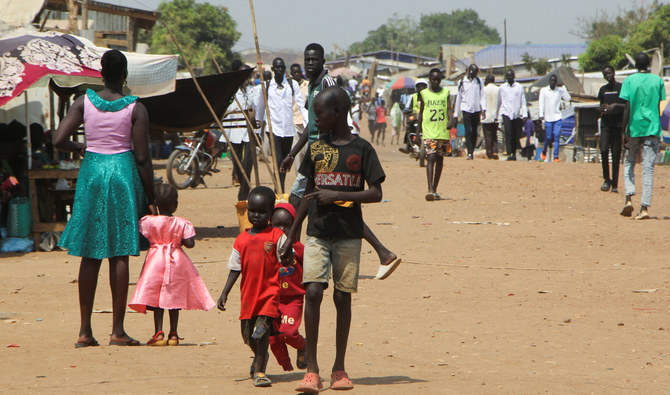
Internally displaced civilians walk at the Protection of Civilian site (PoC) 3 site in the United Nations Mission in South Sudan (UNMISS) compound outside Juba, South Sudan, January 23, 2023. (Reuters)
Short Url
Updated 26 January 2023
Follow

S. Sudan’s displaced hope pope’s visit will bring peace

  • Pope Francis is due to go to Congo from Jan. 31 to Feb. 3 and then spend two days in South Sudan

JUBA: After spending nearly a decade in a camp for the displaced in South Sudan’s Juba, Mayen Galuak hopes that Pope Francis’ visit to the capital city next week will inspire political leaders to finally restore peace, allowing him to go home.

The 44-year-old entered the UN camp, just a few kilometers from his residence, in search of safety three days after conflict broke out in 2013.

In the ensuing years, he has watched as South Sudan’s leaders forged peace deals and broke them; as militias carried out and denied ethnic massacres; and as relentless conflict pushed parts of the country into famine.

Pope Francis is due to go to Congo from Jan. 31 to Feb. 3 and then spend two days in South Sudan. 

The pope has wanted to visit South Sudan for years but plans were postponed due to the instability there and a scheduled trip last June was canceled due to the pope’s knee ailment.

The Vatican’s envoy to the Democratic Republic of Congo has said the trip will remind the world not to ignore decades-long conflicts.

“We are in a bad situation ... since 2013, we have not seen any good peace,” said Galuak, who says he can’t travel to his birth home in the country’s north because of the risk of attack. Sporadic clashes continue to kill civilians throughout the country.

South Sudan gained independence in 2011.


Gazans salvage ancient books in mosque library damaged by war

Updated 17 sec ago
Follow

Gazans salvage ancient books in mosque library damaged by war

  • The Great Omari Mosque library sustained terrible damaged during the war in Gaza
  • The mosque now stands largely ruined, with its library littered with rubble and dust

GAZA CITY, Palestinian Territories: Inside the dusty shell of one of the oldest libraries in the Palestinian territories, a group of Gazan volunteers work diligently to salvage what remains of their ancient cultural heritage.
The Great Omari Mosque library sustained terrible damaged during the war in Gaza, which erupted in October 2023 and devastated swathes of the Palestinian territory, including cultural and religious sites.
The mosque — in the old town of Gaza City — now stands largely ruined, with its library littered with rubble and dust.
“I was shocked and stunned when I saw the extent of the destruction in the library,” Haneen Al-Amsi told AFP, saying the scenes of devastation had spurred her to help launch the restoration initiative.
Amsi, who heads the Eyes on Heritage Volunteer Foundation, said the western part of the library was burned when the mosque was hit, causing irreversible damage.
“The library was estimated to contain about 20,000 books, but currently we are left with fewer than 3,000 or 4,000,” she explained.
Among the debris, volunteers hoping to restore the collection pored over charred fragments of manuscript and shards of yellowed paper.
“The library of the Great Omari Mosque is considered the third largest library in Palestine after the Al-Aqsa Mosque library and the Ahmed Pasha Al-Jazzar library,” Amsi said.
“It is an important historical library that contains original manuscripts and a diverse collection of books on jurisprudence, medicine, Islamic law, literature and various other subjects.”
Gaza’s history stretches back thousands of years, making the tiny territory a treasure trove of archaeological artefacts from past civilizations including Canaanites, Egyptians, Persians and Greeks.
But more than two years of war between Israel and Hamas took a heavy toll on Gaza’s heritage sites.
As of January 2026, the UN’s cultural agency UNESCO, had verified damage to 150 sites since the start of the war on October 7, 2023 sparked by Hamas’s attack on Israel.
These include 14 religious sites and 115 buildings of historical or artistic interest.

- ‘Represent history’ -

Inside one of the library’s old stone rooms, one woman used a paintbrush to dust off an old tome, while other volunteers wearing facemasks and gloves crouched on the floor to leaf through piles of books.
“The condition of the rare and historical books is deplorable due to their being left for more than 700 to 800 days,” Amsi said, talking of “immense damage and gunpowder residue” on the volumes.
An independent United Nations commission said in June 2025 that Israeli attacks on schools, religious and cultural sites in Gaza amounted to war crimes.
“Israel has obliterated Gaza’s education system and destroyed more than half of all religious and cultural sites in the Gaza Strip,” the UN Independent International Commission of Inquiry on the Occupied Palestinian Territory said in a report.
Israel rejected the commission as “an inherently biased and politicized mechanism of the Human Rights Council” and said the report was “another attempt to promote its fictitious narrative of the Gaza war.”
For Amsi, the importance of restoring the books lay in preserving crucial historic records.
“These books represent the history of the city and bear witness to historical events,” she said.