

Playing in Saudi Arabia ‘huge honor’ for me, Pakistani footballer says after hero’s welcome home

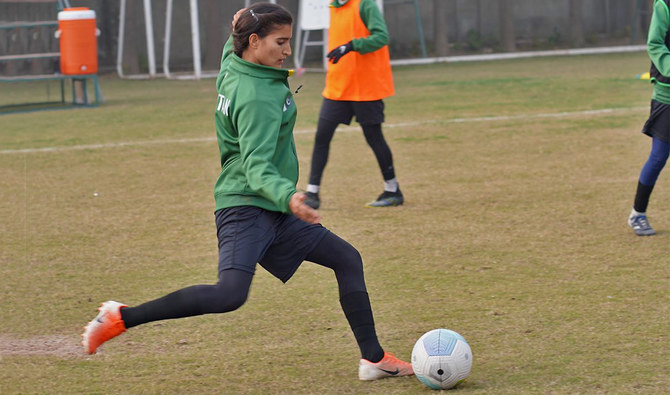
Pakistani woman footballer Sahiba Sardil kicks football during a practice session in Lahore, Pakistan on December 24, 2023. (@TheRealPFF/Twitter)
Short Url
Updated 30 January 2023
Follow

Playing in Saudi Arabia ‘huge honor’ for me, Pakistani footballer says after hero’s welcome home

  • Saudi Arabia won the four-nation football tournament this month, while Pakistan finished runners-up
  • The absence of a proper football facility meant Sardil grew up kicking around football in a dusty space

KARACHI: Pakistani woman footballer Sahiba Sardil, who received a hero’s welcome upon her return to her hometown after participating in a four-nation tournament in Saudi Arabia, said on Sunday that playing in the Kingdom was a “huge honor” for her.

Pakistan fared well in the Women’s International Friendly Tournament held from January 11-19 in Saudi Arabia, finishing runners-up and the hosts winning the tournament. Pakistan started the event on a high note, beating Comoros 1-0 on January 11 before losing 2-1 to Mauritius on January 15.

The green shirts ended the tournament on an impressive note and drew the final match against tournament champions Saudi Arabia 1-1, courtesy of a stellar free-kick goal from skipper Maria Khan. The goal, netted from a considerable distance, won plaudits on social media and laurels for the Pakistan women’s team.

Sardil, who plays as a defender, returned home to a hero’s welcome in Pakistan’s southern port city of Karachi. Video clips have gone viral on social media of her being garlanded with roses as she arrived in Mauripur — a small fishing town in the metropolis — with men dancing to the beat of the drums and waving the Pakistani flag.

Sardil told Arab News she relished the experience of playing an international tournament for the first time ever.

“To go to Saudi Arabia [and play there] was a huge honor for me, to travel outside of Pakistan,” the footballer said.

“It felt really good to go there, the grounds were really impressive and to play there felt really special as we don’t have such grounds in Pakistan.”
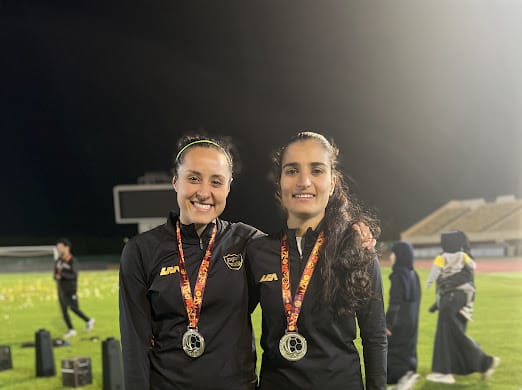


Pakistani woman footballers Maria Khan (left) and Sahiba Sardil pose for a picture in Saudi Arabia on January 20, 2023. (Photo courtesy: Pakistan Football Federation)

She said her team could properly practice in Saudi grounds, owing to their sheer size. According to Sardil, playing against the Kingdom’s women’s team was another wonderful experience.

“We felt really good playing against them [Saudi Arabia], it felt as if we were playing football properly,” she said. “[the other teams] were committing a lot of fouls and hitting the opponents.”

Sardil, whose father is a fisherman and remains usually away for months at sea, recalled how she joyfully told him over the phone about the warm reception she received upon returning home.

“My father called me so I told him about the welcome I received. He was very happy. I told him that this is the happiest day of my life, but you’re not around me,” a visibly emotional Sardil said.

“’I am not with you but my prayers are always with you’,” she quoted her father as saying.

But for Sardil, making it to the national squad was no easy task. Growing up in a conservative locality where women remain within the confines of their homes, Sardil used to play football with her male cousins. The absence of a proper football ground meant she had to contend with kicking around a football in a dusty space.

With only one goalpost at their disposal, Sardil and her cousins used to mark the other one by placing stones on the ground. Her father, who Sardil says had “strict rules” for the women of their household, gave in and allowed her to join a football academy three years ago.

As part of the Pakistani national women’s football team, Sardil got an opportunity to meet her counterparts from other countries, including Saudi Arabia. She said she enjoyed interacting with one particular Laila, the Saudi team’s goalkeeper.

The Pakistan team, Sardil recalled, ended up taking a selfie with Laila and shared other light moments together.

“It was a great experience,” she added. “I will always remember those 10 days I spent in Saudi Arabia.”

T20 World Cup: ICC deputy chief in Lahore for talks after Pakistan boycotts India match

Updated 08 February 2026
Follow

T20 World Cup: ICC deputy chief in Lahore for talks after Pakistan boycotts India match

  • Islamabad’s boycott over Bangladesh’s exclusion has threatened the tournament’s most lucrative game
  • Bangladesh Cricket Board chief has also arrived in Pakistan and is expected to participate in meetings

ISLAMABAD: International Cricket Council (ICC) Deputy Chairman Imran Khwaja arrived in Lahore on Sunday for talks with Pakistan Cricket Board (PCB) officials, the PCB said, as the sport’s governing body strives to save a high-stakes T20 World Cup clash between arch-rivals Pakistan and India.

The development follows Islamabad’s decision to boycott the Feb. 15 Pakistan-India match in Colombo, a move to protest the ICC’s exclusion of Bangladesh from the ongoing T20 World Cup.

The controversy over Pakistan’s participation erupted after the ICC replaced Bangladesh with Scotland, following Bangladesh’s decision to not play matches in India owing to security fears.

The ICC has since requested the Pakistan Cricket Board to reconsider the decision to boycott their match against India in Colombo or they will have to forfeit the marquee game of the tournament.

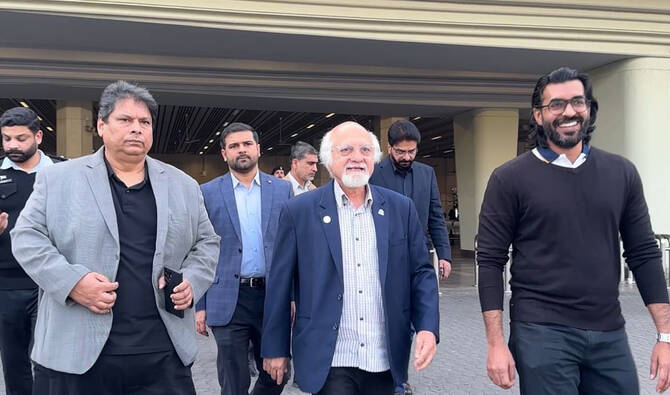
“ICC Deputy Chairman Imran Khwaja arrived in Lahore,” the PCB said on Sunday, adding that he was received at the airport by the PCB chairman’s adviser, Aamir Mir.

Prior to Khwaja’s arrival in Lahore, where the PCB is headquartered, Pakistan welcomed Bangladesh Cricket Board (BCB) President Aminul Islam, who was received by PCB CEO Salman Naseer.

The two visiting officials are scheduled to meet PCB Chairman Mohsin Naqvi.

“Bangladesh Cricket Board President Aminul Islam will also take part in other meetings,” the PCB said in a statement, hinting that he will be part of the meeting with ICC’s Khwaja.

The dispute stems from the ICC’s decision to replace Bangladesh with Scotland last month after Bangladesh refused to play tournament matches in India. Dhaka’s decision followed the removal of Mustafizur Rahman from the Indian Premier League (IPL). He was bought for $1 million by the IPL’s Kolkata Knight Riders, but on Jan. 3 the Board of Control for Cricket in India (BCCI) ordered Kolkata to release Mustafizur without a public explanation but amid regional tensions.

Pakistan have boycotted the 27th match of the tournament against India, due to take place at R. Premadasa Stadium in Colombo. An India-Pakistan fixture is the sport’s most lucrative asset, generating a massive share of global broadcasting and sponsorship revenue.

The PCB has remained defiant amid reports of potential sanctions. On Saturday, the board rejected claims by Indian media that it had initiated a dialogue with the ICC to find a way out of the standoff.

“I categorically reject the claim by Indian sports journalist Vikrant Gupta that PCB approached the ICC,” PCB’s Mir said in a statement. “As usual, sections of Indian media are busy circulating fiction. A little patience and time will clearly show who actually went knocking and who didn’t.”

The standoff highlights the growing friction within the sport’s governance.

Pakistan has accused India’s cricket board of influencing the ICC’s decisions.

Defense Minister Khawaja Asif this week called for the formation of a new cricket governing body, saying the ICC, currently chaired by Jay Shah, son of India’s Home Minister Amit Shah, was being held “hostage” to “Indian political interests.”

India generates the largest share of cricket’s commercial revenue and hence enjoys considerable influence over the sport. Critics argue that this financial contribution translates into decisive leverage within the ICC.

A large part of that revenue comes from the Indian Premier League (IPL), the sport’s most lucrative T20 cricket competition, which is run by the Board of Control for Cricket in India (BCCI). Between 2024 and 2027, the IPL is projected to earn $1.15 billion, nearly 39 percent of the ICC’s total annual revenue, according to international media reports.

While the Pakistani government cleared the team to participate in the rest of the tournament, Prime Minister Shehbaz Sharif maintained that the boycott of the India game was necessary to protest the “unjust” treatment of Bangladesh.