

‘Politically motivated’: Pakistan rejects US State Department report on rights abuses

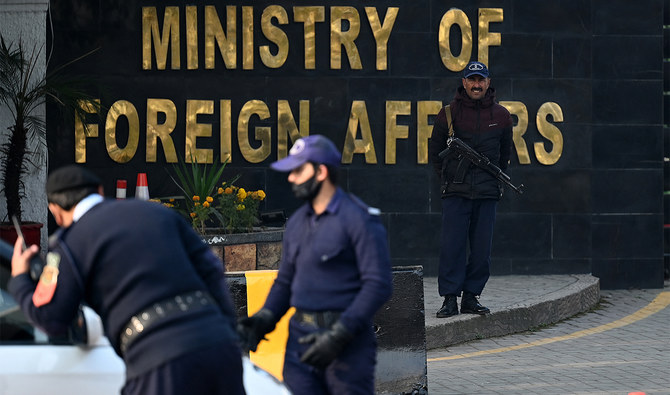
Pakistani police officers stand guard outside the Ministry of Foreign Affairs in Islamabad on January 18, 2024. (AFP/File)
Short Url
Updated 25 April 2024
Follow

‘Politically motivated’: Pakistan rejects US State Department report on rights abuses

  • Annual assessment identified arbitrary detentions, extrajudicial killings, enforced disappearances
  • Pakistan government and state agencies deny involvement in missing persons cases, other rights abuses 

ISLAMABAD: Pakistan said on Thursday it “categorically” rejected the 2023 country report on human rights practices issued by the US State Department, saying the report was politically motivated, lacking in objective evidence and followed an agenda of “politicization of international human rights.”

The annual human rights assessment released earlier this week identified arbitrary killings, extrajudicial killings, enforced disappearance, torture and “cases of cruel, inhuman, or degrading treatment or punishment by the government or its agents” in Pakistan last year.

The report also said the government “rarely took credible steps” to identify and punish officials who may have committed rights abuses.

“The contents of the report are unfair, based on inaccurate information and are completely divorced from the ground reality,” the Pakistani foreign office said in a statement, adding that the assessment used a “domestic social lens to judge human rights in other countries in a politically biased manner.”
 
“This year’s report is once again conspicuous by its lack of objectivity and politicization of the international human rights agenda. It clearly demonstrates double standards thus undermining the international human rights discourse.”

The foreign office said it was “deeply concerning” that a report purported to highlight human rights issues around the world was ignoring or downplaying the “most urgent hotspots of gross human rights violations” like Gaza and Kashmir. It also called on the US demonstrate the “requisite moral courage” to speak the truth about all situations and play a constructive role in supporting international efforts to end human rights violations.

“In line with its constitutional framework and democratic ethos, Pakistan remains steadfast in its commitment to strengthen its own human rights framework, constructively engage to promote international human rights agenda, and uphold fairness and objectivity in the international human rights discourse,” the FO added. 

Political leaders, rights groups and families of victims have long accused the government, the army and intelligence agencies of being behind cases of arbitrary detentions, extrajudicial killings and enforced disappearances, among other rights abuses. Families say people picked up by security forces on the pretext of fighting militancy or crime often disappear for years, and are sometimes found dead, with no official explanation. Pakistani state agencies deny involvement in such cases. 

On Tuesday, Pakistan’s law minister said the government would reconstitute a committee to address enforced disappearances, hours after the release of the US report.

“Now the work is being initiated on this again on the directives of the prime minister. A committee is going to be reconstituted, there will be parliamentary presence in that committee,” Law Minister Azam Nazeer Tarar said. 

“There is no lack of seriousness on the government’s part to resolve this issue.”


‘Fully stand with Bangladesh’: Pakistan PM backs decision to boycott India match

Updated 04 February 2026
Follow

‘Fully stand with Bangladesh’: Pakistan PM backs decision to boycott India match

  • Pakistan’s government have not allowed the national cricket team to play its World Cup match against India on Feb. 15
  • Pakistan has accused India of influencing ICC decisions, criticized global cricket body for replacing Bangladesh in World Cup

ISLAMABAD: Prime Minister Shehbaz Sharif on Wednesday backed his government’s decision to bar the national men’s cricket team from playing against India in the upcoming T20 World Cup tournament, reaffirming support for Bangladesh. 

Pakistan’s government announced on social media platform X last week that it has allowed its national team to travel to Sri Lanka for the World Cup. However, it said the Green Shirts will not take the field against India on their scheduled match on Feb. 15. 

Pakistan’s participation in the tournament was thrown into doubt after Pakistan Cricket Board (PCB) Chairman Mohsin Naqvi criticized the International Cricket Council (ICC) for replacing Bangladesh with Scotland. The decision was taken after Bangladesh said it would not let its team travel to India out of security concerns. 

During a meeting of the federal cabinet, Sharif highlighted that Pakistan has said that politics should be kept away from sports. 

“We have taken this stand after careful consideration and in this regard, we should stand fully with Bangladesh,” Sharif said in televised remarks. 

“And I believe this is a very reasonable decision.”

Pakistan has blamed India for influencing the ICC’s decisions. The global cricket governing body is currently led by Jay Shah, the head of the Board of Control for Cricket in India. Shah is the son of Indian Home Minister Amit Shah. 

Pakistan’s boycott announcement has triggered media frenzy worldwide, with several Indian cricket experts and analysts criticizing Islamabad for the decision. An India-Pakistan cricket contest is by far the most lucrative and eagerly watched match of any ICC tournament. 

The ICC has ensured that the two rivals and Asian cricket giants are always in the same group of any ICC event since 2012 to capitalize on the high-stakes game. 

The two teams have played each other at neutral venues over the past several years, as bilateral cricket remains suspended between them since 2013 due to political tensions. 

Those tensions have persisted since the two nuclear-armed nations engaged in the worst fighting between them since 1999 in May 2025, after India blamed Pakistan for an attack in Indian-administered Kashmir that killed tourists. 

Pakistan denied India’s allegations that it was involved in the attack, calling for a credible probe into the incident.