

Pakistan’s president, PM express sorrow after 50 die in twin transport mishaps

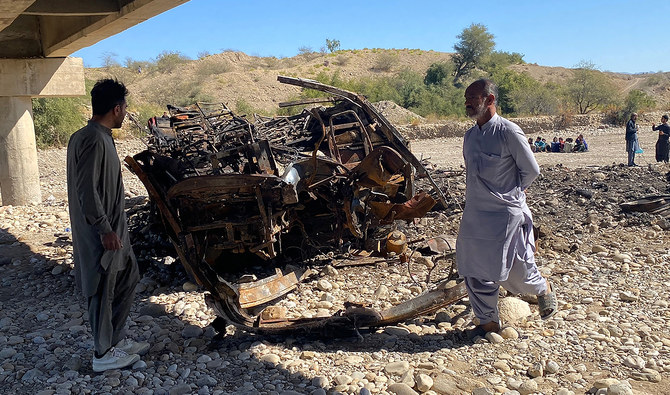
Residents look at the wreckage of a burnt passenger bus in Lasbela district of Pakistan's Balochistan province on January 29, 2023. (Photo courtesy: AFP)
Short Url
Updated 29 January 2023
Follow

Pakistan’s president, PM express sorrow after 50 die in twin transport mishaps

  • A passenger bus fell into a ravine and caught fire in Balochistan's Bela area, killing at least 40 people
  • In second mishap, 10 children were killed after their ferry capsized in country's northwest on Sunday

KARACHI: Pakistan's President Dr. Arif Alvi and Prime Minister Shehbaz Sharif in separate statements on Sunday expressed “deep grief and sorrow” over two transport tragedies that left at least 50 people dead and renewed the debate about transport safety protocols in the South Asian country.

In the first incident, a passenger bus fell into a ravine and later caught fire in the Bela area of Pakistan's southwestern Balochistan province, where road accidents claim thousands of lives annually.  At least 40 people were killed in the accident. 

In another incident, 10 children, aged between seven to 14 years, died when their boat capsized in Tanda Dam lake near Kohat in the country's northwest, according to police.  The boat was carrying between 25 and 30 students on a day trip from a local madrassa when it overturned.

“The president has stressed authorities take practical steps to avert the occurrence of such incidents in the future,” the state-owned Associated Press of Pakistan (APP) reported, citing a statement from the president’s secretariat said.

“The prime minister has directed [authorities concerned] to ensure the provision of all available medical facilities to the injured,” the Prime Minister’s House said in a statement according to the APP. 

Balochistan, a mountainous, desert region bordering Afghanistan and Iran, is Pakistan’s largest but most impoverished province, with a staggering 40,000-kilometer network of road infrastructure.  

According to the Motorway police, 6,000 to 8,000 people die each year in accidents across the Balochistan province, mainly on single-lane roads that have infamously come to be known as "killer highways."  

“A bus going from Quetta to Karachi plunged into a ravine and caught fire at around 3 am,” Hamza Anjum Nadeem, the Bela assistant commissioner, told Arab News. "At least 39 bodies have been recovered and search for others is underway."  

Anjum later confirmed the death of another passenger, taking the count to 40.

Of these, 38 dead bodies were being moved to the southern port city of Karachi, 177 kilometers away from Bela, for medico-legal formalities, Karachi Police Surgeon Dr. Summaiya Syed told Arab News.

Balochistan is the epicenter of the $64 billion China-Pakistan Economic Corridor (CPEC), a road and infrastructure development plan, which aims to ultimately provide the shortest route for Chinese cargo headed for the Middle East, Africa, and Central Asia.  

Major roads are slated for construction under the CPEC, including the road from Balochistan’s Khuzdar district to the Chinese-funded, deepwater port of Gwadar. But for now, the absence of dual carriageways, inadequate training of drivers, and a lack of highway patrol mean thousands continue to die on these roads each year.  

Like road accidents, mass drownings are also common in Pakistan when aged and overloaded vessels lose their stability and pitch passengers into the water.

In July, 18 women drowned when an overcrowded boat carrying a wedding party across the Indus river in Punjab province capsized.

The South Asian country also has poor road safety controls and thousands of lives are lost to road crashes each year, particularly in the southwestern Balochistan province.

According to the National Road Safety Strategy 2018-2030, a report administered by the Asian Development Bank that cited police data, 6,548 people died at the scene of an accident on Pakistan’s roads in 2016. Of these, 355 fatalities happened on national highways and 6,003 on provincial roads.  

At least seven people were killed, and 15 others were injured after a passenger bus collided with a truck in Balochistan's Killa Saifullah district this month.    

In June last year, 22 people were killed when a passenger bus veered off a narrow road and fell into a ravine in the same district.


Dozens killed as security forces repulse separatist attacks in Pakistan’s Balochistan

Updated 4 sec ago
Follow

Dozens killed as security forces repulse separatist attacks in Pakistan’s Balochistan

  • The attacks unfolded early Saturday when outlawed Baloch Liberation Army members attacked several cities in the restive region
  • Security official says 37 militants, 10 security personnel killed in skirmishes that revived memories of similar attack in 2024

QUETTA/ISLAMABAD: Dozens of militants and security personnel and policemen were killed as Pakistani security forces repulsed coordinated attacks by separatist militants in the southwestern Balochistan province, officials said on Saturday, in the latest incident of violence in the insurgency-hit region.

Separatist militants, affiliated with the Balochistan Liberation Army (BLA), launched “coordinated” attacks in several cities of Balochistan early Saturday, according to a senior police official, who requested anonymity.

The attacks in the provincial capital of Quetta began at around 6am with a powerful explosion, followed by intense gunfire that lasted for two hours along with multiple explosions. Residents of Dalbandin and Nuhski said they heard explosions and gunfire, while similar attacks were launched in Mastung, Gwadar, Pasni and Turbat.

A security official said Pakistani forces had repulsed the attacks and killed 37 “Indian-backed militants,” who were in continuous contact with “their handlers in Afghanistan.” Islamabad has frequently blamed such attacks on India and Afghanistan, an allegation consistently denied by Kabul and New Delhi.

“The terrorists of Fitna Al-Hindustan (Indian-backed Baloch separatist groups) launched coordinated attacks this morning at more than 12 locations, including Quetta, Noshki, Dalbandin, Pasni, and Gwadar,” the security official said.

“In these attacks, 37 terrorists have been eliminated. Throughout the operation, the terrorists were reportedly in continuous contact with their handlers in Afghanistan. Ten security personnel were martyred while few others were injured.”

Security personnel shift an injured man at a hospital in Quetta on January 31, 2026, following an attack by Baloch separatists. Ethnic Baloch separatists launched "coordinated" attacks across Pakistan's Balochistan province on January 31, killing at least four policemen, officials said, the latest violence in insurgency-hit southwest region. (AFP)

A senior official at the Civil Hospital in Quetta told Arab News they had received 15 bodies, including nine policemen.

“Eight injured with bullet wounds were brought to the hospital,” said the official, who spoke on condition of anonymity. “Five of them were later shifted to the Combined Military Hospital (CMH) Quetta.”

Balochistan, which borders Iran and Afghanistan, is the site of a decades-long insurgency waged by Baloch separatist groups who often attack security forces and foreigners, and kidnap government officials.

Shahid Rind, the Balochistan chief minister’s aide for media and political affairs, said police and paramilitary Frontier Corps (FC) had foiled the attacks and were chasing the assailants.

“After the killing of more than 70 terrorists at different places in Balochistan in the last two days, terrorists have attempted to attack at a few places in Balochistan, which have been foiled by timely action by the police and FC,” he said on X.

“At present, the pursuit of the fleeing terrorists is underway. More details will be revealed very soon.”

Family members mourn the death of a relative killed in an attack by Baloch separatists, at a hospital in Quetta on January 31, 2026. Ethnic Baloch separatists launched "coordinated" attacks across Pakistan's Balochistan province on January 31, killing at least four policemen, officials said, the latest violence in insurgency-hit southwest region. (AFP)

In a statement issued on Saturday, BLA said the group had launched ‘Operation Herof 2.0,’ which included a series of attacks in multiple cities of Balochistan.

Saturday’s attacks follow coordinated attacks carried out by the group in Aug. 2024 in various districts of Balochistan which killed dozens of people.

The separatists accuse the central government of stealing the region’s resources to fund development elsewhere in the country. The Pakistani government denies the allegations and says it is working for the uplift of local communities in Balochistan.

Pakistan Railways suspended train service from Balochistan to other parts of the country for a day, following Saturday’s attacks.

“Quetta-Peshawar bound Jaffar Express, and Quetta-Chaman passenger trains have been canceled due to the prevailing security situation in Balochistan,” Muhammad Kashif, the railways controller in Quetta division, told Arab News.