

HADAF, NIDLP sign agreement to support Saudization in industrial, logistics sectors

1 / 2
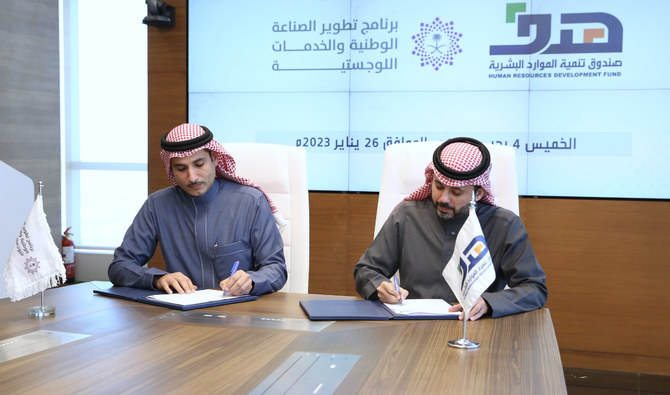
Turki Al-Jawini, Director General of HADAF (R), and Suliman Al-Mazroua CEO of NIDLP sign an agreement to support Saudization. (Supplied)
2 / 2
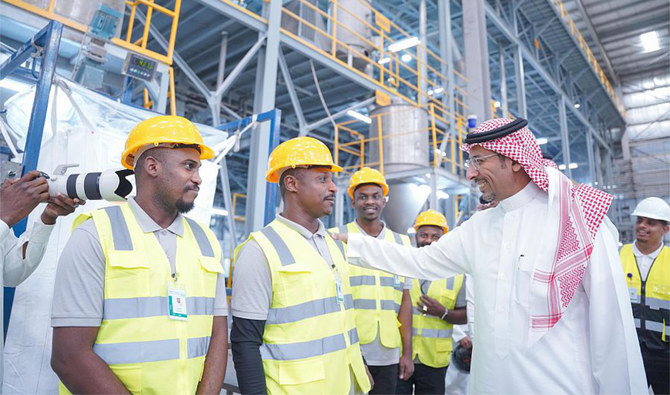
Bandar Alkhorayef, minister of industry and mineral resources, during a tour of industrial cities in Jeddah in March 2022. (SPA)
Short Url
Updated 26 January 2023
Follow

HADAF, NIDLP sign agreement to support Saudization in industrial, logistics sectors

  • The agreement aims to transform the Kingdom into a leading industrial power and an international logistics platform in several promising areas

RIYADH: The Saudi Human Resources Development Fund, known as HADAF, concluded a cooperation agreement with Saudi Arabia’s National Industrial Development and Logistics Program in Riyadh on Thursday, Jan. 26, to support the training and recruitment of national cadres in opportunities generated by program’s initiatives.

In a joint statement, the two sides agreed to contribute to the development of human capital in support of the Kingdom’s Vision 2030 initiatives.

The agreement was signed by Turki Al-Jawini, director-general of HADAF, and Suliman Al-Mazroua, CEO of NIDLP. 

The agreement aims to transform the Kingdom into a leading industrial power and an international logistics platform in several promising areas, focusing on the application of 4G technologies for industry. It will also contribute to the creation of employment and training opportunities for national cadres.

The agreement’s provisions include cooperation in the exchange of information, the transfer of expertise and the implementation of joint projects. 

The parties also agreed to establish a joint working group to provide periodic reports on the progress of work.

HADAF revealed that in 2022 it supported the employment of 400,000 citizens in private-sector enterprises through the fund’s programs and initiatives.

Al-Jawini said that the fund has undergone many transformations over the past year and is presently working in partnership with various government and private-sector companies to empower Saudis with job opportunities.

The number of people who benefitted from the fund’s training and counseling services in the past year exceeded 1.49 million, he added, while the number of enterprises that benefitted from the fund’s services during the same period exceeded 138,000.

Total disbursements on training and support programs over the past year reached SR6 billion ($266 million), Al-Jawini said.

Crown Prince Mohammed bin Salman launched in October 2022 the National Industrial Strategy, which aims to drive growth in the sector and increase the number of factories to 36,000 by 2035, SPA reported.

The strategy also aims to develop an industrial economy that attracts investment and contributes to achieving economic diversification and sustainable growth by developing domestic products and non-oil exports in line with the objectives of Saudi Vision 2030.

Saudi Arabia is seeking to triple manufacturing by 2030, to create tens of thousands of high-quality jobs and to increase the value of industrial exports to SR557 billion, the total additional investments in the sector to SR1.3 trillion and the export of advanced technology products sixfold.

Through the strategy, the Kingdom aims to empower the private sector, increase the flexibility and competitiveness of the industrial sector, lead the regional industrial integration of value chains and achieve global leadership by investing in promising new technologies.

Saudi Arabia is currently the fourth largest manufacturer of petrochemical products in the world, while its industrial outputs contribute to global supply and manufacturing chains.


Saudi deputy foreign minister calls for Sudanese unity during meeting in Cairo

Updated 8 sec ago
Follow

Saudi deputy foreign minister calls for Sudanese unity during meeting in Cairo

  • Waleed Al-Khuraiji says a political solution to the civil war in Sudan must be based on respect for its sovereignty
  • He rejects quasi-government formed by one of the warring factions in July, denounces external intervention in form of weapons supplies and foreign fighters

LONDON: Saudi Arabia’s deputy foreign minister, Waleed Al-Khuraiji, on Wednesday stressed the important need to maintain the territorial integrity of Sudan.

Speaking at the fifth Sudan peace coordination meeting in Cairo, he said a political solution to the civil war that began in April 2023 must be based on respect for Sudanese sovereignty and unity.

He highlighted the efforts the Kingdom is making in an attempt to ensure stability in Sudan, help reach a ceasefire agreement that ends the conflict, prevent the collapse of state institutions, and maintain the unity, territorial integrity and capabilities of the country, the Saudi Press Agency reported.

Al-Khuraiji also said that Saudi efforts to address the worsening humanitarian crisis caused by the war are continuing, in an attempt to alleviate the suffering of the Sudanese people.

It is important that the conflicting factions return to political dialogue, he added, as stated in the Jeddah Declaration of May 2023 and the short-term ceasefire deal that was agreed that same month.

The war in Sudan, between rival military factions the Sudan Armed Forces and the paramilitary Rapid Support Forces, poses a threat to regional stability, Al-Khuraiji warned.

He rejected the quasi-government formed by the Rapid Support Forces in July last year as an obstruction to ongoing efforts to resolve the crisis, a threat to the unity and sovereignty of Sudan, and a risk to regional security and the safety of the Red Sea.

“The announcement of parallel entities outside the framework of legitimate institutions is worrying and disrupts efforts through the political track to solve the crisis,” he said.

The prevention of external intervention in the conflict, including illegal support in the form of weapon supplies and foreign fighters, is crucial for efforts to achieve a ceasefire and facilitate humanitarian operations, Al-Khuraiji added.

He also called for the establishment of safe corridors so that deliveries of aid can reach those in need, similar to a mechanism established in August last year at the Adre crossing on Sudan’s border with Chad.