

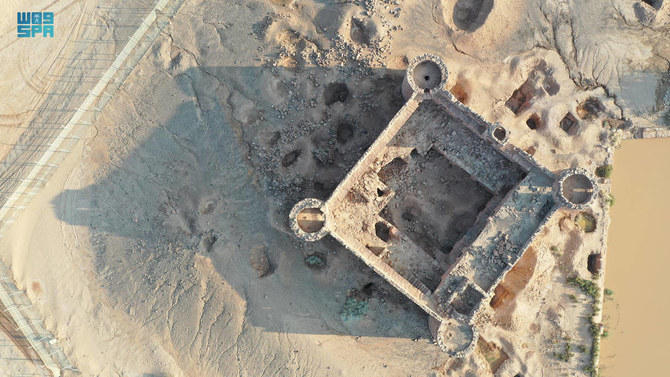
ThePlace: Al-Muazzam Fort, one of the most impressive desert forts in Saudi Arabia

1 / 4
The fort was established in 1031 A.H. (1622 A.D.) as a station for pilgrims and Umrah performers to rest. (SPA)
2 / 4
The fort was established in 1031 A.H. (1622 A.D.) as a station for pilgrims and Umrah performers to rest. (SPA)
3 / 4
The fort was established in 1031 A.H. (1622 A.D.) as a station for pilgrims and Umrah performers to rest. (SPA)
4 / 4
The fort was established in 1031 A.H. (1622 A.D.) as a station for pilgrims and Umrah performers to rest. (SPA)
Short Url
Updated 03 April 2023
Follow

ThePlace: Al-Muazzam Fort, one of the most impressive desert forts in Saudi Arabia

  • It includes the pond of Al-Muazzam and the Hijaz railway station

Al-Muazzam Fort in the Tabuk region typifies the detail of Islamic architecture and reflects the interest of the late Islamic eras in serving pilgrims on the Levant route.

The fort was established in 1031 A.H. (1622 A.D.) as a station for pilgrims and Umrah performers to rest. It also served as a headquarters for military barracks to secure the way to and from Madinah and Makkah.

Its total area is 10,000 square meters and its walls, which were built in a rectangular shape, store memories spanning more than four centuries. In the middle of the fort, a large yard  is surrounded by rooms, staircases and upper passages.

Refined stones were used to build the fort, which has two floors topped by a protective wall as high as the internal corridor. Its four facades have no windows except for small openings that were once used to defend the fort.

It includes the pond of Al-Muazzam and the Hijaz railway station. Reddish-yellow carved stone was used to construct the fort, which bears four foundation inscriptions.

Al-Muazzam Fort’s distinctive large entrance includes an arch and defensive openings.

The fort was visited by many well-known travelers and explorers, including Germany’s Julius Oetting in 1301 A.H. (1884 A.D.), who was accompanied by France’s Charles Huber. The trip was documented in the book “A Journey in the Arabian Peninsula.”


14 sculptures go on display at public spaces in Riyadh

Updated 11 December 2025
Follow

14 sculptures go on display at public spaces in Riyadh

  • The works were chosen by Riyadh Art from its international Tuwaiq Sculpture symposium to reflect its ‘vision of weaving beauty and intellect into the city’s fabric’
  • Initiative aligns with efforts to make art a key part of city’s identity that improves quality of life and promotes the cultural economy, says Royal Commission for Riyadh City’s Khalid Al-Hazani

RIYADH: Fourteen sculptures selected from the annual international Tuwaiq Sculpture symposium, a Riyadh Art program, went on display on Wednesday at three prominent public spaces across the Saudi capital: ROSHN Front, the SEDRA residential community, and Sports Boulevard.

The project is part of Riyad Art’s efforts to showcase artworks in public spaces, and the addition of more works in other places is expected later.

Khalid Al-Hazani, the executive vice president of the lifestyle sector at the Royal Commission for Riyadh City, said: “This step reflects (Riyadh Art’s) vision of weaving beauty and intellect into the city’s fabric, and creating vibrant and culturally rich public spaces, allowing art to become an integral part of people’s daily lives.”

It is also in line with Riyadh Art’s broader strategy for transforming the city into an open-air art gallery, he added, thereby “turning art into a central element of the city’s identity and a key contributor to improving quality of life and promoting the cultural economy.” 

The Riyadh Art Program installed on Wednesday 14 sculptures selected from the Tuwaiq International Sculpture Symposium at prominent locations in Riyadh, including the ROSHN Front, SEDRA Residential Community, and Sports Boulevard. (Supplied)

The three chosen locations were considered perfect places to host the artworks because of their vibrancy, strong community connections and accessibility, Al-Hazani noted.

“This provides residents and visitors with the opportunity to engage with the sculptures in their everyday lives,” he said.

Seven of the sculptures have been installed at ROSHN Front, considered a key urban hub. The artworks on display there form a thought-provoking artistic landscape that encourages interaction, organizers said, and explores a number of themes including the values of urban transformation, community spirit, and creative curiosity.

Three sculptures are on display at the SEDRA residential community. Chosen to complement its serene character and nature-integrated urban planning, they blend in with their surroundings to reflect the values of environmental harmony, contemplation and renewal, organizers explained.

The remaining four sculptures are at Sports Boulevard, known for its open, green spaces. These works reflect several concepts, in particular ideas of nature, balance and public health.

All of the sculptures are part of Riyadh Art’s permanent collection, which includes works created by local and international artists during the Tuwaiq Sculpture symposium.