

Power returns to cities in Pakistan day after massive outage

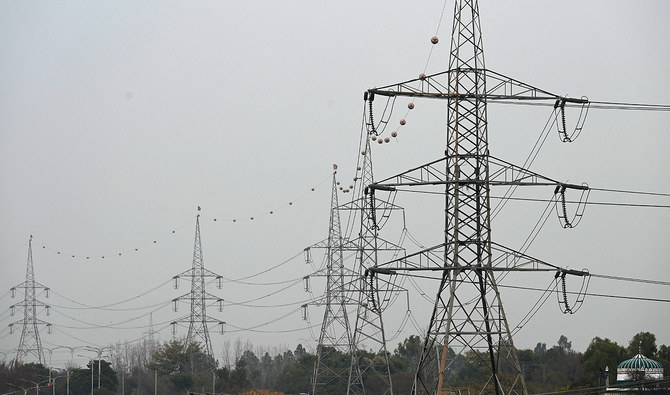
A general view of the high voltage lines during a nationwide power outage in Rawalpindi on January 23, 2023. (Photo courtesy: AFP)
Short Url
Updated 24 January 2023
Follow

Power returns to cities in Pakistan day after massive outage

  • The outage started around 7:30am on Monday, a failure linked to a cost-cutting measure
  • Power largely returned to mega cities overnight, with localized and brief falls in connection

ISLAMABAD: Power had returned to most cities across Pakistan on Tuesday, a day after a nationwide breakdown left the country of 220 million people without electricity.

The outage started around 7:30 am (0230 GMT) on Monday, a failure linked to a cost-cutting measure as Pakistan grapples with an economic crisis.

Energy Minister Khurram Dastgir Khan said on Monday evening that power was being gradually restored.

Electricity largely returned to mega cities Karachi and Lahore overnight, but with localized and brief falls in connection continuing.

The capital Islamabad and other cities, including Rawalpindi, Quetta, Peshawar and Gujranwala, also reported that the lights were back on.

However, some rural areas were still waiting to be reconnected.

The country’s power system is a complex and delicate web, where problems can quickly cascade.

Khan said a variation in frequency on the national grid caused the cut, as power generation units were turned on early Monday morning.

The units are temporarily switched off on winter nights to save fuel, he had told reporters earlier.

Localized power cuts are common in Pakistan, and hospitals, factories and government institutions are often kept running by private generators. But the machines are beyond the means of most citizens and small businesses.

In parts of northern Pakistan, temperatures were due to drop below freezing overnight with supplies of natural gas — the most common heating method — also unreliable due to load-shedding.

The economy is already hobbled by rampant inflation, a falling rupee and severely low foreign exchange reserves, with the power cut piling extra pressure on small businesses.

In the garrison city of Rawalpindi, homeware trader Muhammad Iftikhar Sheikh, 71, said he was unable to demonstrate electronic products to browsing patrons.

“The customers never buy without testing first,” he said. “All of us are sitting idle.”

Schools mostly continued either in the dark or using battery-powered lighting.

A shop owner in the southern port city Karachi, where temperatures were higher, told AFP he feared his entire dairy stock would spoil without refrigeration.

Printer Khurrum Khan, 39, said orders were piling up because of the blackout.

Unreliable power is “a permanent curse which our governments have failed to overcome,” he said.

Mobile phone services were also disrupted as a result of the outage, the Pakistan Telecommunication Authority tweeted.

A similar breakdown in January 2021 affected the entire country, after a fault occurred in southern Pakistan, tripping the national transmission system.


PM calls for tapping gemstone reserves as Pakistan pushes for economic recovery

Updated 26 January 2026
Follow

PM calls for tapping gemstone reserves as Pakistan pushes for economic recovery

  • Pakistan this month approved first national policy framework for precious stones, aiming to lift annual exports to $1 billion
  • PM Shehbaz Sharif directs implementation of new policy framework, completion of Islamabad Gemstone Center by Aug. 2027

ISLAMABAD: Prime Minister Shehbaz Sharif on Monday called for tapping Pakistan’s vast gemstone reserves, Sharif’s office said, as Islamabad seeks to boost their exports to support economic recovery.

The development comes two weeks after Pakistan approved its first national policy framework for gemstones and precious stones, aiming to reform the sector, align it with international standards and lift annual exports to $1 billion within five years.

Pakistan has intensified efforts to monetize its untapped mineral resources, amid fiscal pressures and an International Monetary Fund-backed reform program. Over the past two years, Islamabad has hosted international minerals conferences and signed agreements with countries including the United States, Saudi Arabia and China to attract investment and move up the value chain in mining and minerals processing.

On Monday, PM Sharif presided over a meeting on the promotion of precious stones and minerals in Islamabad, at which he directed seeking services of relevant experts of international repute for the construction of proposed gemstone centers in Islamabad, Gilgit-Baltistan and Azad Kashmir, according to his office.

“There is a need to utilize the potential of gemstone reserves in Pakistan so that valuable foreign exchange can be earned from the exports of these precious stones,” Sharif was quoted as saying by his office.

Despite officials estimating Pakistan’s gemstone reserves at around $450 billion, formal exports remain negligible, at about $5.8 million annually, due to weak certification systems, limited domestic processing capacity, widespread smuggling and fragmented regulation across federal and provincial authorities.

Pakistan’s new policy framework includes geological mapping to accurately assess reserves, the establishment of internationally accredited laboratories and certification regimes and the creation of a dedicated authority to regulate and promote the sector. The government also plans to set up a National Warranty Office and centers of excellence to support training, research and value-added processing.

The prime minister directed the implementation of the policy framework and the completion of Islamabad Gemstone Center by Aug. 2027.

A location has been identified on the Constitution Highway for the establishment of a gemstone center in Islamabad, according to Sharif’s office. The center will provide international standard value addition services, certification, incubation center and trade center facilities.

“Exports should be increased through value addition in the gemstone industry,” he said, urging officials to work together with the governments of all provinces, Gilgit-Baltistan and Azad Kashmir to promote the industry.