

Global partnerships required to address supply chain issues in Saudi Arabia: ROSHN CEO 

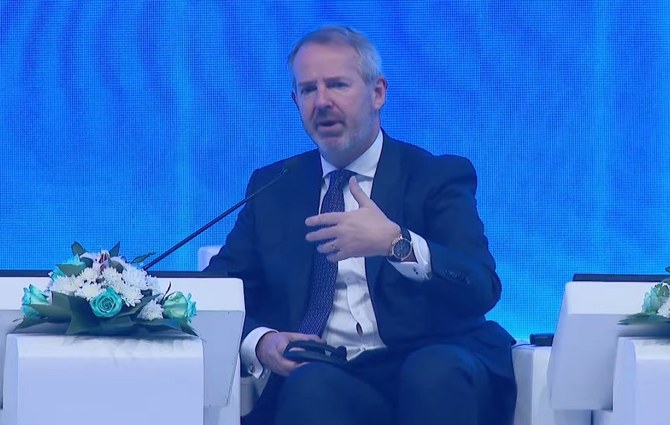
Speaking at the Real Estate Future Forum in Riyadh on Jan. 23, David Grover, CEO of ROSHN, said demand is being driven by the volume of developments in the Kingdom’s giga-projects. (Supplied)
Short Url
Updated 23 January 2023
Follow

Global partnerships required to address supply chain issues in Saudi Arabia: ROSHN CEO 

RIYADH: International cooperation with foreign companies is required to address the supply chain issues in Saudi Arabia's booming construction sector, according to a top real estate developer.  

Speaking at the Real Estate Future Forum in Riyadh on Jan. 23, David Grover, CEO of ROSHN, said demand is being driven by the volume of developments in the Kingdom’s giga-projects. 

As a solution, he suggested that Saudi firms need to be partnering with companies from around the world to address the commodities and supply chain issues.  

He said his company has huge mandates in the Kingdom at the moment, as they are working hard to materialize the goals outlined in Vision 2030.  

“In terms of the volume of construction we are trying to do at the moment is quite large. The supply chain within the Kingdom will no doubt struggle to support us and the rest of the giga-projects,” warned Grover.  

The executive revealed that ROSHN is constantly carrying out negotiations with investors abroad to come into Saudi Arabia, as the Kingdom has a healthy business atmosphere to invest in.  

"It is a great time to come to (Saudi Arabia). It is without a doubt the busiest construction and real estate market on the planet at the moment.”  

According to a report by the US Saudi Business Council, the construction sector in Saudi Arabia maintained its growth momentum in the third quarter of 2022 with contracts worth SR25.2 billion ($6.7 billion) awarded during the period,  

The report suggested that multiple Vision Realization Programs in the fields of tourism, housing, and infrastructure development drove the sector’s growth in the Kingdom. 

Grover pointed out that the private sector also has a huge role to play even though most of the giga-projects in the Kingdom are fueled by the government. 

“Retal and Al Akaria, two of our private sector partners, are absolutely competing with our own products in a very supportive way. There is plenty of space for local private companies to come along and work with us,” he explained.  

According to Grover, ROSHN has a nationwide focus as it sails ahead in the real estate sector.  

ROSHN’s first project SEDRA is being developed over eight phases in Riyadh’s northern sector. In November 2022, the company started the key handover at the first phase of development at SEDRA, ahead of the scheduled time.  

ROSHN also launched the first phase of its Al Arous project in Jeddah in November, named ‘The Bride of the Red Sea’ which will offer more than 2,200 single-family units.  

In December 2022, ROSHN acquired the shopping and business areas of Riyadh Front, a mega business and leisure development. 


Kuwait to boost Islamic finance with sukuk regulation

Updated 8 sec ago
Follow

Kuwait to boost Islamic finance with sukuk regulation

  • The move supports sustainable financing and is part of Kuwait’s efforts to diversify its oil-dependent economy

RIYADH: Kuwait is planning to introduce legislation to regulate the issuance of sukuk, or Islamic bonds, both domestically and internationally, as part of efforts to support more sustainable financing for the oil-rich Gulf nation, Prime Minister Sheikh Ahmad Abdullah Al-Ahmad Al-Sabah said on Wednesday.

Speaking at the World Governments Summit in Dubai, Al-Sabah highlighted that Kuwait is exploring a variety of debt instruments to diversify its economy. The country has been implementing fiscal reforms aimed at stimulating growth and controlling its budget deficit amid persistently low oil prices. Hydrocarbons continue to dominate Kuwait’s revenue stream, accounting for nearly 90 percent of government income in 2024.

The Gulf Cooperation Council’s debt capital market is projected to exceed $1.25 trillion by 2026, driven by project funding and government initiatives, representing a 13.6 percent expansion, according to Fitch Ratings.

The region is expected to remain one of the largest sources of US dollar-denominated debt and sukuk issuance among emerging markets. Fitch also noted that cross-sector economic diversification, refinancing needs, and deficit funding are key factors behind this growth.

“We are about to approve the first legislation regulating issuance of government sukuk locally and internationally, in accordance with Islamic laws,” Al-Sabah said.

“This enables us to deal with financial challenges flexibly and responsibly, and to plan for medium and long-term finances.”

Kuwait returned to global debt markets last year with strong results, raising $11.25 billion through a three-part bond sale — the country’s first US dollar issuance since 2017 — drawing substantial investor demand. In March, a new public debt law raised the borrowing ceiling to 30 billion dinars ($98 billion) from 10 billion dinars, enabling longer-term borrowing.

The Gulf’s debt capital markets, which totaled $1.1 trillion at the end of the third quarter of 2025, have evolved from primarily sovereign funding tools into increasingly sophisticated instruments serving governments, banks, and corporates alike. As diversification efforts accelerate and refinancing cycles intensify, regional issuers have become regular participants in global debt markets, reinforcing the GCC’s role in emerging-market capital flows.

In 2025, GCC countries accounted for 35 percent of all emerging-market US dollar debt issuance, excluding China, with growth in US dollar sukuk issuance notably outpacing conventional bonds. The region’s total outstanding debt capital markets grew more than 14 percent year on year, reaching
$1.1 trillion.