

Mikati convenes Cabinet session and urges unity to elect new president

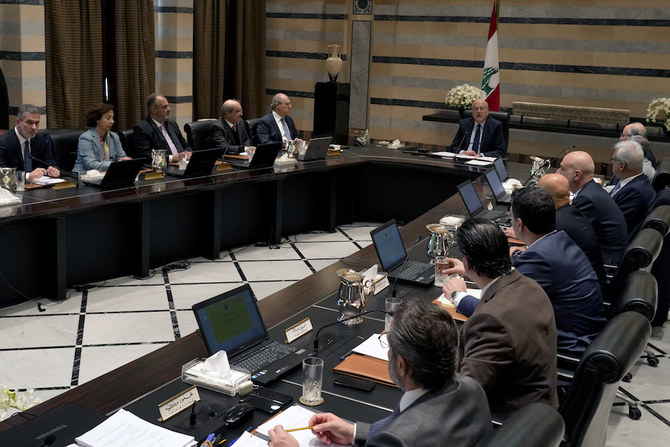
Lebanese caretaker Prime Minister Najib Mikati, center right, heads the cabinet meeting in Beirut, Lebanon, Wednesday, Jan. 18, 2023. (AP)
Short Url
Updated 18 January 2023
Follow

Mikati convenes Cabinet session and urges unity to elect new president

  • The session was attended by 17 ministers, including seven of 12 Christian ministers
  • The ministers of the Free Patriotic Movement boycotted the session

BEIRUT: The Lebanese caretaker government held its second session amid the presidential vacuum on Wednesday.

The ministers of the Free Patriotic Movement boycotted the session, arguing that a caretaker government has no right to hold sessions to manage the country’s affairs.

The session was attended by 17 ministers, including seven of 12 Christian ministers. Hezbollah’s ministers also attended after being given permission by their leader, Hassan Nasrallah.

In total, six were absent — the ministers of defense, foreign affairs, energy, emigrants, social affairs and justice.

The caretaker Prime Minister, Najib Mikati, persuaded Economy Minister Amin Salam and Tourism Minister Walid Nassar to attend. Both are affiliated with the FPM but are not official members.

He also persuaded Kamal Hayek, chairman of the board of directors of Electricité du Liban, to attend despite FPM’s influence over the Energy Ministry.

Mikati, who has been fiercely criticized by the FPM for holding Cabinet sessions, said their only purpose was to serve citizens during a national crisis.

The Cabinet approved two treasury advances. The first for $62 million will pay for fuel from ships already waiting at sea. The treasury has had to pay fines on the shipments already.

The second, for $54 million, is intended to pay for the maintenance of Lebanon’s power stations.

Mikati said afterwards that the government needed to take steps to protect food security by getting cash for essentials such as wheat. Such needs cannot be postponed for sectarian and political ends, he said.

“Any government action in the future will be consistent with the logic of the constitution and safeguarding partnership. It does not seek to challenge or provoke any party,” he said.

He said all in parliament must come together to solve the nation’s problems, not least choosing a new president.

“The essence of partnership and respect for the constitution would be for everyone to assume national responsibility; hence our call to quickly move forward toward consensus in order to elect a president capable of bringing together the Lebanese before it is too late.”

Political squabbling however continued as parliament prepared on Thursday for an 11th attempt to elect a new president. 

The head of the Lebanese Forces, Samir Geagea, accused Hezbollah and its allies of obstructing the process.

He also said parliament speaker Nabih Berri was helping the bloc disrupt the voting sessions in an attempt to wear down MPs and force through their preferred candidate.

“We will not accept this, and we will consult all parties to agree on a sovereign president,” Geagea said.

The Council of Maronite Bishops urged MPs to assume their responsibilities to prevent the country’s collapse.

Under the Lebanese constitution, a Maronite usually assumes the presidency, while others are given key roles including the leadership of the army, the governorship of the Banque du Liban and senior judicial positions.

The council said it was concerned there was an attempt to create a vacuum in the Maronite positions in particular, and the Christian positions in general, to change the nation’s identity.

Public school teachers meanwhile held sit-ins in protest at going unpaid, saying the situation was so perilous that many of them could not cover the cost of traveling to work. 

Donor countries have so far refused Ministry of Education appeals for help.


Lebanese finance minister denies any plans for a Kushner-run economic zone in the south

Updated 45 min 44 sec ago
Follow

Lebanese finance minister denies any plans for a Kushner-run economic zone in the south

  • Proposal was made by US Envoy Morgan Ortagus but was ‘killed on the spot’
  • Priority is to regain control of state in all aspects, Yassine Jaber tells Arab News

DAVOS: Lebanon’s finance minister dismissed any plans of turning Lebanon’s battered southern region into an economic zone, telling Arab News on the sidelines of the World Economic Forum’s meeting in Davos that the proposal had died “on the spot.”

Yassine Jaber explained that US Envoy to Lebanon Morgan Ortagus had proposed the idea last december for the region, which has faced daily airstrikes by Israel, and it was immediately dismissed.

Jaber’s comments, made to Arab News on the sidelines of the World Economic Forum in Davos, were in response to reports which appeared in Lebanese media in December which suggested that parts of southern Lebanon would be turned into an economic zone, managed by a plan proposed by Jared Kushner, US President Donald Trump’s son in law.

Meanwhile, Jaber also dismissed information which had surfaced in Davos over the past two days of a bilateral meeting between Lebanese ministers, US Middle East Envoy Steve Witkoff and Kushner.

Jaber said that the meeting on Tuesday was a gathering of “all Arab ministers of finance and foreign affairs, where they (Witkoff and Kushner) came in for a small while, and explained to the audience the idea about deciding the board of peace for Gaza.”

He stressed that it did not develop beyond that.

When asked about attracting investment and boosting the economy, Jaber said: “The reality now is that we need to reach the situation where there is stability that will allow the Lebanese army, so the (Israeli) aggression has to stop.”

Over the past few years, Lebanon has witnessed one catastrophe after another: one of the world’s worst economic meltdowns, the largest non-nuclear explosion in its capital’s port, a paralyzed parliament and a war with Israel.

A formal mechanism was put in place between Lebanon and Israel to maintain a ceasefire and the plan to disarm Hezbollah in areas below the Litani river.

But, the minister said, Israel’s next step is not always so predictable.

“They’re actually putting pressure on the whole region. So, a lot of effort is being put on that issue,” he added.

“There are still attacks in the south of the country also, so stability is a top necessity that will really succeed in pushing the economy forward and making the reforms beneficial,” he said.

Lawmakers had also enacted reforms to overhaul the banking sector, curb the cash economy and abolish bank secrecy, alongside a bank resolution framework.

Jaber also stressed that the government had recently passed a “gap law” intended to help depositors recover funds and restore the banking system’s functionality.

“One of the priorities we have is really to deal with all the losses of the war, basically reconstruction … and we have started to get loans for reconstructing the destroyed infrastructure in the attacked areas.”

As Hezbollah was battered during the war, Lebanon had a political breakthrough as the army’s general, Joseph Aoun, was inaugurated as president. His chosen prime minister was the former president of the International Court of Justice, Nawaf Salam.

This year marks the first time a solid delegation from the country makes its way to Davos, with Salam being joined by Jaber, Economy and Trade Minister Amr Bisat, and Telecoms Minister Charles Al-Hage.

“Our priority is to really regain the role of the state in all aspects, and specifically in rebuilding the institutions,” Jaber said.