

Pakistan’s Sherry Rehman, Ayesha Malik featured in Forbes ‘50 Over 50: Asia 2023’ list

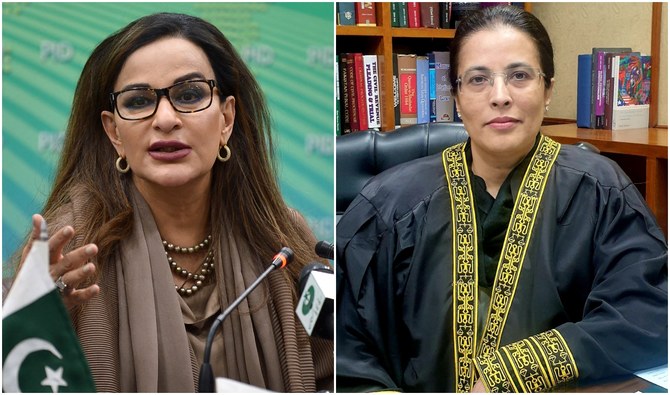
The collage of photos shows Pakistan’s federal minister for climate change, Sherry Rehman and Supreme Court’s Justice Ayesha Malik. (Photo courtesy: Uk Government/AFP)
Short Url
Updated 13 January 2023
Follow

Pakistan’s Sherry Rehman, Ayesha Malik featured in Forbes ‘50 Over 50: Asia 2023’ list

  • Forbes honors women over 50 for ‘reaching new heights’, ‘inspiring new generations’
  • List features women over 50 across the world from tech, art, politics and other industries

ISLAMABAD: Pakistan’s federal minister for climate change, Sherry Rehman and Supreme Court’s Justice Ayesha Malik were featured this week in a list compiled by Forbes magazine that includes 50 women over the age of 50 who made headlines in 2022. 

Forbes released the ‘50 Over 50: Asia 2023’ list on January 11 to celebrate women across technology, pharmaceuticals, art, politics and beyond who are “reaching new heights in their industries and inspiring the region’s next generation.”

Rehman, 62, was appointed as the country’s climate change minister in April 2022 after Prime Minister Shehbaz Sharif was elected to office. A few months after Rehman took over the reins of the post, heavy rains triggered unprecedented floods. Over 1,700 people were killed while more than 33 million in the country were affected by the calamity, which also inflicted damages of over $30 billion, Pakistan estimated. 

At the Sharm el-Sheikh Climate Change Conference (COP 27) in Egypt last year, Rehman was influential in convincing the world to set up a “loss and damage” fund for developing countries. The fund aims to channel money from countries that cause high carbon emissions, to others that are vulnerable to climate change damages and disasters. 

Malik, on the other hand, made history in January 2022 when she became the first woman judge of Pakistan’s apex court. The Judicial Com­mis­sion of Pakistan (JCP) approved her elevation from the Lahore High Court (LHC) to the apex court after it was approved by a majority of five votes against four. 

“Malik previously served for a decade as a judge on the Lahore High Court, ruling on the enforcement of international arbitration in Pakistan and sat on the Green Bench, advocating environmental justice,” Forbes wrote about her. 

The publication also acknowledged Malik’s “seminal judgment” on virginity tests in rape cases, which were hailed widely in Pakistan. 

About Rehman, Forbes mentioned her credentials as a former information minister, journalist, Pakistan’s ambassador to the US and the country’s first female leader of the opposition in the Senate. 

“Rehman has received various awards, including Pakistan’s highest civil award, the Nishan-e-Imtiaz,” Forbes wrote.

The magazine mentioned how Rehman had also been named among the ‘25 Most Influential Women in 2022 by Financial Times.’


Pakistan increases Reko Diq investment to $244 million as Barrick reviews project

Updated 5 sec ago
Follow

Pakistan increases Reko Diq investment to $244 million as Barrick reviews project

  • State-owned PPL injects $50.2 million more in special purpose vehicle formed to manage Islamabad’s 25 percent stake in copper-gold mine
  • Canadian operator Barrick Mining Corporation this month ordered project’s review following deadly separatist attacks in Balochistan province

KARACHI: The state-run Pakistan Petroleum Limited (PPL) has invested an additional Rs14 billion ($50.2 million) equity in the multi-billion-dollar Reko Diq copper-gold mine, the company said in its latest financial report on Thursday, as the project’s Canadian operator reviews the project following recently deadly attacks. 

Canada’s Barrick Mining Corporation owns a 50 percent share in Reko Diq in the southwestern Balochistan province, along with three Pakistani federal state-owned enterprises including PPL that own 25 percent, while the Balochistan government has the remaining 25 percent share in the project.

The Canadian company announced earlier this month it planned to “immediately” begin a comprehensive review of all aspects of the Reko Diq project following coordinated attacks in Balochistan on Jan. 30-31 that killed 36 civilians and 22 security forces personnel. 

“With respect to the Reko Diq project, the company has made further equity investment in Pakistan Minerals Private Limited (PMPL) during the period amounting to Rs14,025 million ($50.2m),” PPL told its shareholders in its financial statement for the half year ending at Dec. 31.

The additional equity has increased PPL’s total cost of investment in the PMPL to Rs68.1 billion ($243.6 million), it added. 

The PMPL is a special purpose vehicle formed to manage the federal government’s 25 percent stake in the Reko Diq project. It is a consortium of three state-owned enterprises (SOEs) namely the PPL, the Oil & Gas Development Company Limited (OGDCL) and Government Holdings (Private) Limited (GHPL) which is responsible for handling financing, equity contributions and strategic, legal or technical dealings with partners like Barrick.

“The project continued to advance site works during the period (July-December FY26),” the PPL said. “The operator (Barrick) is undertaking a review of all aspects of the project, including with respect to the project’s security arrangements, development timetable and capital budget.” 

This week, Balochistan Chief Minister Sarfraz Bugti assured investors that Pakistan has the “capacity and capability” to secure the Reko Diq project amid surging militancy. 

The PPL explores, drills, and produces oil and natural gas. Its current portfolio, together with its subsidiaries and associates, consists of 47 exploratory blocks that include one offshore Block-5 in Abu Dhabi and one onshore block in Yemen.

In December, PPL signed a strategic Deed of Assignment under which it assigned 25 percent of its participating interest (PI) and operatorship of Eastern Offshore Indus C block to Turkish Petroleum Overseas Company, a unit of state-owned Türkiye Petrolleri Anonim Ortaklığı.

Assigning 20 percent PI each to OGDCL and Mari Energies Limited, the company has retained the remaining 35 percent PI to play a key role in the block’s development.