DUBAI: Iran on Thursday shut down a decades-old French research institute in response to cartoons published by the French satirical magazine Charlie Hebdo that mocked the country’s ruling clerics.
Iran’s Foreign Ministry called the closure of the French Institute for Research in Iran a “first step” in response to the cartoons, which the magazine had billed as a show of support for anti-government demonstrations that have convulsed Iran for nearly four months.
The ministry said it would “seriously pursue the case and take the required measures” to hold France accountable. On Wednesday, Iran summoned the French ambassador to complain about the cartoons.
The shuttered research institute, which is connected to the French Foreign Ministry, was created in 1983 through the merger of an archaeological delegation dating back to the late 19th century and an institute of Iran studies. It includes a library boasting some 49,000 references, including 28,000 books.
On Thursday, there was a heavy security presence around the institute and the nearby French Embassy in central Tehran. Graffiti left on the outer walls — apparently by government supporters — referred to France as “the home of homosexuals” and a “place of blasphemy.”
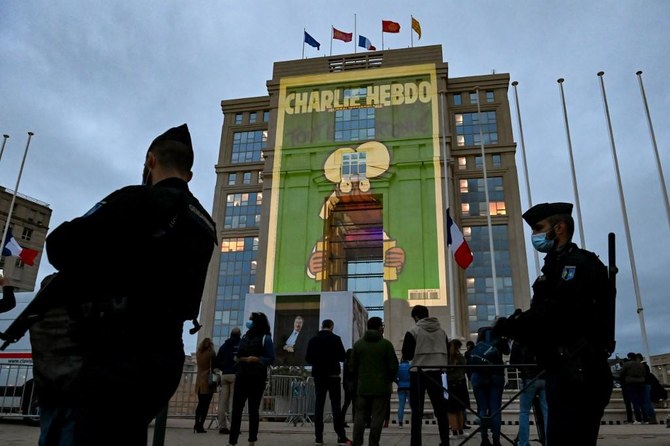
Charlie Hebdo has a long history of publishing vulgar cartoons mocking Islamists, which critics say are deeply insulting to Muslims. Two French-born Al-Qaeda extremists attacked the newspaper’s office in 2015, killing 12 cartoonists, and it has been the target of other attacks over the years.
Its latest issue features the winners of a recent cartoon contest in which entrants were asked to draw the most offensive caricatures of Iran’s Supreme Leader Ayatollah Ali Khamenei.
One of the finalists depicts a turbaned cleric reaching for a hangman’s noose as he drowns in blood, while another shows Khamenei clinging to a giant throne above the raised fists of protesters. Others depict more vulgar and sexually explicit scenes.
Iran’s Foreign Minister Hossein Amirabdollahian on Wednesday vowed a “decisive and effective response” to the publication of the cartoons, which he said had insulted Iran’s religious and political authorities.
French Foreign Minister Catherine Colonna accused Iran of following “bad politics.’’
Iran “is not only practicing violence against its own people but is also practicing a policy of keeping people hostage, which is particularly shocking,” she said Thursday on LCI television.
“In France, not only does freedom of the press exist — unlike what happens in Iran — it is also exercised under the control of judges and an independent justice system, which is something that Iran undoubtedly knows little about. Also in French law we do not have the notion of blasphemy.”
She did not respond directly to the ambassador being summoned or expressly defend Charlie Hebdo. The French government, while defending free speech, has rebuked the privately-owned magazine in the past for fanning tensions.
Iran has been gripped by nationwide protests for nearly four months following the death in mid-September of Mahsa Amini, a 22-year-old woman who had been detained by Iran’s morality police for allegedly violating the country’s strict Islamic dress code.
Women have taken the lead in the protests, with many stripping off the compulsory Islamic headscarf in public. The protesters have called for the overthrow of Iran’s ruling clerics in one of the biggest challenges to their rule since the 1979 Islamic Revolution that brought them to power.
Charlie Hebdo, which has published similarly offensive cartoons about dead child migrants, virus victims, neo-Nazis, popes, Jewish leaders and other public figures, presents itself as an advocate for democracy and free expression. But it routinely pushes the limits of French hate speech laws with often sexually explicit caricatures that target nearly everyone.
The paper drew fire for reprinting caricatures of Islam’s Prophet Muhammad that were originally published by a Danish magazine in 2005. Those cartoons were seen as sacrilegious and deeply hurtful to Muslims worldwide. Islamist groups around the world organized demonstrations, many of which turned violent, as well as boycotts of Danish products.


![]()

Iran closes French institute over Charlie Hebdo cartoons
Short Url
https://arab.news/bt5gp
Iran closes French institute over Charlie Hebdo cartoons
- Iran warned France on Wednesday of repercussions following publication of cartoons mocking country's supreme leader
- French Minister Catherine Colonna said there were no lessons to take from Iran over press, judicial freedoms


Latest updates



Recommended


© 2026 SAUDI RESEARCH & PUBLISHING COMPANY, All Rights Reserved And subject to Terms of Use Agreement.