

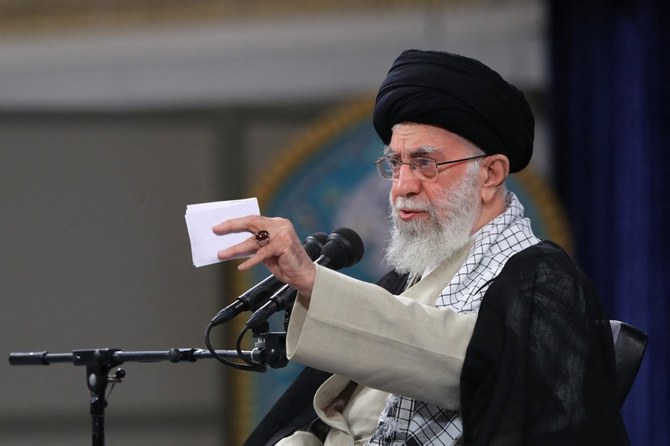

LONDON: French satirical magazine Charlie Hebdo on Wednesday published a special issue mocking Supreme Leader Ayatollah Ali Khamenei in support of anti-government protests in Iran.
The weekly released the edition titled “January 7” to commemorate the anniversary of the deadly 2015 terror attack on its Paris offices, with the subject “beat the mullahs.”
“The freedom to which every human being aspires is incompatible with the archaism of religious thought and with submission to every supposedly spiritual authority, of which Ali Khamenei is the most deplorable example,” the magazine said.
Following months of protests and repression throughout Iran following the death in custody of Mahsa Amini — a 22-year-old Iranian Kurdish woman arrested by the morality police for violating the country’s dress code — the French publication launched an international contest on Dec. 8 under the title, Mullahs Get Out.
Contestants were asked to produce caricatures of Khamenei, as a “symbol of backward-looking, narrow-minded, intolerant religious power” and advised that the cartoon should be the “funniest and meanest” possible.
#MullahsGetOut COMPETITION |Charlie Hebdo is launching a competition to produce caricatures of the Islamic Republic of Iran's Supreme Leader. So get drawing and make sure that Khamenei is the last Supreme Leader the Iranians have to suffer! More info https://t.co/q3xqVPIZi8 pic.twitter.com/DhbLVG2drG
— Charlie Hebdo (@Charlie_Hebdo_) December 9, 2022
“Cartoonists and caricaturists have a duty to help support Iranians in their struggle as they fight for their freedom, by ridiculing this religious leader who represents the past and casting him into history’s garbage bin,” Charlie Hebdo said on its website page.
French newspaper Le Monde on Tuesday published a story with one of the cartoons, noting that the paper was allowed to see 35 drawings chosen from the 300 sent to the Charlie Hebdo editorial office, including from Iran, Turkiye, the US, Senegal, and Australia.
Charlie Hebdo director, Laurent “Riss” Sourisseau, said the Iranian protest movement was of global significance, and the magazine had “wanted drawings from all over the world and to not lock ourselves into French-centric thinking” to reflect “the visual diversity of the opposition.”
Describing some of the works, Le Monde said: “One cartoon shows Khamenei being punched with the slogan ‘Women, Life, Freedom,’ while another depicts a mullah being crushed under a heel.
#MullahsGetOut #Mahsa_Amini pic.twitter.com/NUmVFeKFYz
— دشمن آخوند و آخوند پرست (@margbarakhonda) December 29, 2022
“Among the very political drawings, the supreme leader is also depicted as (the late American actress) Marilyn Monroe, whose dress is lifted by the wind of the headscarves that women have freed themselves from. In another, armed with stones, they pommel him,” it added.
Iranian authorities, angered at news of the publication, warned France on Wednesday to expect a response for the “insulting” cartoons depicting Iran’s political leader.
In a tweet, Iran’s Foreign Minister Hossein Amirabdollahian said: “The insulting and indecent act of a French publication in publishing cartoons against the religious and political authority will not go without an effective and decisive response.
“We will not allow the French government to go beyond its bounds. They have definitely chosen the wrong path.”
کاریکاتورهای منتخب مسابقه مجله شارلی ابدو رو میتونیم توی لینک زیر ببینید: https://t.co/WrmV83VS39#MullahsGetOut pic.twitter.com/YqV3ZUwx3m
— farnaz davari (@farnazdavari) January 4, 2023
Since the beginning of the current wave of protests in mid-September, Charlie Hebdo has targeted Khamenei on different occasions, in one cartoon depicting him with bloody hands and a turban and attire showing the logo of clothing manufacturer Nike and its motto, Just Do It.
The cartoon was met with outrage by Iranian authorities prompting the country’s Foreign Ministry to summon the French charge d’affaires in Tehran.
Over the years Charlie Hebdo has been at the center of numerous controversies over its cartoons and was the target of terrorist attacks in 2011, 2015 (when 12 people were killed), and 2020, all believed to be linked to the magazine’s publication of images depicting the Prophet Muhammad.


