

UAE voices support for initiatives to boost Pakistan climate resilience — Islamabad

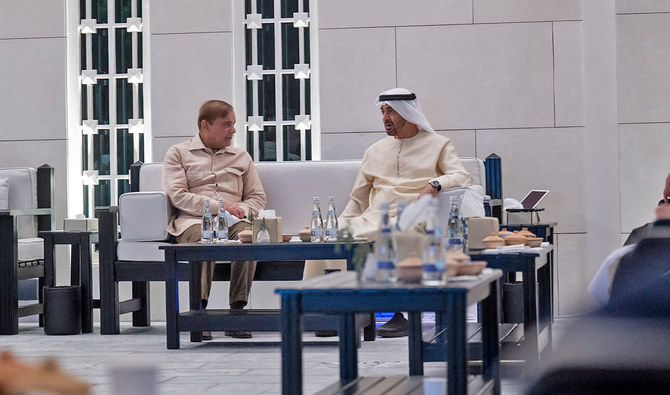
A handout picture released by UAE's Ministry of Presidential Affairs on April 30, 2022, shows UAE President Mohamed bin Zayed Al Nahyan (R) meeting with Pakistan Prime Minister Shahbaz Sharif in the Gulf emirate. (AFP/File)
Short Url
Updated 03 January 2023
Follow

UAE voices support for initiatives to boost Pakistan climate resilience — Islamabad

  • PM urges UAE president for high-level participation in Geneva donor conference for flood-hit Pakistanis 
  • Monday's gathering in Geneva aims to raise funds for the victims of last summer’s unprecedented flooding 

ISLAMABAD: United Arab Emirates (UAE) President Sheikh Mohamed bin Zayed Al-Nahyan on Tuesday assured Pakistan Prime Minister Shehbaz Sharif of the Gulf nation's support for initiatives aimed at strengthening Pakistan against the impacts of climate change, the Pakistani foreign office said. 

The statement came after a telephonic conversation between the two leaders, during which PM Sharif thanked Sheikh Mohamed for the UAE's financial and material support to Pakistan after the recent devastation caused by the climate-induced floods in Pakistan.   

The two leaders reiterated their mutual commitment to further expand and diversify special bilateral relations between Pakistan and the UAE. 

"The Prime Minister briefed His Highness on the upcoming ‘International Conference on Resilient Pakistan,’ to be held in Geneva on 9 January 2023 and solicited His Highness support for High level participation from the UAE," the foreign office said in a statement. 

"His Highness expressed UAE’s whole hearted support for the initiatives to strengthen Pakistan’s climate resilience which is the main agenda of the Conference." 

The gathering in Geneva, which is being jointly hosted by the United Nations and Pakistan, aims to raise funds for the victims of last summer’s unprecedented flooding, which experts partly attribute to climate change. The disaster killed 1,739 Pakistanis, affected 33 million and caused more than $30 billion in economic losses.  

Pakistan and the UAE enjoy close fraternal ties for five decades that are rooted firmly in common belief and shared values and culture. The UAE is Pakistan’s largest trading partner in the Middle East and a major source of investments. 

PM Sharif also invited the UAE president to visit Pakistan. 


Pakistan, Canada explore deeper trade, mining and agriculture cooperation

Updated 5 sec ago
Follow

Pakistan, Canada explore deeper trade, mining and agriculture cooperation

  • The development comes as Pakistan seeks to boost trade, foreign investment to strengthen its more than $400 billion economy
  • Both sides reviewed the evolving global economic landscape, underscored the need for adaptive trade strategies, Islamabad says

KARACHI: Pakistani and Canadian officials have discussed ways to deepen cooperation in trade, mining and agriculture, the Pakistani commerce ministry said on Saturday, with both sides seeking to expand economic ties.

The statement came after Pakistani Commerce Minister Jam Kamal Khan’s meeting with Canadian High Commissioner to Pakistan Tarik Ali Khan that focused on expanding bilateral cooperation in trade, investment, mining, agriculture, energy and emerging sectors.

Pakistan, which is recovering from a prolonged economic meltdown under a $7 billion International Monetary Fund (IMF) program, has sought to boost trade, foreign investment to strengthen its more than $400 billion economy.

“During the meeting, both sides reviewed the evolving global economic landscape and underscored the need for adaptive trade strategies amid shifting supply chains and geopolitical realignments,” the Pakistani commerce ministry said in a statement.

“The federal minister emphasized Pakistan’s intent to diversify partnerships and attract quality foreign investment, particularly in value-adding and export-oriented sectors.”

A major focus of discussions was cooperation in the mining and minerals sector. Pakistan has vast mineral resources, including Reko Diq copper-gold mine, which is one of the world’s largest undeveloped mines.

The Reko Diq project, located in the Balochistan province, is also being developed by Canadian mining giant Barrick Gold in partnership with Pakistan’s federal and provincial governments.

Commerce Minister Khan highlighted Pakistan’s growing interest in developing small and medium-scale mining projects and stressed the importance of modern exploration techniques, surveying expertise and responsible mining governance.

“The Canadian high commissioner noted Canada’s global leadership in mining services and exploration technologies and expressed willingness to support Pakistan through capacity-building initiatives, technical assistance and business-to-business matchmaking,” the commerce ministry said.

“In this context, both sides discussed Pakistan’s participation in the Prospectors & Developers Association of Canada (PDAC) conference in Toronto, with an emphasis on linking Pakistani miners with reputable Canadian exploration companies and service providers.”

The meeting also covered agricultural cooperation, with particular reference to the recent resumption of Canadian canola exports to Pakistan, according to the statement. The two sides acknowledged the successful arrival of initial shipments and agreed to work closely on addressing regulatory and procedural bottlenecks to ensure smooth and timely imports.

“Discussions further explored potential cooperation in dairy and livestock development, including animal genetics, modern dairy farming technologies and disease-control mechanisms, aimed at enhancing productivity and quality standards in Pakistan,” the commerce ministry added.

“On the energy front, the Canadian High Commissioner raised issues related to Canadian investments in renewable energy projects in Pakistan and stressed the importance of regulatory predictability and timely approvals to sustain investor confidence. Both sides also reviewed progress on the Pakistan–Canada Bilateral Investment Treaty (BIT) and agreed on the need to maintain momentum in negotiations to encourage greater Canadian investment.”